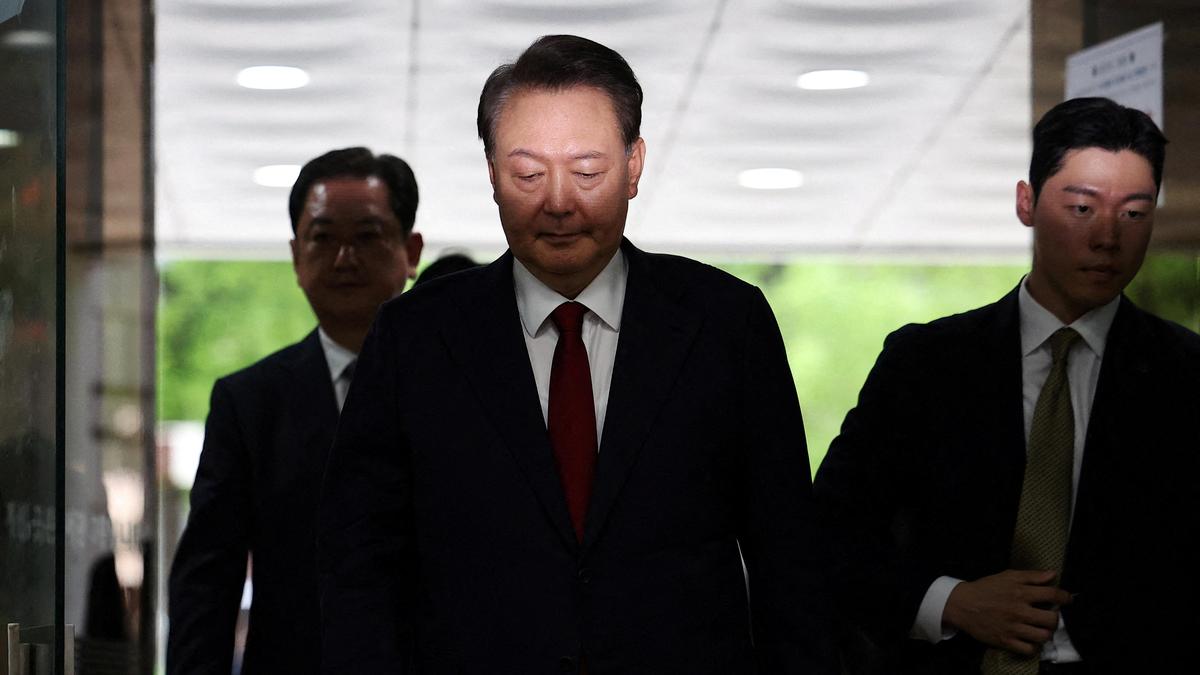
The sentencing of former South Korean President Yoon Suk Yeol to a seven-year prison term for obstruction of arrest represents a definitive stress test for the constitutional separation of powers in a high-pressure democracy. Beyond the immediate political volatility, this verdict establishes a legal precedent for the "Threshold of Executive Immunity"—the precise point where a head of state’s discretionary power to maintain order transforms into a criminal interference with the judiciary. The core of the court’s logic rests on the distinction between legitimate executive privilege and the systemic sabotage of law enforcement protocols.
The Triad of Institutional Subversion
The appellate court’s decision was not a singular judgment on intent, but rather a calculation of three distinct layers of institutional damage. To understand why a seven-year term was deemed proportionate, one must categorize the actions into a structural framework of subversion.
- The Procedural Breach: This involves the physical deployment of state resources—specifically security forces and administrative directives—to prevent the execution of a legally sanctioned warrant. The court defined this as a "Weaponization of Bureaucracy," where the machinery of the state was redirected to protect an individual rather than uphold the law.
- The Constitutional Asymmetry: The presidency holds a unique mandate to enforce the law. When that office is used to block the law, it creates a logical paradox that threatens the integrity of the entire legal system. The court identified this as a "Violation of the Fiduciary Duty of Governance," arguing that the higher the office, the higher the penalty for its misuse.
- The Evidentiary Erosion: By delaying the arrest through obstruction, the former president effectively created a window for potential evidence tampering. Even if tampering was not proven to have occurred, the creation of the opportunity for such interference was cited as an aggravating factor in the sentencing phase.
The Mechanics of the Seven-Year Sentence
Legal observers often struggle to quantify the "severity" of a sentence without a comparative framework. In South Korean criminal law, obstruction of justice usually carries lighter penalties for private citizens. However, the appellate court applied a "Multiplier of Authority" to the baseline sentencing guidelines.
The court utilized a specific logic gate to arrive at the seven-year figure:
- Base Offense: Obstruction of a public official in the performance of their duties.
- Aggravating Factor A: Use of military or specialized police units to achieve the obstruction.
- Aggravating Factor B: The duration of the standoff, which lasted several hours, causing significant public disorder.
- Mitigating Factors: Virtually absent. The court noted that a lack of remorse and a continued insistence on the "extra-legal" nature of the presidency prevented any reduction in the term.
The resulting sentence serves as a quantitative deterrent. It is designed to be long enough to survive political cycles, ensuring that the individual remains incapacitated through at least one full subsequent administration, thereby neutralizing the potential for immediate political resurgence or pardon lobbying.
Systemic Failure Points and Executive Overreach
The case highlights a critical bottleneck in the South Korean "Imperial Presidency" model. The concentration of power in the Blue House (or the current presidential office) creates a vacuum where subordinate officials feel compelled to follow illegal orders under the guise of national security.
This creates a "Cascade of Culpability." When Yoon ordered the obstruction, he did not act alone; he leveraged a chain of command. The court’s ruling suggests that the "Defense of Superior Orders" is no longer a viable shield for subordinates when the order itself is a direct assault on the judiciary. This shift effectively raises the cost of compliance for every official in the executive branch.
The Divergence Between Political Mandate and Legal Limit
A common defense used during the trial was the "State of Exception" theory—the idea that a president must sometimes bypass the law to protect the stability of the nation. The appellate court rejected this, drawing a hard line between political survival and national security.
- Political Survival: Avoiding arrest to maintain a hold on power.
- National Security: Protecting the state from external or internal existential threats.
The court found that the arrest warrant in question did not pose a threat to the state, but rather to the occupant of the office. By conflating the person with the institution, Yoon committed a categorical error that the judiciary was forced to correct through a punitive sentence.
The Economic and Geopolitical Cost Function
While the media focuses on the courtroom drama, the deeper impact lies in the "Institutional Risk Premium" now applied to South Korea. For investors and international partners, the jailing of a former leader for obstruction signals both a strength and a weakness.
The Strength: It proves that the rule of law is functional and that no individual is above the judiciary. This reduces long-term "corruption risk" by demonstrating that the system self-corrects.
The Weakness: It highlights a recurring cycle of "Political Retribution Culture." If every outgoing president faces the threat of imprisonment, the incentive for a peaceful transition of power diminishes. This creates a "Defensive Governance" environment where leaders spend their final years in office focused on self-preservation rather than policy innovation.
The seven-year sentence increases this pressure. It signals to future leaders that the cost of failure is not just political irrelevance, but literal incarceration. This likely leads to more aggressive executive maneuvers in the future as leaders seek to "bulletproof" their exits.
Strategic Realignment of the Judiciary
The judiciary’s stance in this case indicates a pivot toward "Judicial Activism in Defense of the Republic." By issuing a sentence that exceeded many initial analyst expectations, the appellate court has positioned itself as the final arbiter of constitutional integrity.
This creates a new equilibrium. The judiciary is no longer a passive observer of executive disputes; it is an active participant in defining the boundaries of power. For the South Korean legislature, this necessitates a rewrite of the laws governing presidential immunity and the specific protocols for arresting a sitting or former head of state.
The Regulatory Void
Current statutes are remarkably thin regarding the mechanics of a presidential arrest. This lack of clarity is what allowed the obstruction to occur in the first place. The "Operational Friction" observed during the standoff—where police and presidential security forces faced off—was a direct result of a lack of clear legal hierarchies in such an unprecedented scenario.
To prevent a recurrence, the legislative branch must codify:
- The Primacy of Judicial Warrants: Explicitly stating that the Presidential Security Service (PSS) must yield to judicial officers in the execution of a warrant.
- Automatic Suspension of Command: The moment a valid arrest warrant is issued for a president, their ability to command security forces for personal protection must be legally decoupled from their state duties.
- Sanctions for Bureaucratic Compliance: Clear, non-pardonable penalties for any official who assists in the obstruction of a judicial order.
The Probability of a Supreme Court Overturn
Given the rigidity of the appellate court’s logic, the likelihood of a significant reduction in sentence by the Supreme Court is low. The Supreme Court typically focuses on errors of law rather than the reassessment of facts. Since the appellate court meticulously tied the sentence to existing (though rarely used) statutory multipliers for "High-Level State Crimes," the legal foundation is remarkably sturdy.
The only remaining variable is the "Political Clemency Vector." In South Korea, presidential pardons are a common tool for "National Harmony." However, the specific nature of this crime—obstruction of the very process that leads to a pardon—makes a future pardon a high-risk political move for any successor. To pardon someone for obstructing the law is to validate the obstruction itself.
The sentencing of Yoon Suk Yeol is the finalization of a move from a personality-driven political system to a rule-driven one. The seven-year term is a calibration of the state's intolerance for executive defiance. For global observers and internal actors alike, the takeaway is clear: the executive's shield is not a sword, and when it is used as one, the judiciary will ensure the blowback is terminal to the individual’s career and freedom.
Future administrations must now operate under a "Surveillance of Precedent." Every executive order, every use of the security apparatus, and every interaction with the judiciary will be filtered through the lens of the Yoon verdict. The cost of executive overreach has been officially priced into the South Korean political market.