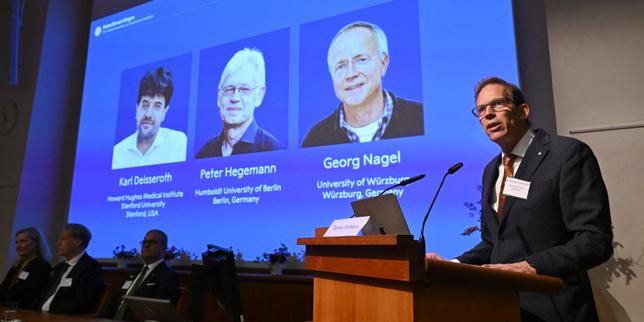
For decades, neuroscientists faced a brutal limitation. They could map the anatomy of the brain with staggering precision, yet turning individual neurons on and off inside a living, moving organism remained an elusive dream. Electrical stimulation was too clumsy, flooding entire brain regions with current rather than targeting specific circuits. That all changed when optogenetics burst onto the scene, earning Karl Deisseroth, Peter Hegemann, and Georg Nagel the 2026 Nobel Prize in Physiology or Medicine.
If you've ever wondered how scientists actually control brain cells using light, the answer lies in a brilliant fusion of microbiology and bioengineering.
The Algae Protein That Started It All
The breakthrough didn't start in a high-tech mammalian laboratory. It started in pond scum. Peter Hegemann and Georg Nagel spent years investigating single-celled green algae (Chlamydomonas reinhardtii) and discovered channelrhodopsin. This remarkable microbial protein acts as a direct light-gated ion channel. When hit with specific wavelengths of light, the protein opens instantly, allowing ions to rush across the cell membrane.
Nature had already built a microscopic switch driven entirely by photons.
The missing link was figuring out how to translate this biological switch into complex animal neural networks. Enter Karl Deisseroth, a psychiatrist and bioengineer at Stanford University. Deisseroth realized that if you could insert the gene for channelrhodopsin into specific mammalian neurons, you could control those exact cells with pulses of laser light delivered via fiber optics.
Why Optogenetics Upended Traditional Neuroscience
Traditional brain research relied heavily on pharmacology or crude electrical wires. Drugs flood the entire brain, causing widespread off-target effects and taking minutes or hours to wash out. Electricity fires everything in the vicinity indiscriminately.
Optogenetics flipped the script entirely. Researchers could now target a single subtype of neuron responsible for a specific behavior, park a tiny optical fiber next to the region, and fire action potentials with millisecond precision.
When researchers flash light into the modified neural tissue, the engineered cells fire immediately. Turn the light off, and they stop. You can literally watch an animal freeze, move, or alter its social behavior in real time just by toggling a light switch.
Real World Applications and Therapeutic Horizons
This technology isn't just an elegant academic toy. It has reshaped our understanding of neurological and psychiatric disorders.
By isolating specific circuits in animal models, researchers mapped the exact pathways responsible for Parkinson's tremors, severe depression, anxiety, and addiction. While human clinical trials using optogenetic gene therapy are still in early phases, the foundational mapping provided by Deisseroth, Hegemann, and Nagel serves as the blueprint for next-generation neurotherapeutics. Doctors can eventually bypass damaged neural circuits with pinpoint optogenetic stimulation, restoring lost function without systemic drug side effects.
The 2026 Nobel Prize honors more than a clever laboratory trick. It marks the moment molecular biology and optics converged to illuminate the darkest black box in human biology.
Karl Deisseroth, Peter Hegemann, Georg Nagel win for ...
This video provides an overview of the 2026 Nobel Prize announcement honoring Karl Deisseroth, Peter Hegemann, and Georg Nagel for their groundbreaking work on light-gated ion channels.