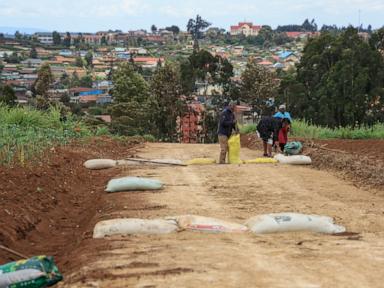
Watch a tropical downpour hit a bare hillside in central Kenya, and you'll see a farm's entire future turn into brown soup in under twenty minutes.
For decades, the standard advice given to smallholders across East Africa was simple enough on paper. Dig a few trenches, plant some Napier grass along the edges, and hope the long rains between March and May don't turn violent. That playbook is failing. When rain falls in concentrated, erratic bursts—the exact weather pattern East Africa has dealt with over the last several seasons—water doesn't soak into baked earth. It sheets off the top, carving deep gullies through maize plots and carrying away the only nutrient-rich topsoil a family has.
Kenyan farmers aren't waiting around for massive infrastructure projects to save their plots. Across counties like Murang'a, Machakos, Makueni, and Nyeri, growers are shifting away from single-fix drainage ditches toward layered, low-cost earthworks and biological barriers that trap water where it lands. If you're looking at how Kenyan farmers adopt new techniques to curb erosion during heavy rains, the real story isn't about expensive machinery. It's about reshaping how water moves across small, sloped plots using tools most households already own.
Why Traditional Ditch Digging Fails in Heavy Downpours
Most people assume soil erosion happens because a farm lacks drainage. Dig a channel, send the water downhill, and problem solved.
In practice, poorly designed drainage ditches accelerate the exact damage they're supposed to prevent. When heavy rain hits compacted soil, runoff gains speed fast. If a farmer cuts a steep, unlined channel straight down or slightly across a slope without breaking the water's velocity, that trench turns into a firehose. Within two heavy storms, the ditch walls collapse, the channel widens into a ravine, and the farmer loses productive planting rows alongside the soil.
There's also a timing trap. Soil compaction happens during dry spells when livestock graze crop residues or intense sun bakes exposed clay. Once the crust forms, infiltration rates drop near zero. Even gentle slopes—anything over a five percent grade—start shedding topsoil long before the ground underneath gets wet.
Zai Pits and Micro-Catchments Are Replacing Flat Planting
Walk through drier parts of Machakos or Makueni counties today, and you'll notice fields that look like giant waffle irons. Instead of plowing the entire field flat—which loosens soil right before storms wash it away—farmers are digging zai pits (also called planting basins).
Originally popularized in the Sahel and adapted widely across semi-arid Kenya, a zai pit is a small hole roughly 20 to 30 centimeters wide and 15 to 20 centimeters deep. Farmers mix a handful of compost or animal manure into the bottom of each pit before dropping in maize, sorghum, or legume seeds.
Here's why this works so well during torrential rain:
- Zero runoff velocity: Water hits the field and drops straight into thousands of miniature reservoirs instead of building momentum down the hill.
- Targeted fertility: Because manure stays inside the basin rather than spreading across open soil, heavy rain doesn't sweep expensive nutrients into the nearest river.
- Moisture banking: Even if the rains stop abruptly after two weeks of flooding, the trapped water sits directly around the root zone.
It's brutal work with a hand hoe during the dry season. Nobody pretends digging thousands of holes by hand is easy. Yet farmers who make the switch rarely go back to conventional plowing, simply because they stop watching their fertilizer wash into their neighbor's valley.
Fanya Juu Terraces Built for Steep Slopes
On the steeper ridges of the central highlands—places like Kiambu, Embu, and Murang'a—pits alone won't hold back a hillside when 80 millimeters of rain falls overnight. You need structural terracing, and the preferred method across Kenya is fanya juu (Swahili for "throw it upwards").
Unlike standard bench terraces where soil is pushed downhill, a fanya juu terrace requires digging a trench along the exact contour line of the slope and throwing the excavated soil uphill to form an embankment. Over several rainy seasons, water running down the slope hits that soil ridge, slows down, and drops its sediment load right behind the bund. Eventually, the hillside naturally levels itself into flat, stepped benches without requiring heavy earthmoving equipment.
The catch? An unstabilized soil ridge will melt like sugar in a torrential storm.
To lock those ridges in place, Kenyan farmers plant deep-rooted perennial grasses directly onto the embankment. Vetiver grass and Napier grass are the heavy lifters here. Vetiver sends dense, spongy roots straight down two to three meters, acting like living rebar that holds the soil wall together even when saturated. Napier grass provides slightly less root depth, but dairy farmers love it because they can cut the stalks every few weeks to feed zero-grazed cattle.
The Contour Line Mistake That Ruins Terraces
Ask any agricultural extension officer in Kenya why a newly built terrace failed, and nine times out of ten, the answer is a crooked contour line.
If a farmer eyeballs the slope instead of measuring it properly, the trench tilts slightly toward one end. Water flows to that low spot, pools until it overtops the ridge, and breaches the wall. Once a breach happens, all the water collected along a 50-meter terrace pours through a single one-meter gap, gouging a massive scar straight down the farm.
You don't need laser levels to avoid this. Smallholder groups across Kenya use a simple A-frame level—three wooden poles tied into an A-shape with a string and a stone hanging from the top. By walking the A-frame across the hillside and marking where the string lines up with the center notch, two people can map a dead-level contour line in an afternoon.
Agroforestry and Cover Crops Stop Raindrops Before They Hit Dirt
The violence of soil erosion actually starts before water ever flows across the ground. A single falling raindrop hits bare soil at roughly 30 kilometers per hour. Multiply that by millions of drops, and you get splash erosion—the mechanical shattering of soil aggregates into fine silt that clogs surface pores and triggers runoff.
Kenyan farmers tackling erosion seriously focus heavily on keeping soil covered year-round, using three distinct layers:
- Boundary and contour trees: Fast-growing nitrogen-fixing species like Calliandra calothyrsus and Grevillea robusta (silky oak) are planted along terrace edges and farm boundaries. Their canopies break the fall of heavy rain, while pruned branches provide firewood and high-protein livestock fodder.
- Legume cover crops: Intercropping maize with dolichos lablab, desmodium, or common beans creates a dense green mat across the soil surface within weeks of the first rains. Desmodium pulls double duty in western Kenya, where farmers use it in the "push-pull" system to suppress parasitic Striga weeds and stemborer pests while anchoring topsoil.
- Crop residue mulching: Instead of burning maize stalks or stripping fields bare for cattle grazing right after harvest, farmers leave stover lying flat across the rows. Even a 30 percent ground cover cuts splash erosion dramatically.
Organizations like the World Agroforestry Centre (ICRAF), headquartered in Nairobi, have spent decades documenting how tree-crop integration stabilizes watersheds across East Africa. Their field trials consistently show that combining physical terraces with agroforestry hedges reduces soil loss far more reliably than relying on earthworks alone.
Retention Ditches and Water Pans Turn Floods Into Dry-Season Irrigation
There's a mindset shift happening among progressive smallholders in Kenya: runoff isn't waste water to be dumped off your land as fast as possible. It's free irrigation water you haven't caught yet.
When heavy rains hit tin roofs, footpaths, and compacted roads running alongside farms, massive volumes of water pour onto agricultural land from outside the farm's boundaries. Instead of letting road runoff tear through their crops, farmers are cutting cutoff drains at the upper edge of their property that divert incoming water directly into lined farm ponds or water pans.
In counties like Machakos and Kitui, farmers excavate rectangular pits holding anywhere from 50,000 to 250,000 liters of water, lining them with heavy-duty UV-stabilized geomembrane sheets so the water doesn't seep into sandy subsoil. During peak downpours, road runoff fills the pond in days. When the rains vanish two months later, that captured water keeps high-value crops—kale, tomatoes, avocados, or passion fruit—alive through the dry spell.
What used to be an erosive flood becomes the reason a household has produce to sell when market prices peak.
What Actually Stops Farmers From Adopting These Techniques
If zai pits, fanya juu terraces, and contour hedgerows work so well, why aren't they on every single farm from Kisumu to Mombasa?
Honesty matters here. These methods fail to spread when outside advisors ignore the real constraints smallholders face on the ground:
- The labor bottleneck: Digging terraces and zai pits happens during the dry season, right when heat is highest and household food stores are lowest. A single elderly farmer or a female-headed household without extra hands simply cannot move tons of compacted earth alone. In areas where adoption sticks, neighbors usually form rotational self-help groups (mwethya in Kamba communities) to dig terraces together one farm at a time.
- Land tenure insecurity: Nobody spends three weeks digging deep contour trenches and planting slow-growing timber trees on land they're renting season-to-season. Terracing thrives where families hold clear title deeds and know their children will farm that same slope.
- Free-grazing livestock conflicts: Leaving crop residues on the field or planting young vetiver slips on terraces works great until a neighbor's goats wander across the unfenced boundary during the dry season and eat your erosion barriers down to the roots. Community bylaws around controlled grazing often matter just as much as agricultural training.
How to Audit and Protect a Sloped Plot Before the Next Rains Hit
If you're managing sloped farmland or advising growers dealing with erratic, heavy rainfall, don't try to overhaul ten acres in one week. Start where the water moves fastest and build upward.
Walk your property during or immediately after a heavy rainstorm—not on a sunny afternoon when everything looks fine. Look for three warning signs: shiny, crusted soil surfaces where water isn't soaking in, small finger-like channels (rills) forming between crop rows, and exposed plant roots sitting above the soil line.
Once you see where water concentrates, take these steps before the next planting season starts:
- Build an A-frame level first: Spend two hours tying three straight poles together and calibrating the plumb line on level ground. Never guess a contour line by eye on a slope steeper than three percent.
- Start at the top of the slope: Always dig your cutoff drain or upper fanya juu terrace at the highest point of your land first. If you build terraces at the bottom of a hill while leaving the upper slope unprotected, runoff from above will blow out your lower walls during the first major storm.
- Plant your barrier grass the exact week rains begin: Digging a soil bund without immediately planting vetiver, Napier, or Makarikari grass on the ridge leaves loose dirt exposed to the heaviest early storms. Have your grass splits ready before the sky opens.
- Keep something growing between main harvests: Even a fast-maturing cover crop like cowpeas or lablab sown after maize harvest protects soil structure from sun-baking and keeps roots active until the next heavy downpour arrives.