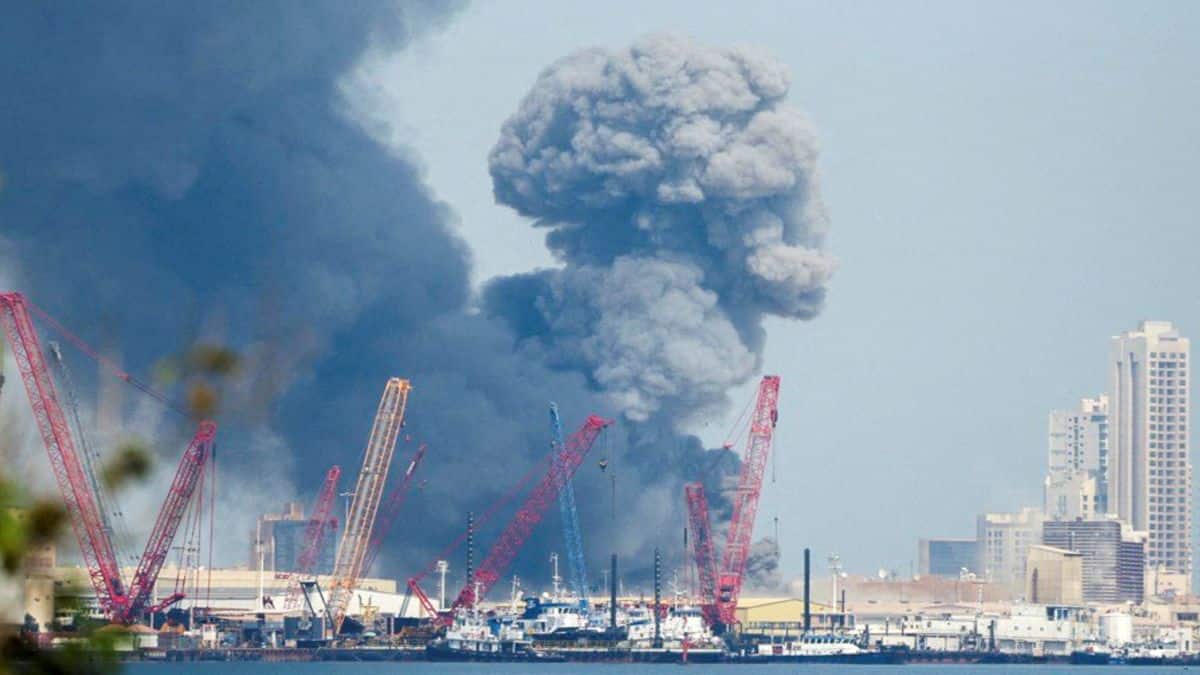
The transition from shadow warfare to direct state-on-state kinetic exchange in the Middle East has fundamentally altered the risk profiles for global energy markets, civil aviation, and regional urban centers. When Iran executes direct strikes against Israel, the primary objective shifts from plausible deniability to a calculated demonstration of penetration capability. This shift forces a re-evaluation of three specific vectors: integrated air defense efficacy, the logistical friction of mass displacement, and the psychological degradation of civilian populations under sustained aerial threat.
Understanding this conflict requires a move away from the anecdotal "photos of destruction" toward a structural analysis of the Escalation Ladder. The current friction is not a series of isolated explosions but a feedback loop governed by defense-to-offense cost ratios and the hard limits of interceptor inventories.
The Triad of Kinetic Impact
The fallout of a direct missile and drone offensive is measured by the intersection of three distinct variables. Each variable acts as a multiplier for the others, determining the overall severity of the geopolitical shock.
- Saturation vs. Interception Thresholds: The success of an aerial strike is not binary. It is defined by the leaking rate—the percentage of projectiles that bypass a multi-tiered defense system. If a system like the Iron Dome or Arrow-3 maintains a 90% intercept rate, the remaining 10% represents the "kinetic reality" that dictates public policy and military retaliation.
- Displacement Velocity: Unlike gradual economic downturns, bombings trigger an immediate surge in the velocity of human movement. This is not merely a humanitarian crisis; it is a logistical bottleneck that strains road networks, fuel supplies, and emergency communication systems.
- Communication Asymmetry: In the minutes following a strike, the gap between official state data and decentralized social media reporting creates a vacuum. This vacuum is often filled by psychological operations designed to maximize the perceived impact of the strike, regardless of actual structural damage.
The Economics of the Intercept
A critical blind spot in standard reporting is the Cost-Exchange Ratio. Every time an Iranian-made Shahed drone, costing approximately $20,000 to $50,000, is launched, it may require a Tamir interceptor (Iron Dome) costing roughly $40,000 to $50,000, or a Patriot/Standard Missile-3 costing millions.
This creates a systemic imbalance:
- Attrition of High-Value Assets: The defender must decide which targets are worth the "spend" of an interceptor. Strategic sites (airfields, nuclear facilities) receive 100% coverage, while peripheral areas may face "calculated exposure."
- The Production Bottleneck: Missiles take months to manufacture; drones take days. Sustained conflict favors the actor with the higher production volume of lower-cost munitions, regardless of the sophistication of the defender's technology.
- The Saturation Point: Every battery has a finite number of firing tubes. Once a battery is empty, there is a "reload window" of extreme vulnerability. Strategic strikes are timed to exploit this specific temporal gap.
The Infrastructure of Evacuation
Evacuations are often portrayed as chaotic flights, but they are governed by the Infrastructure Stress Limit. When a state issues an evacuation order, it initiates a high-stakes stress test on its national backbone.
Transport and Energy Constraints
A sudden mass movement of 50,000 to 100,000 people from a target zone (such as Northern Israel or Southern Lebanon) consumes localized fuel reserves within hours. If the power grid is concurrently targeted, the ability to coordinate this movement via digital maps or cellular networks collapses. The failure of "just-in-time" logistics during a bombing campaign turns a planned withdrawal into a static target for secondary strikes.
The Buffer Zone Dilemma
Creating a "safe zone" or buffer requires more than just moving people; it requires the reallocation of state resources to regions that were previously under-served. This shifts the economic burden from the war front to the interior, creating secondary inflation in housing and food prices. This "internal migration tax" is a primary goal of low-intensity, long-duration bombardment.
Precise Mapping of the Escalation Feedback Loop
The relationship between a strike and its aftermath is not linear. It follows a predictable cycle of action and reaction that can be mapped via Game Theory.
- Phase 1: Probing. Using low-cost drones to map the location and response times of radar arrays and mobile interceptors.
- Phase 2: Saturation. A massive volley intended to overwhelm the processing limits of the Aegis or Iron Dome command-and-control software.
- Phase 3: Impact Assessment. Utilizing satellite imagery and "ground-truth" social media feeds to verify which warheads reached their terminal phase.
- Phase 4: Political Re-calibration. The state must choose between a "proportional" response (targeting similar military assets) or an "asymmetric" response (targeting the economic or energy infrastructure of the aggressor).
The danger of the current Iran-Israel-Hezbollah nexus is that all parties have moved into Phase 4, where the definition of "proportional" is subjective and prone to inflationary expansion.
Defensive Fragility and the Fallacy of the Shield
The most dangerous misconception in modern conflict is the belief in a "hermetic" shield. No defense system is impenetrable. The technical limitation of air defense is rooted in Probability of Kill ($P_k$). If a single interceptor has a $P_k$ of 0.8, military doctrine dictates firing two interceptors per incoming threat to ensure a higher success rate.
This mathematical reality leads to:
- Interceptor Depletion: In a mass strike of 300+ projectiles, the defender may exhaust their entire ready-to-fire inventory in under 30 minutes.
- Fragment Damage: Even a successful interception creates a debris field. Falling shrapnel from a destroyed ballistic missile can weigh hundreds of kilograms and travel at supersonic speeds. "Zero casualties" from a direct hit does not mean zero damage to the civilian environment.
- Sensor Blindness: Electronic Warfare (EW) can "ghost" radar systems, making it impossible to distinguish between a real missile and a digital artifact. This forces the defender to either waste interceptors on ghosts or risk ignoring a real threat.
The Strategic Forecast for Regional Security
The precedent set by direct state-level strikes means the "gray zone" of proxy warfare is dissolving. For stakeholders in energy, shipping, and regional stability, the focus must shift from if a strike will happen to the resilience of the response system.
The Tactical Directive:
Governments and private entities must pivot toward Decentralized Resilience. This involves the hardening of communication networks that do not rely on a central hub, the pre-positioning of modular energy units (solar/battery) in evacuation zones, and the implementation of automated "shut-down" protocols for critical infrastructure during an incoming volley.
The primary threat is no longer the explosive yield of a single warhead, but the systemic paralysis that follows a coordinated, multi-domain saturation of the target state's decision-making capacity. Security is no longer found in the thickness of a bunker's walls, but in the speed and redundancy of the network that manages the crisis.
Immediate priority must be placed on the procurement of low-cost counter-UAS (Unmanned Aerial System) technology, such as directed energy weapons or electronic jamming arrays, to rebalance the cost-exchange ratio. Without a technical solution to the "cheap drone" problem, the economic weight of defense will eventually bankrupt the defender's operational readiness.