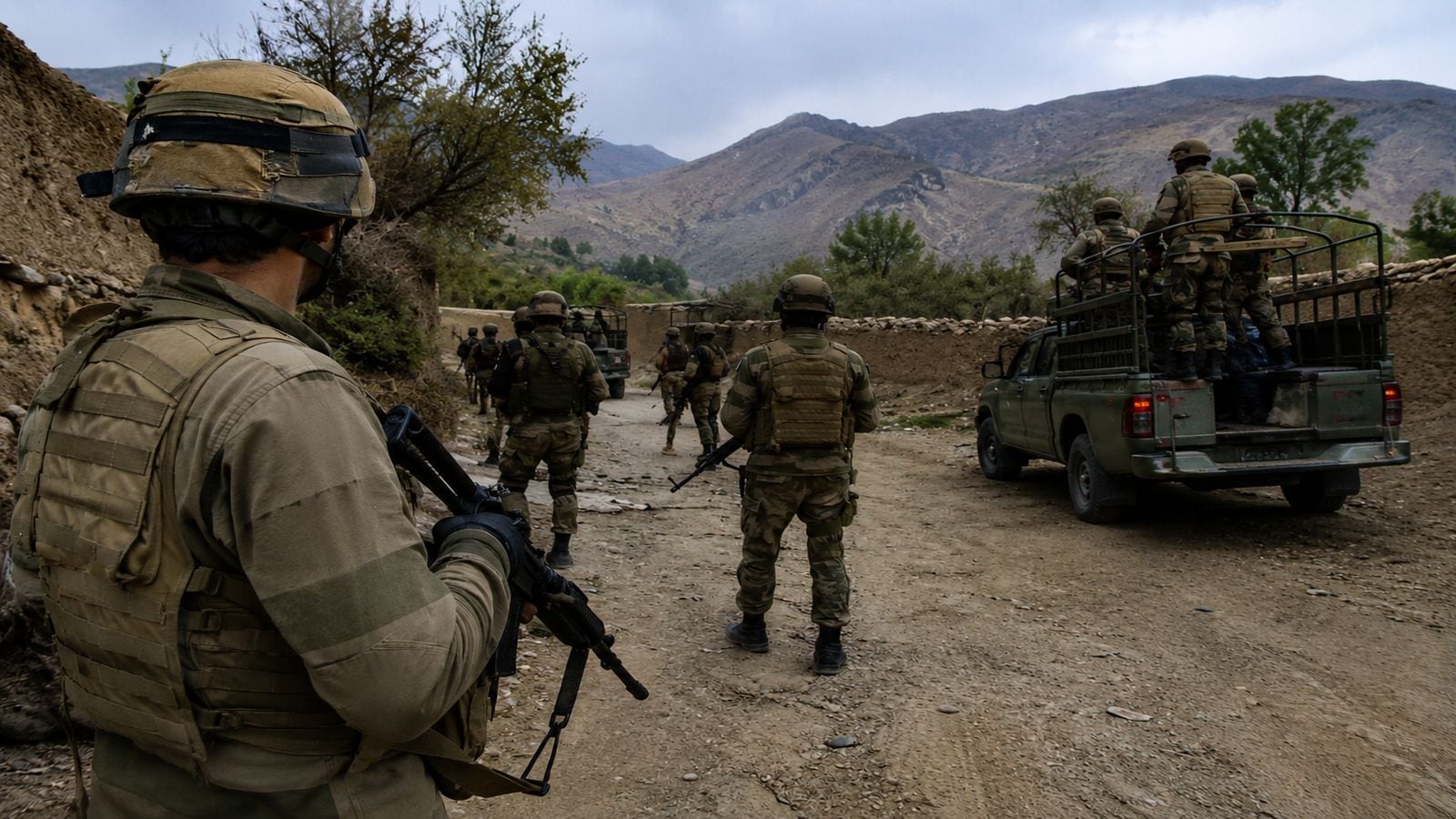
The press releases out of northwest Pakistan always follow the same script. Twenty-seven militants eliminated. Targeted intelligence-based operations. Safe havens disrupted. The military wins, the state beats its chest, and the media prints the body count without asking a single critical question.
It is a comforting narrative. It is also completely wrong. Discover more on a related topic: this related article.
Mainstream defense reporting treats counter-insurgency like a corporate spreadsheet where higher numbers equal better performance. They see twenty-seven dead insurgents and calculate progress. What they fail to see is the structural machinery of the Khyber Pakhtunkhwa borderlands, where tactical body counts are not a metric of success—they are a lagging indicator of a strategy that is spinning its wheels.
We need to stop celebrating tactical liquidation and start looking at the math of the conflict. Further analysis by USA Today highlights similar views on this issue.
The Body Count Fallacy
For decades, military analysts have fallen into the trap of kinetic reductionism. This is the flawed belief that you can defeat an ideological insurgency by simply killing its personnel faster than it can recruit them.
It did not work for the United States in Vietnam. It did not work for the Soviets in Afghanistan. And it is not working in the tribal districts of Pakistan today.
When security forces kill two dozen fighters in places like North Waziristan or Dera Ismail Khan, they are pruning the branches of a tree while watering the roots. Insurgencies like the Tehrik-i-Taliban Pakistan (TTP) do not operate like conventional armies. They do not suffer from recruitment shortages. In fact, aggressive, heavy-handed kinetic operations often serve as the ultimate recruitment tool for these groups.
Imagine a scenario where an operation eliminates five mid-level commanders but destroys local infrastructure, disrupts trade, and displaces civilian populations in the process. The immediate tactical result is a win. The long-term strategic result is a fresh crop of angry, disenfranchised locals ready to pick up the rifles of the men who were just killed.
The state is trading temporary tactical silence for long-term strategic noise.
The Regional Safe Haven Myth
The conventional media coverage loves to focus on local operations, completely ignoring the geopolitical reality of the Durand Line. You cannot clean up a room if the window is wide open and a dust storm is blowing outside.
Since the Taliban took control of Kabul, the geopolitical dynamic has fundamentally shifted. Mainstream reporting treats the TTP as an isolated domestic issue. It is not. It is an regional franchise backed by a cross-border sanctuary that the Pakistani state has proved utterly powerless to close.
- The Afghan Sanctuary: Militants launch attacks in Pakistan, slip across the porous border into Afghanistan, rearm, and rest.
- The Weapon Supply: The withdrawal of Western forces left billions of dollars in advanced military hardware floating around the black markets of Kabul and Peshawar. The militants are better armed than ever before.
- The Ideological Alignment: The rulers in Kabul share a deep theological and historical bond with the TTP. They will never dismantle them, no matter how many diplomatic assurances they give.
Every time a headline trumpets the elimination of a militant cell in Khyber Pakhtunkhwa, it ignores the reality that ten more cells are being organized, trained, and equipped just a few miles away across the border. Focusing entirely on internal operations while failing to address the regional sanctuary is the strategic equivalent of mopping the floor while the pipes are still bursting.
The Illusion of Stability
People frequently ask: "If the military keeps killing militants, won't the region eventually become secure?"
This question is built on a broken premise. Security is not the absence of militants; it is the presence of legitimate governance, economic opportunity, and the rule of law.
Right now, the state's approach is entirely cyclical. The military clears an area, declares victory, and moves on. Then, a governance vacuum occurs. The civilian state machinery—schools, courts, police, local administration—fails to move into the cleared territory because it is either underfunded, corrupt, or terrified. The militants quietly bleed back into the community, re-establish their shadow courts, extort local businesses, and the entire cycle repeats.
True stability cannot be delivered at the tip of a bayonet. Until the local police force is modernized, the judiciary actually functions, and young men in the merged districts have options other than smuggling or militancy, body counts are just temporary metrics on a whiteboard in Rawalpindi.
The Brutal Trade-Offs of the Hardline Stance
The contrarian truth is that a purely kinetic strategy is a luxury Pakistan can no longer afford. The country is facing a crippling economic crisis. Running continuous, high-tempo military operations across multiple districts drains billions from an exhausted treasury.
Furthermore, this endless war footing destroys the economic potential of the region. Khyber Pakhtunkhwa should be a vital trade corridor connecting Central Asia to the Arabian Sea. Instead, it remains a heavily militarized security zone, locked out of global investment and domestic development.
Is there a downside to moving away from this kinetic focus? Absolutely. Shifting from a military-first strategy to a governance-first strategy takes years, if not decades, to show results. It requires political courage, massive financial investment, and the willingness to accept short-term security risks while building long-term institutional strength. It is slow, boring, unglamorous work that doesn't produce dramatic headlines or neat press releases.
But the alternative is continuing down a path that has yielded nothing but twenty years of perpetual conflict.
Stop looking at the body counts as a sign of victory. They are a sign of a meat grinder that keeps spinning because the state refuses to unplug the machine.