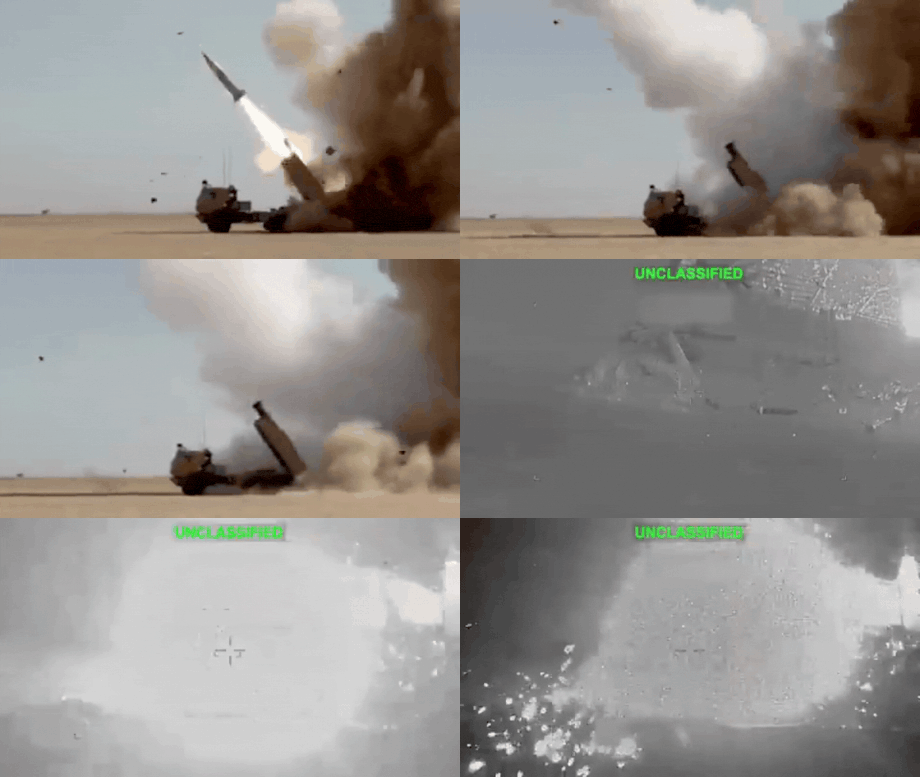
The release of declassified strike footage by the United States Department of Defense functions less as a military status update and more as a high-fidelity instrument of psychological and diplomatic signaling. In the theater of modern asymmetric warfare, the visual confirmation of a strike serves three distinct strategic purposes: the validation of precision capabilities, the public attribution of responsibility, and the recalibration of the adversary’s risk-benefit calculus. By examining the technical and tactical layers of these operations, we can move beyond the surface-level narrative of "retaliation" to understand the structural logic of controlled escalation.
The Architecture of Kinetic Signaling
Military action in the Middle East operates within a framework of proportional deterrence. This is not a zero-sum conflict but a calibrated exchange where the volume of force is tuned to achieve a specific political outcome without triggering a full-scale regional conflagration. The efficacy of these strikes depends on the Triad of Credible Force:
- Attribution Certainty: The ability to link a specific proxy group to its state sponsor through intelligence intercepts and forensic analysis of debris.
- Proportionality Gradient: Selecting targets that mirror the damage received—for example, striking ammunition depots or command nodes in response to drone attacks on personnel.
- Visual Transparency: Using high-resolution optics to prove that "collateral damage" was minimized, thereby stripping the adversary of the "civilian casualty" counter-narrative.
The recent videos released highlight a shift in the transparency of the kill chain. By showing the moment of impact from the perspective of an electro-optical/infrared (EO/IR) sensor, the U.S. demonstrates a persistent "unblinking eye" over the battlespace. This level of surveillance suggests that every movement within these facilities is logged, categorized, and archived for future target selection.
Technical Variable Analysis: The Cost of Interdiction
A fundamental misunderstanding in public discourse is the cost-exchange ratio between offensive drones and defensive interceptors. When Iranian-backed militias deploy a "one-way attack" (OWA) drone, the unit cost may be as low as $20,000. Engaging that drone with a sophisticated surface-to-air missile (SAM) like the RIM-161 Standard Missile 3 or even a NASAMS interceptor costs millions.
This creates a Structural Deficit in Attrition:
- Financial Asymmetry: The defender spends orders of magnitude more than the attacker to maintain the status quo.
- Inventory Depletion: Every interceptor fired is one less available for a high-intensity conflict with a peer adversary.
- Operational Fatigue: Constant 24/7 monitoring of the airspace taxes the electronic warfare (EW) suites and the personnel operating them.
To break this deficit, the U.S. strategy has pivoted from pure defense to proactive degradation. Instead of shooting the arrow, they are striking the archer. The target sets seen in the declassified videos—logistics hubs, storage bunkers, and drone assembly points—are designed to increase the "cost of entry" for the adversary. When the infrastructure required to launch a $20,000 drone costs $50 million to rebuild, the economic logic of the conflict shifts.
The Logic of the Targeted Strike Zone
Target selection is governed by a hierarchy of value that balances tactical gain against the risk of escalation. We can categorize these targets using the Functional Disruption Model:
Tier 1: C4I Nodes (Command, Control, Communications, Computers, and Intelligence)
These are the brains of the operation. Striking these centers disrupts the ability of militia groups to coordinate multi-vector attacks. The goal is to induce "organizational friction," where the time between an order and its execution increases significantly.
Tier 2: Kinetic Enablers
This includes rocket launchers, drone catapults, and pre-positioned munitions. Striking these offers immediate tactical relief but lacks long-term strategic impact because these assets are easily replaced by state sponsors.
Tier 3: Economic and Sovereignty Markers
Striking oil refineries or official government buildings would signal a shift to total war. The U.S. has notably avoided these targets, maintaining a "sanctuary" for Iranian soil while treating proxy locations in Iraq, Syria, and Yemen as "active kinetic zones."
Precision as a Diplomatic Lever
The use of the R9X "Flying Ninja" Hellfire—a missile that uses kinetic blades rather than explosives to neutralize a target—represents the peak of this "surgical" philosophy. While not explicitly confirmed in every video, the emphasis on "zero civilian casualties" in Pentagon briefings points to a heavy reliance on low-collateral weaponry.
This precision is a requirement for maintaining the Coalition Consent Framework. The U.S. operates in Iraq and Syria under complex legal and diplomatic agreements. If a strike kills civilians, the host nation faces immense internal pressure to expel U.S. forces. Thus, the technical capability of the weapon system directly enables the geopolitical presence of the military. If the technology fails, the strategy collapses.
The Intelligence-Strike Feedback Loop
The videos serve as an audit of the Intelligence Community (IC). For a strike to be successful, the "Find, Fix, Track, Target, Engage, Assess" (F2T2EA) cycle must be seamless.
- Find: Identification of a threat through SIGINT (Signals Intelligence) or HUMINT (Human Intelligence).
- Fix/Track: Maintaining a constant lock on the target via UAVs.
- Target/Engage: The kinetic event shown in the footage.
- Assess: Battle Damage Assessment (BDA).
The public release of BDA footage is a specific message to the adversary's intelligence apparatus: "Your concealment measures are insufficient." It exposes the failure of their camouflage, their underground hardening, and their operational security (OPSEC).
Constraints of the Kinetic Approach
It is critical to recognize the limitations of this strategy. Kinetic strikes are a "holding action." They do not solve the underlying political grievances or the ideological motivations of the proxy groups.
- The Hydra Effect: Removing a local commander often leads to the promotion of a younger, more radical successor who lacks the established "backchannel" connections that sometimes facilitate informal de-escalation.
- Hardening and Burial: In response to these strikes, adversaries have moved production facilities deeper underground, often beneath 30+ meters of reinforced concrete and rock, necessitating the use of "Bunker Busters" (GBU-57 MOP), which are significantly more escalatory.
- Proxy Autonomy: There is an educated hypothesis among analysts that some proxy groups have achieved a level of "operational autonomy" where they may ignore directives from Tehran to de-escalate, seeking instead to draw the U.S. into a localized quagmire.
Strategic Forecast: The Shift to Electronic and Cyber Attrition
As the visual theater of kinetic strikes continues, a secondary, invisible conflict is accelerating. The U.S. is increasingly using "Non-Kinetic Effects" (NKE) to achieve the same goals seen in the videos. This includes:
- GPS Spoofing: Causing drones to "return to home" or crash by feeding them false coordinate data.
- Directed Energy: Testing high-power microwave systems to fry the circuit boards of incoming swarms.
- Financial Interdiction: Using cyber tools to freeze the digital wallets used to pay the militia members who operate the launch sites.
The kinetic strikes we see in the news are the "loud" part of the strategy, designed for public consumption and deterrent signaling. The "quiet" part—the systemic dismantling of the financial and technical networks—is where the long-term resolution will be found.
The current trajectory suggests a period of "Normalized Instability." The U.S. will continue to release high-definition evidence of its lethality to maintain a baseline of deterrence, while the adversary will continue to probe for weaknesses in the defensive "dome." Success is defined not by the total elimination of the threat, but by the successful management of the escalation ladder.
The immediate strategic priority is the integration of AI-driven sensor fusion to reduce the "sensor-to-shooter" timeline. By automating the detection of launch signatures, the U.S. can transition from "retaliatory strikes" (happening hours or days later) to "interdiction strikes" (happening minutes before a launch). This move from reactive to predictive kinetic action represents the next evolution in regional power projection.