When law enforcement agencies publicize unredacted primary-source extortion correspondence months after an abduction, the operational objective shifts from private negotiation to crowdsourced forensic linguistics. The decision by the Pima County Sheriff’s Department and federal task force partners to release two distinct ransom communications from the Nancy Guthrie disappearance represents a calculated pivot in investigative methodology. Rather than relying solely on digital footprints, metadata, or physical evidence—which have thus far yielded no definitive suspects—investigators are leveraging idiolect identification to crack an anonymous profile.
Deconstructing this strategy requires evaluating the linguistic markers, the tactical evolution of the perpetrator's demands, and the psychological indicators embedded within the texts.
The Anatomy of the Communications
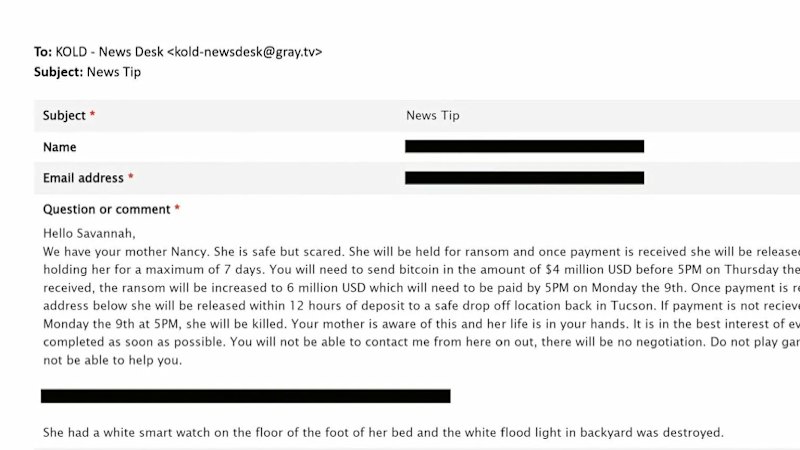
The dossier comprises two separate text-based digital messages transmitted to a Tucson media outlet during the initial week of February. Each note displays structural, syntactic, and phraseological choices that construct a behavioral fingerprint.
The first communication, dispatched on February 2, operates on a compressed compliance model:
- Monetary Demand: Four million dollars in cryptocurrency (Bitcoin).
- Escalation Function: A penalty clause increasing the demand to six million dollars if initial deadlines are bypassed.
- Temporal Constraint: A rigid compliance window spanning maximum-urgency increments, backed by an explicit termination threat.
- Internal Verification Markers: Inclusion of specific physical layout details from the victim's residence—specifically referencing an Apple Watch left on the floor and a compromised exterior floodlight.
The second communication, transmitted on February 6, exhibits a sharp shift in tone, tactical posture, and narrative intent:
- Status Update: A declaration that the target perished shortly after abduction, attributed to pre-existing cardiac vulnerability.
- Disposal Indicator: The assertion that the body is "buried in nature now".
- Absolution Framework: An attempt to mitigate liability through a formal apology ("We are truly sorry") and a deterministic assertion that the outcome was immutable.
Linguistic Profiling and Behavioral Shift
The utility of releasing these documents lies in forensic stylometry—the statistical analysis of an author’s unique writing style, syntax, punctuation habits, and idiosyncratic vocabulary choices.
The initial note relies heavily on transactional authoritarianism. The phrasing is clipped, commanding, and transactional ("You will not be able to contact me from here on out, there will be no negotiation"). It mimics institutional or corporate ultimatum structures while maintaining strict operational security boundaries. The inclusion of internal domestic markers (the watch, the light) served a dual purpose: proving direct access to the crime scene while foreclosing the viability of external bluffing by copycats.
Conversely, the second note introduces a psychological regression. The syntax transitions from imperative commands to defensive rationalization ("We did not fully grasp the seriousness of her physical condition"). This abrupt transformation signals one of two operational realities: either the perpetrator experienced a profound shift in risk perception following unanticipated public exposure, or the second note reflects a tactical maneuver designed to halt active tracking by convincing search parties that recovery efforts are futile.
Comparative Forensic Precedents
Using authored text to identify anonymous offenders follows established investigative blueprints. The most prominent historical parallel involves the Federal Bureau of Investigation tracking Theodore Kaczynski. In that case, the publication of a long-form ideological text exposed unique patterns of diction, spelling idiosyncrasies, and thematic obsessions that allowed family members to recognize the syntax and prompt an arrest.
In contemporary digital kidnappings, the variables shift from printed manifestos to ephemeral digital transmissions routed through specific IP nodes. However, human cognitive constraints remain constant. Writers consistently repeat idiosyncratic phrasing, structural rhythms, and lexical choices even when attempting deliberate disguise. By shifting the evidentiary burden to the public sphere, investigators are gambling that someone intimately familiar with the author's daily writing habits—an employer, former associate, family member, or classmate—will identify the distinct linguistic profile.
Operational Limitations and Tactical Reality
Relying on public recognition of writing styles carries inherent systemic friction:
- Stylistic Masking: Sophisticated offenders can utilize automated text-generation systems or stylistic prompts to neutralize their natural idiolect, rendering linguistic comparisons inconclusive.
- Noise-to-Signal Ratio: Public appeals of this magnitude inevitably generate high volumes of false-positive tips, diverting investigative bandwidth away from verifiable physical evidence.
- The Extortion Variable: Authorities have previously noted that high-profile missing persons cases attract opportunistic copycats and fraudulent extortion attempts, complicating the task of isolating genuine communications from fabricated interference.
Despite these constraints, the release of unredacted syntax patterns bypasses traditional investigative bottlenecks. It transforms an army of private citizens into an analytical filter capable of cross-referencing linguistic anomalies against localized social graphs.
Cross-reference these linguistic indicators against localized communicative baselines, personal correspondence archives, and sudden behavioral anomalies within social networks connected to the greater Tucson area.