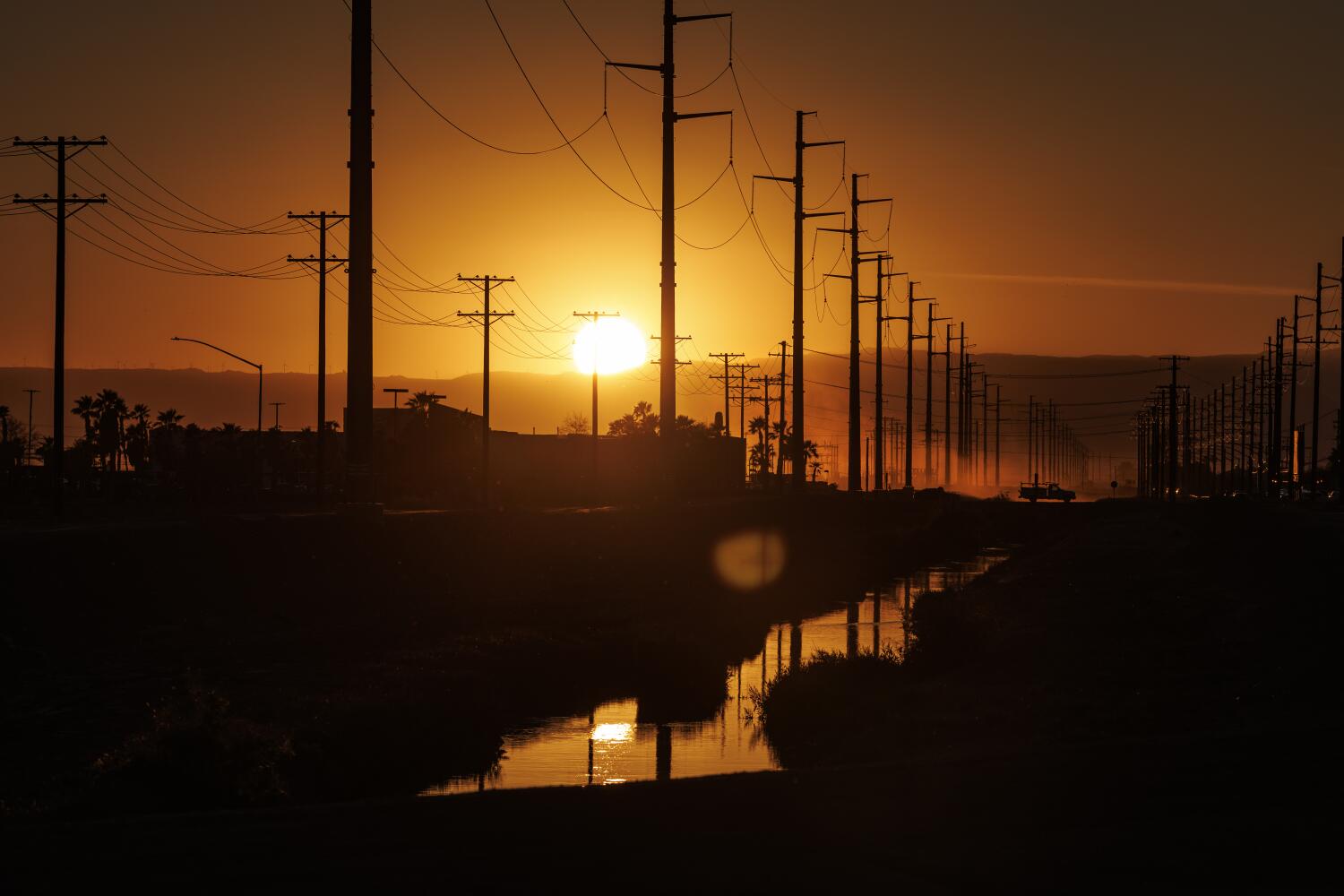
The arrest of a protester at an Imperial County board meeting makes for a great headline. It paints a picture of "Big Tech" steamrolling the "Little Guy." It suggests a David versus Goliath narrative where the sling is a megaphone and the giant is a windowless concrete box filled with servers.
This narrative is a lie. For another perspective, see: this related article.
It is a comfortable, lazy story that local activists and surface-level journalists tell themselves to avoid the difficult math of 21st-century survival. When you protest a data center, you aren't protecting your environment; you are voting for your own economic obsolescence. You are choosing a crumbling tax base over a digital gold mine because you are afraid of noise levels that are lower than a passing lawnmower.
The Myth of the Resource Vampire
The standard argument against data centers—the one echoed from Imperial County to Northern Virginia—is that they are resource vampires. The claim is they suck the grid dry and drink the local water supply until the taps run brown. Further insight on this matter has been provided by Wired.
Let’s look at the actual physics.
Modern data centers are some of the most efficient industrial users of energy on the planet. Unlike a manufacturing plant that spews particulate matter or a refinery that risks groundwater contamination, a data center is essentially a giant radiator.
Activists love to cite "peak power" usage without mentioning that data centers provide the financial floor for grid modernization. When a provider like Amazon, Google, or Microsoft moves in, they don't just "take" power. They often fund the substations and high-voltage transmission lines that the local utility could never afford to build on its own. They are the anchor tenants of the electrical grid. Without them, your residential rates go up because the cost of maintaining the infrastructure is spread across fewer, poorer users.
As for water, the "evaporative cooling" scare is outdated. The industry is moving rapidly toward closed-loop systems and air-cooling technologies. In desert environments like Imperial County, these facilities are often more water-efficient than the industrial agriculture they replace. A hundred acres of alfalfa consumes exponentially more water than a hundred acres of server racks. But nobody arrests a farmer for turning on a sprinkler.
The Jobs Fallacy
"But they don't create any jobs!"
This is the favorite refrain of the short-sighted. It’s true that a 500,000-square-foot data center might only employ 50 to 100 full-time staff once operational. If you are measuring success by the number of bodies punching a clock, you are living in 1954.
We need to talk about the Tax-to-Service Ratio.
A residential development with 500 homes requires schools, police, fire departments, trash pickup, and road maintenance. Those 500 homes almost always cost the county more in services than they provide in property taxes. They are a net drain.
A data center is a fiscal miracle. It demands almost zero public services. Servers don't send children to school. Servers don't get into domestic disputes requiring police intervention. Servers don't need parks or libraries.
In Loudoun County, Virginia—the data center capital of the world—these "jobless" buildings generate over $600 million in annual tax revenue. That money pays for the teachers, the roads, and the emergency services that the rest of the population enjoys. When you block a data center, you are effectively demanding a tax hike for yourself and your neighbors.
The NIMBY Paradox
The protest in Imperial County wasn't about the environment. It was about "character." It was about the fear of change.
I’ve sat in these boardrooms. I’ve seen the "battle scars" of developers who try to play nice with local committees. They offer to plant trees. They offer to paint the buildings "desert tan" to blend in. It’s never enough.
The irony is that the people screaming the loudest about data centers are usually recording the protest on an iPhone, uploading it to Facebook, and syncing it to the cloud. They want the digital life, but they want the physical infrastructure to exist in someone else's backyard.
This "Not In My Backyard" (NIMBY) attitude is a luxury for the wealthy. For a place like Imperial County, which has historically struggled with high unemployment and a narrowing economic path, it is a form of civic suicide.
The Hidden Cost of Saying No
Imagine a scenario where every mid-tier county successfully bans data centers.
The infrastructure doesn't disappear; it just moves. It moves to regions—or countries—with lower environmental standards and higher carbon intensity. By pushing these facilities away, local activists are essentially outsourcing the environmental impact to places that can't afford to say no, while simultaneously starving their own schools of funding.
We also have to address the "noise" complaints. Data centers use large fans. These fans hum. If you stand fifty feet away, it sounds like a distant HVAC unit. Yet, protesters act as if the county is being invaded by a fleet of low-flying jet engines. Compare that hum to the noise of a distribution warehouse—hundreds of semi-trucks braking, accelerating, and idling 24/7.
Data centers are the quietest neighbors you could ask for, but because they look like "The Matrix," people project their technological anxieties onto the architecture.
Why the Board is Right to be Frustrated
The tension at these meetings doesn't come from a lack of democracy. It comes from a clash between emotional grandstanding and fiscal reality.
Board members are tasked with keeping the lights on and the budget balanced. When a resident stands up and shouts about "saving the land" while the county is facing a massive deficit, the frustration is inevitable. The arrest in Imperial County was a symptom of a process that has become hijacked by performative outrage.
If you want to save your community, stop looking for reasons to say no.
Start asking for better terms. Ask for the data center provider to fund a local STEM program. Ask for a commitment to use recycled water for cooling. Ask for a local hiring preference for the construction phase.
But if you just show up to scream "get out," don't be surprised when the tax revenue leaves with them, and your town is left with nothing but a "For Lease" sign and a high-speed connection to a world that passed you by.
The "Little Guy" isn't the one fighting the data center. The Little Guy is the one who will lose his job when the county can no longer afford to pay its employees because a few loud voices preferred a vacant lot to a vibrant tax base.
Your internet has to live somewhere. If you're too precious to let it live near you, prepare to pay for that vanity in every property tax bill for the next thirty years.
Stop fighting the future. You're losing.