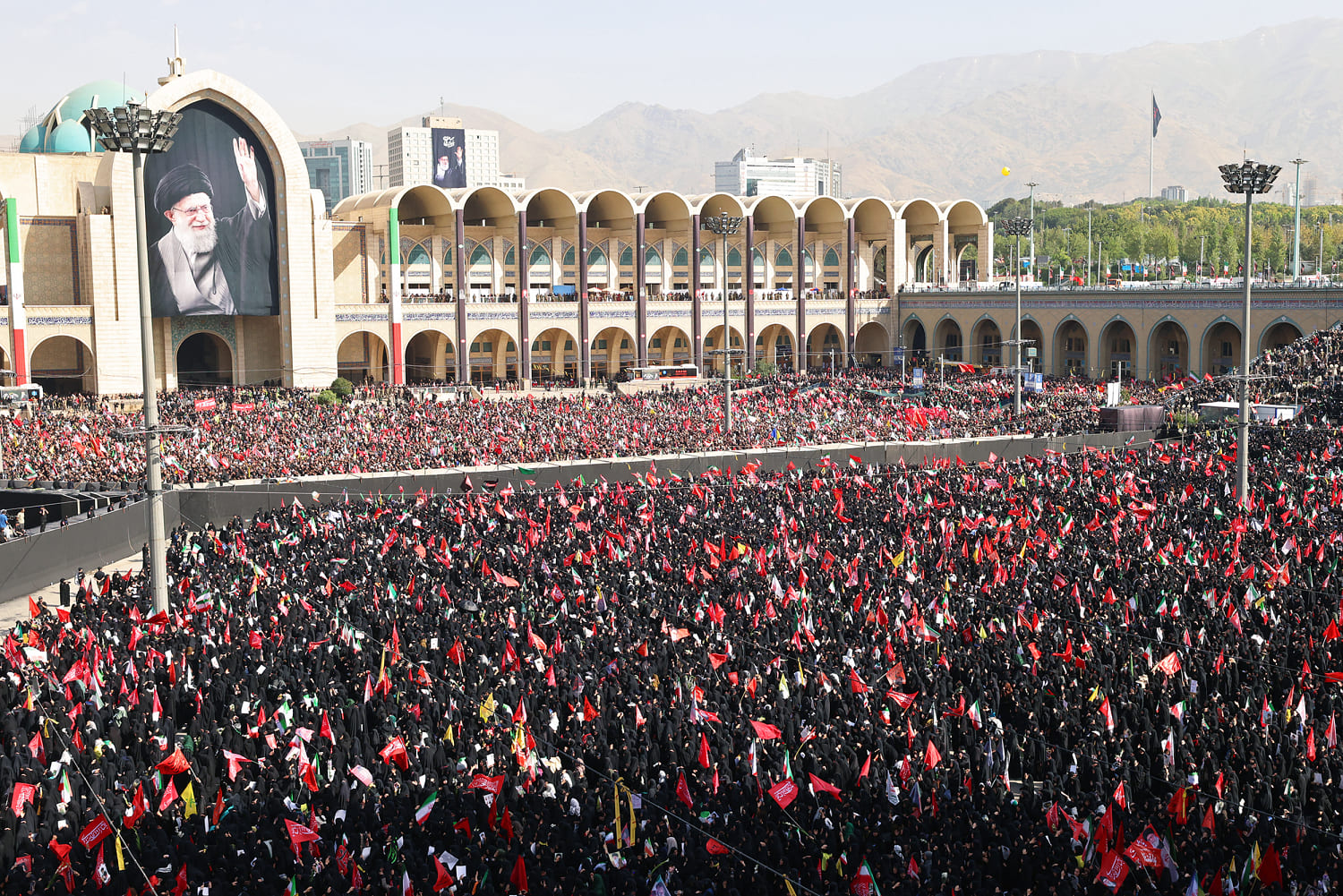
The state funeral of Iran’s late Supreme Leader Ali Khamenei, commencing on July 4, 2026, represents a calculated execution of state capacity and geopolitical signaling. Following a four-month delay induced by active kinetic conflict with the United States and Israel, the parameters of this six-day event extend far beyond a domestic religious rite. The management of an expected 30 million attendees across transnational geographies functions as an active stress test of civil infrastructure, security systems, and regional supply chains.
Analyzing this event requires moving past the narrative of spontaneous public assembly. Instead, it must be evaluated through the concrete frameworks of mass logistics, state-engineered redundancy, and infrastructure strain.
The Tri-Hub Supply Chain and Urban Strain Mitigation
Hosting a multi-city event of this scale creates immediate bottlenecks in three core areas: sustenance, shelter, and communications infrastructure. To prevent systemic failure in Tehran during the initial phases on July 4 and 5, the state deployed a decentralized allocation model across a rigid geometric grid.
Food and Resource Distribution Metrics
Rather than relying on existing commercial retail supply chains, which are vulnerable to localized hoarding and inflation, the National Funeral and Farewell Ceremony Committee nationalized the distribution of foundational goods. The baseline caloric requirement for millions of transient pilgrims was addressed by routing raw inputs directly to centralized state bakeries, which produced 50 million loaves of bread. This volume bypasses the traditional Tehran Grand Bazaar network, mitigating the risk of localized food deserts within the urban core.
Real Estate Reconfiguration Strategy
The immediate influx of regional participants from Iraq, Afghanistan, and Pakistan presents a housing deficit that local hospitality infrastructure cannot absorb. The governorate of Tehran addressed this by converting institutional real estate into temporary civil shelters, utilizing a two-pronged approach:
- Educational Reconstitution: 700 schools were cleared of administrative equipment and converted into dormitory spaces, maximizing square footage per capita.
- Ecclesiastical Staging: 5,000 mosques were designated as secondary hubs, leveraging existing sanitization and open-floor layouts to process high-density foot traffic.
- High-Capacity Bivouacs: Within localized green spaces like Mellat Park, the Red Crescent deployed 1,000 high-capacity tents to manage overflow, establishing emergency medical triage points directly adjacent to the primary crowd channels.
Bandwidth and Data Flow Management
High crowd density naturally degrades cellular networks due to cell-tower throttling and spectrum congestion. Because the state requires continuous monitoring of crowd sentiment and real-time security telemetry, a reliable communications layer was mandatory.
The telecommunications ministry deployed dedicated fiber-optic infrastructure across 10 high-priority nodes within the Imam Khomeini Mosalla Grand Mosque complex. By offloading user data from standard cellular bands to fixed, high-throughput public access points, the state preserves cellular bandwidth for military, law enforcement, and Islamic Revolutionary Guard Corps (IRGC) secure communications channels.
Transnational Staging and Border Dynamics
The itinerary of the funeral operates across a distinct geographical sequence: Tehran, Qom, Najaf, Karbala, and finally, Mashhad. Moving a high-value asset—and millions of associated mourners—across an international border during an uneasy ceasefire creates extreme border friction and operational risk.
[Tehran Public Staging] ➔ [Qom Clerical Center] ➔ [Transnational Transit to Iraq] ➔ [Najaf/Karbala Processions] ➔ [Mashhad Final Burial]
The transit to Najaf and Karbala on July 7 serves a dual structural purpose. Legitimizing the new leadership under Ayatollah Mojtaba Khamenei requires explicit alignment with the Iraqi Shia clerical establishment. However, from a logistics perspective, this introduces severe cross-border security challenges.
The state mitigated private transit bottlenecks by leveraging parastatal enterprises. For instance, the SAIPA automotive group was nationalized to provide dedicated logistics and transport assets specifically for thousands of Iraqi pilgrims, controlling the inbound and outbound vectors to prevent chaotic, unmonitored border crossings.
Security Constraints and the Decapitation Risk Counter-Strategy
The primary structural risk of the July 2026 funeral is security containment. Because Ali Khamenei was assassinated via a targeted joint US-Israeli air strike on February 28, 2026, the state operates under the assumption that a high-density gathering of senior leadership constitutes a premium target for secondary kinetic or cyber disruption.
Airspace Denegation and Kinetic Shields
The absolute closure of commercial airspace over Tehran and provincial capitals during the ceremonies is a mandatory defense mechanism. By clearing civilian transponders from the radar matrix, air defense systems can immediately classify any unauthorized radar signature as hostile, reducing the latency required for automated surface-to-air missile engagement.
Leadership Dispersal and Continuity Protocols
The conspicuous absence or highly managed appearances of senior officials—including the new Supreme Leader Mojtaba Khamenei, who has largely remained out of public view since the initial strikes—reflects a rigid institutional continuity plan.
The state cannot risk a single-point-of-failure event where the executive branch, military high command, and clerical elite are co-located. Therefore, while civilian leaders like President Masoud Pezeshkian and Parliament Speaker Mohammad Bagher Qalibaf handle visible diplomatic duties at the Grand Mosalla, the core military command structure remains insulated within fortified underground command and control nodes.
Strategic Outlook
The state funeral functions as a live demonstration of political survival and logistical resilience directed at foreign adversaries and internal factions. The structural success of the week-long event depends entirely on whether the infrastructure-strain mitigation strategies hold under the weight of tens of millions of participants.
If the state successfully maintains public order, prevents logistical collapses in food or transport, and protects its remaining leadership cadre throughout the multi-city transit, it will establish a baseline of operational stability for the transition of power to Mojtaba Khamenei. Conversely, any systemic failure in these logistical sectors will expose critical vulnerabilities in Iran’s post-war domestic control apparatus.