The air inside a collapsed tunnel does not merely sit; it presses. It has weight, smell, and memory. It carries the microscopic dust of crushed stone, the damp chill of subterranean water tables, and the flat, exhausted exhale of trapped human lungs.
When disaster strikes deep beneath the surface of the earth, time undergoes a strange distortion. For the person trapped in the dark, every second stretches into an eternity measured by the frantic thumping of their own heart. But for the rescue crews stationed on the other side of the blockage, time operates with a cruel, agonizing velocity. The clock is an enemy. Every tick represents oxygen depleting, stability worsening, and hope flickering.
Consider what happens when the mountain itself fights back.
In the rugged terrain of Nepal, where the Himalayas thrust jagged peaks toward the sky, infrastructure projects often carve through ancient, unpredictable geology. These tunnels are lifelines of connectivity, piercing through towering ridges to link isolated communities. But they are also high-stakes environments where nature holds all the cards.
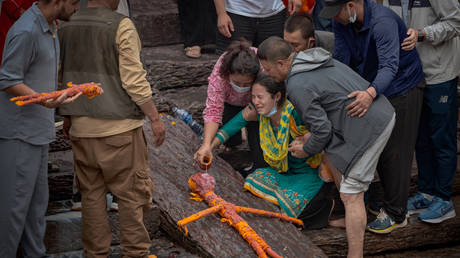
When a section of one such tunnel recently gave way, trapping workers in the suffocating gloom, the initial response was immediate. Sirens wailed against the mountain backdrop. Families rushed to the site, their faces pale masks of terror, clutching mobile phones like talismans. Officials mobilized. Heavy machinery rumbled to life.
Yet, the mountain had other plans.
Mud and water. Those four words represent a rescue worker's worst nightmare.
To understand the sheer frustration of the rescue operation, you have to look past the official press briefings and visualize the physical reality of the site. As Prime Minister KP Sharma Oli and other disaster management officials closely monitored the crisis, the rescue teams on the ground faced an immediate, paralyzing obstacle. This was not a neat, clean cave-in of dry rubble that could be cleared with systematic excavation. This was a liquid nightmare.
Mud behaves like a slow-moving predator. It flows into spaces carved by human hands, filling every crevice, sealing off air pockets, and swallowing equipment whole. Water adds an entirely different dimension of peril. As pumps whined and crews fought to clear the blockage, more water seeped through the fractured rock face above, threatening to turn the rescue tunnel into a submerged tomb. Every cubic foot of mud removed seemed instantly replaced by a new slide of slurry.
It is easy from the comfort of a lit room to ask why rescue operations take hours, or days. Why can't heavy excavators just clear the path? Why are the prime minister and emergency coordinators forced to report frustrating delays?
The answer lies in the physics of unstable earth.
(Note: The following scenario illustrates the mechanics of tunnel collapses based on historical engineering data from mountainous regions.)
Imagine standing inside a tube of reinforced concrete and shattered rock. Above you rests millions of tons of mountain. When a partial collapse occurs, the structural integrity of the entire bore is compromised. If heavy machinery vibrates the earth too aggressively while trying to scoop away the mud, it can trigger a secondary collapse, burying not just the trapped workers, but the rescue crew as well. Every movement must be calculated. Every shovel of mud must be weighed against the risk of bringing down the ceiling.
Rescuers are not just machine operators; they are surgeons working in pitch-black chaos. They use handheld tools, small buckets, and sheer muscle power when the machinery is too heavy or the space is too confined. They crawl into spaces that defy claustrophobia, listening intently for the faint tap of a metal rod against stone, a human signal cutting through the roar of rushing water.
The human element of this crisis cannot be overstated.
Behind every statistic released to international news agencies is a kitchen table left set for dinner. There is a mother who cannot stop shaking, a child who does not yet understand why television broadcasts show pictures of their father's workplace surrounded by flashing lights, and a community holding its collective breath.
Prime Minister Oli’s public acknowledgment of the delays caused by mud and water was more than a logistical update. It was a rare, raw admission of vulnerability in the face of natural fury. Leaders are expected to project absolute control, to command solutions into existence. But mountains do not care about political titles or emergency decrees. They obey only gravity and time.
When delays stretch on, the psychological toll on the surface matches the physical toll underground. The families waiting outside the perimeter form a community of shared agony. They share blankets, brew endless pots of bitter tea, and avoid looking into each other's eyes too long, terrified of reading the dread they feel inside themselves. Every time a rescue vehicle shifts position or a siren blares, heads snap up. Every silence feels heavier than the last.
This is the hidden cost of our modern ambition. We carve paths through the most inhospitable landscapes on Earth to bring people closer, to trade, to travel, and to build. We trust the concrete and steel to hold. But we share our world with ancient tectonic forces that were shaping continents long before we uttered our first words.
The operation in Nepal remains a stark reminder of our fragility. It highlights the immense bravery of ordinary individuals—engineers, firefighters, local volunteers, and soldiers—who willingly crawl into the belly of the earth to drag strangers back to the light. They do not wear capes. They wear mud-stained jumpsuits and carry battered flashlights. They fight against time, mud, and water, driven by a stubborn, beautiful refusal to abandon their own.
Deep beneath the Himalayan foothills, the pumps continue to hum, the shovels continue to bite into the sludge, and the dark holds its breath.