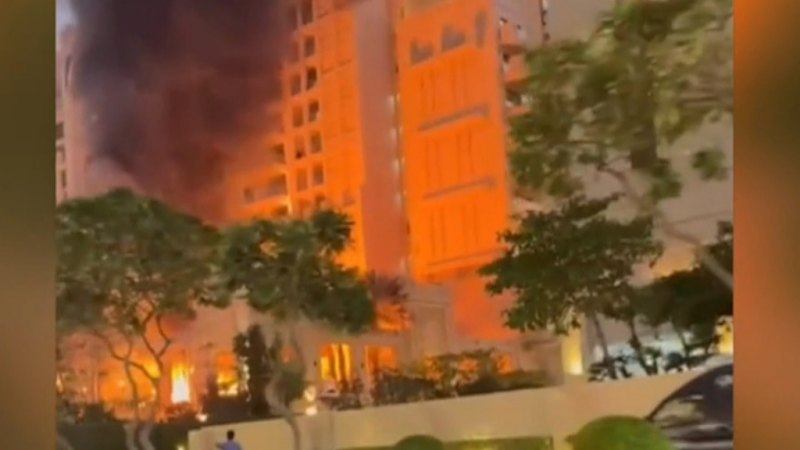
The vibration of a smartphone on a bedside table in Beirut sounds different than it does in Sydney. In Australia, it is a nuisance—a reminder of a meeting or a text from a friend. In a conflict zone, that low hum is a heartbeat. It is the sound of a government alert, a message from a loved one, or the notification that a commercial flight has been cancelled. Again.
Sarah—a hypothetical but representative composite of the hundreds currently holding Australian passports in the Middle East—doesn't look at the Mediterranean view from her balcony anymore. She looks at the sky for silver wings that aren't there. She is one of the thousands caught in the tectonic shift of global geopolitics, where the "She’ll be right" attitude of home has been replaced by the cold math of risk assessment. Meanwhile, you can read similar events here: The Cold Truth About Russias Crumbling Power Grid.
The news cycles call them "stranded." It is a word that conjures images of desert islands or broken-down cars. But being stranded in a modern conflict is a digital and bureaucratic purgatory. It is the act of refreshing a browser tab 400 times a day, watching the "Status" column of the airport website turn from a hopeful green to a terminal, bleeding red.
The Invisible Geography of Fear
When the Australian government issued its "Do Not Travel" and "Leave Immediately" warnings, the logistics seemed straightforward on paper. Pack a bag. Go to the airport. Buy a ticket. To see the full picture, check out the recent article by Reuters.
The reality is a jagged mess.
Commercial airlines are not charities; they are businesses governed by insurance premiums. When the risk of a missile crossing a flight path rises by even a fraction of a percent, the insurance costs for a Boeing 777 skyrocket. Suddenly, the route is no longer viable. One by one, the luminaries of the sky—Lufthansa, Emirates, Air France—flicker out.
For an Australian family in Southern Lebanon or the outskirts of Tel Aviv, this isn't just a travel inconvenience. It is the closing of a trapdoor. They are tethered to a land that feels increasingly like a powder keg, watching the price of the few remaining "escape" seats climb to $5,000, then $8,000, then $12,000.
Wealth becomes the only passport that matters. If you have the credit limit, you might get out. If you are a dual citizen with a mortgage back in Melbourne and a local business that is currently evaporating, you sit and wait for a miracle—or a military transport plane.
The Myth of the Easy Exit
There is a common refrain heard in the comments sections of news sites: Why didn't they leave earlier?
It is a question asked by people who have never had to pack a life into two suitcases. Consider the elderly couple who moved back to their ancestral village to retire on an Australian pension. Their house is there. Their memories are there. They spent thirty years working in a factory in Geelong to afford this peace, and now they are told to abandon it for a temporary cot in a hangar in Cyprus.
Leaving isn't just a logistical hurdle. It is a mourning process.
The Australian government faces its own harrowing calculus. Organizing charter flights isn't as simple as making a phone call. It requires diplomatic "overflight" permissions—essentially asking every country between Point A and Point B for permission to pass through their air. In a region where borders are shifting or disputed, those permissions are hard-won.
The Department of Foreign Affairs and Trade (DFAT) operates in a world of variables. They must weigh the safety of the citizens on the ground against the safety of the flight crews they send in. It is a high-stakes game of chicken with history.
The Weight of Two Passports
Dual citizenship is often viewed as a luxury—a "best of both worlds" scenario. But in times of crisis, it becomes a Weight.
Many Australians currently stuck in the Middle East feel a fractured identity. To the local authorities, they are locals who should stay and endure. To some back home, they are "vacationers" who overstayed their welcome. They exist in a liminal space.
They spend their nights on WhatsApp groups, sharing rumors of "ghost flights" or secret bus convoys to the border. These groups are the new town squares. They are filled with frantic voice notes and grainy photos of checkpoints.
"Is the road to the North open?"
"Has anyone heard from the embassy in the last three hours?"
"My daughter has asthma and we are running out of inhalers."
This is the human cost of a "standard" news headline. It isn't just about people in a terminal. It is about the father who has to decide if he takes the risk of driving his family through a volatile corridor to reach an airport that might be closed by the time he arrives. It is about the student who is watching her future in Sydney dissolve because her visa paperwork is trapped in an office that no longer exists.
The Logistics of Silence
Silence is the hardest part.
When a government says they are "monitoring the situation," it sounds like inaction. To the person on the ground, it feels like abandonment. But behind that silence is a frantic scramble. Consular officials are often working out of makeshift offices, dealing with expired passports, lost documentation, and the sheer volume of thousands of terrified people.
Australia’s geographic isolation makes this harder. We are not a neighboring country that can send a fleet of buses. We are an ocean away. Every rescue effort is a massive, multi-day operation that requires coordination with allies like the UK, Canada, and the US.
The "stranded" aren't just waiting for a plane. They are waiting for a window of time where the world decides to be still enough for them to pass through.
The Cost of the Ticket Home
When the planes finally do land in Perth or Sydney, the story doesn't end.
The passengers walk through the gates, squinting at the harsh Australian sun, carrying the smell of jet fuel and adrenaline. They are safe. But they are also hollowed out. Many have left behind siblings, parents, or homes that may not be there when they return—if they ever return.
The financial toll is staggering. The emotional toll is permanent.
We look at the footage of people hugging in arrivals and feel a sense of closure. We think the problem is solved because the "Aussies" are home. But for those who spent weeks listening for the hum of a phone, the silence of a quiet Australian suburb is now jarring. They find themselves checking the news out of habit. They still look at the sky.
The conflict continues, and the geography of the Middle East remains a patchwork of closed gates and high walls. For those still there, the wait isn't about a flight anymore. It's about whether the world remembers they are there at all.
Somewhere in a darkened room in Beirut, a phone vibrates. A hand reaches out. The screen glows. The flight is still "Pending."
The sun rises over the Mediterranean, indifferent to the schedules of men.


