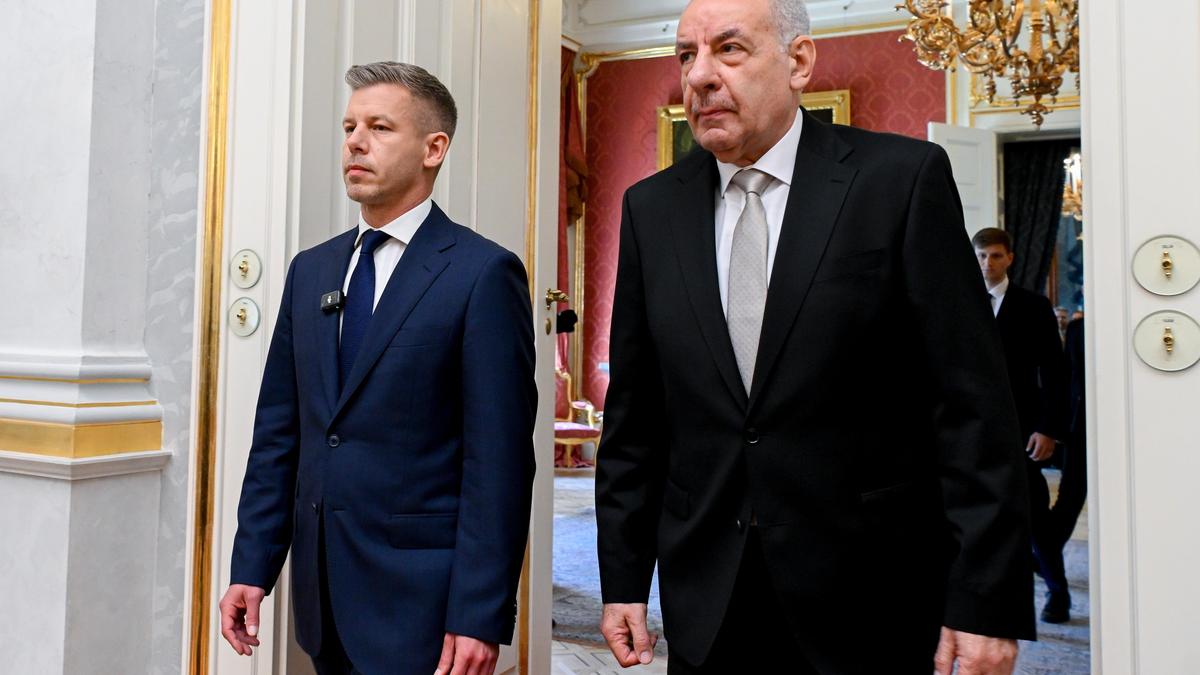
The international press is salivating over the prospect of a constitutional crisis in Budapest. The narrative is already written: Péter Magyar, the insurgent Prime Minister, is launching a frontal assault on Hungary’s legal framework to forcibly evict President Tamás Sulyok. Pundits talk about "institutional warfare" and "the unraveling of the state."
They are fundamentally misreading the board.
What the mainstream commentariat labels a reckless constitutional crisis is actually a highly calculated, legally sound consolidation of power. Magyar is not tearing up the rule book; he is exploiting the exact mechanisms built into it. The assumption that removing a president requires a revolutionary coup or an illegal power grab ignores the realities of Central European parliamentarism.
The Lazy Consensus: "Magyar is Burning the House Down"
Commentators look at Hungary and see a fragile democracy on the brink of collapse because a Prime Minister wants to replace a head of state. This view treats the Hungarian presidency as if it were the American executive—a separate, co-equal branch of government with a deep popular mandate.
It is not. The Hungarian president is elected by Parliament, possesses largely ceremonial powers, and historically serves as a rubber stamp or a symbolic figurehead.
The conventional narrative argues that Magyar cannot legally touch Sulyok without triggering a systemic meltdown because the Prime Minister's party lacks the historic, absolute control over the judiciary that previous administrations enjoyed. They claim that any attempt to amend the Fundamental Law (the Constitution) to shorten the president's term will destroy Hungary's international standing and spark immediate domestic retaliation.
This argument falls apart under scrutiny. It assumes that constitutional amendments are inherently unstable. In reality, the Hungarian Fundamental Law has been amended over a dozen times since its inception in 2011. Amendment is not a crisis; it is standard operating procedure in Budapest.
The Nuance: Constitutional Engineering vs. Authoritarianism
To understand why the mainstream analysis fails, you have to understand the mechanics of Hungarian public law. Under Article 11 of the Fundamental Law, the President of the Republic can be stripped of office through an impeachment process or via a structural amendment to the office itself.
[Mainstream View: Illegal Coup] -> Leads to: International Sanctions & Domestic Chaos
[The Reality: Constitutional Amendment] -> Leads to: Legal Continuity & Power Consolidation
If Magyar’s coalition alters the constitutional requirements for holding the presidency—or modifies the term limits retroactively—it is a lawful exercise of parliamentary sovereignty. It may be aggressive, and it may be deeply polarizing, but it is entirely legal.
I have watched political analysts make this exact mistake across Europe for a decade. They confuse institutional friction with systemic collapse. When a new government takes power on a promise of sweeping reform, clean slaths require moving the obstacles left behind by the old guard. Sulyok represents the institutional hangover of the previous regime. Magyar removing him is not an attack on the rule of law; it is the logical conclusion of a democratic mandate to change direction.
People Also Ask: Dismantling the Flawed Premises
The questions dominating search engines right now reveal just how deeply the public has been misled by superficial reporting.
Can a Prime Minister just remove a President in Hungary?
The short answer is no, a Prime Minister cannot do it by decree. The long answer is that a Prime Minister with a functioning parliamentary majority can alter the legal framework that defines the President's tenure. The mainstream media frames this as a dictatorial overreach. It is actually the supremacy of parliament over a non-elected executive figurehead.
Will this move cause Hungary to face EU sanctions?
The European Union has repeatedly shown that its legal machinery moves at a glacial pace. The EU punishes nations for violating specific treaties, not for restructuring domestic offices via constitutional means. By the time Brussels forms a committee to look into the legality of Sulyok’s removal, a new president will already be sitting in the Sándor Palace, and the political reality will have shifted permanently.
Is Tamás Sulyok protected by judicial immunity?
Immunity protects a president from criminal prosecution for actions taken while in office; it does not protect the office itself from being structurally redefined by the legislature. Confusing personal immunity with structural permanence is a rookie mistake made by journalists who read the first paragraph of a constitution and skipped the rest.
The Strategic Cost of the Move
No contrarian take is worth its salt without admitting the downsides. Magyar's strategy is not risk-free.
- The Economic Premium: Capital markets hate unpredictability. Every time a European nation tinkers with its constitution, the Hungarian Forint faces short-term volatility. Bond yields tick upward because foreign investors price in political risk.
- The Bureaucratic Gridlock: Forcing out a sitting president consumes immense political capital. It delays economic reforms, tax restructuring, and infrastructure projects while the legislative machinery focuses entirely on a high-stakes game of political musical chairs.
But Magyar has clearly calculated that the cost of leaving an adversarial president in office—someone who can veto legislation, delay appointments, and act as a beachhead for the opposition—is far higher than the temporary pain of an international media firestorm.
Stop Misinterpreting Political Will as a Crisis
The establishment wants you to believe that stability means keeping the same people in the same chairs forever. They view any radical shift in institutional power as an existential threat to the state.
This is an illusion. True stability in a parliamentary system comes from alignment between the executive branch and the legislative majority. A government that cannot execute its mandate because of a hostile, holdover president is fundamentally unstable.
Magyar’s move to amend the constitution to remove Sulyok is not a sign of a system breaking down. It is a sign of a system working exactly as designed—allowing the winners of an election to actually govern without being sabotaged by the ghosts of governments past. Stop mourning the fate of an elite bureaucrat and start watching how real power consolidates.