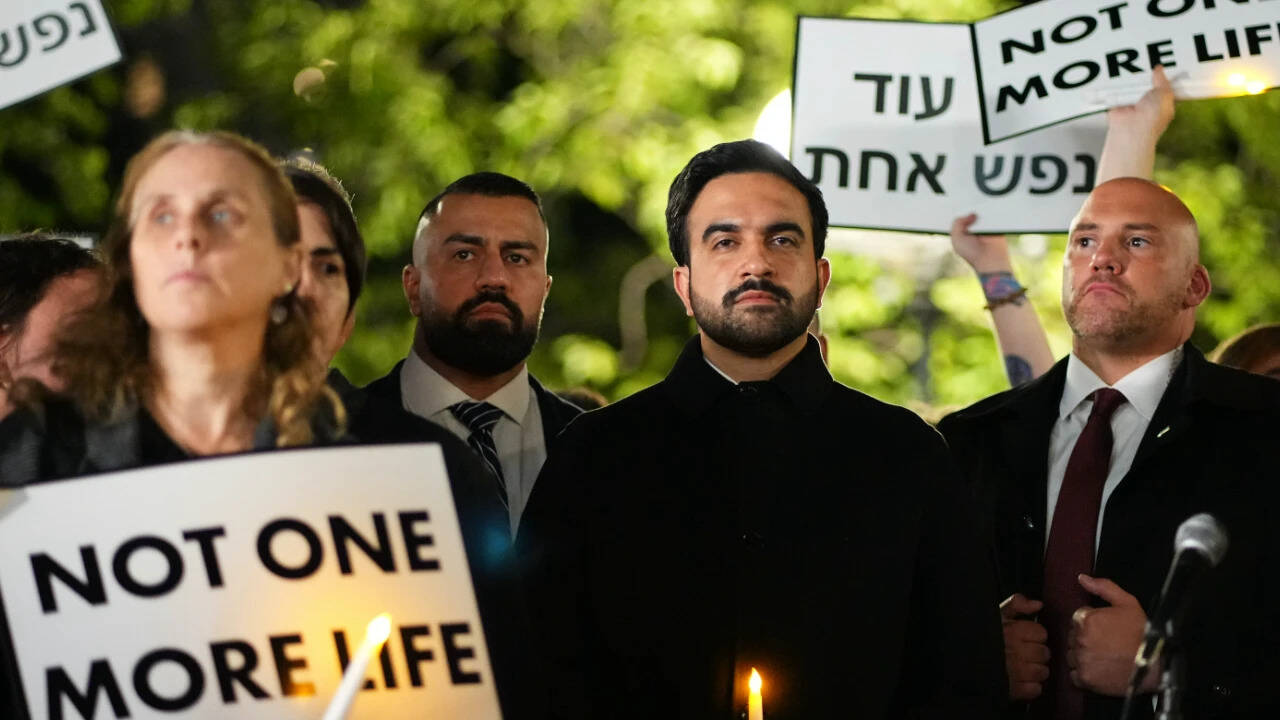
Mainstream political journalism has a terminal addiction to the "both sides" moral panic. Every single October, the press corps dusts off the exact same playbook. Find a progressive lawmaker who refuses to recite the approved, sanitized press release on the Middle East, isolate a single clause from a longer statement, and let the establishment pile on.
That is the entire anatomy of the recent media circus surrounding New York State Assemblymember Zohran Mamdani. You might also find this similar article useful: The Structural Failure of Campus Greek Systems.
The lazy consensus across corporate newsrooms goes like this: Mamdani issued an anniversary statement regarding October 7 that mentioned Palestinian suffering alongside Israeli grief, and prominent Democrats immediately slammed him for "victim blaming." The media frames this as a straightforward breach of political etiquette—a radical rookie stepping on a rake while the adults in the room scold him for lacking basic empathy.
This framing is completely backward. As highlighted in recent articles by The Guardian, the effects are worth noting.
If you actually read the mechanics of modern political communication—and look at the specific wording of Mamdani’s statements versus the curated outrage of his critics—you realize this controversy isn't about empathy. It is a calculated enforcement of ideological conformity. The establishment isn't angry because Mamdani blamed victims. They are angry because he refused to erase the political context that makes their own foreign policy positions uncomfortable.
The Anatomy of a Manufactured Outrage Cycle
I have watched political comms shops engineer these exact firestorms for over a decade. The formula never changes because it works every time on a compliant press corps.
First, a progressive politician releases a statement on a sensitive anniversary. In Mamdani’s case—as a democratic socialist representing Astoria, Queens, and a vocal critic of Israeli government policies—his statements consistently acknowledge the horror of the October 7 Hamas attacks while simultaneously refusing to decouple that day from the decades of military occupation, blockade, and the subsequent devastation in Gaza.
Second, opposition researchers and rival PACs strip away the opening condemnation. They highlight the transition word—"but," "however," or "while"—and treat the mere mention of structural context as an endorsement of terrorism.
Third, moderate Democrats rush to the microphones to perform moral superiority. They drop soundbites about "no excuse for victim blaming," knowing full well that legacy outlets will print the accusation in the headline without ever examining whether the label actually applies.
Let’s define our terms precisely, because the political class relies on linguistic sloppiness to win arguments. Victim blaming occurs when an observer argues that the target of a crime brought the violence upon themselves through their own behavior, clothing, or choices—thereby absolving the perpetrator of moral agency. Causal analysis, on the other hand, examines the political, historical, and material conditions that produce violent conflict without excusing the individuals who commit atrocities.
Conflating the two isn't an accident. It is a deliberate rhetorical shield. When a politician says, "Hamas committed horrific war crimes on October 7, and those crimes occurred within a 75-year system of dispossession and occupation," that is not victim blaming. It is an elementary statement of geopolitical reality. Pretending that history began at 6:29 AM on October 7, 2023, is not moral clarity; it is historical amnesia.
Why the Democratic Establishment Actually Attacked Mamdani
To understand why figures inside the New York Democratic machine—from state party operatives to congressional moderates—went after Mamdani with such ferocity, you have to look at the electoral map of New York City, not the map of the Levant.
New York politics is currently a street fight between two incompatible visions of the Democratic Party:
- The Donor-Class Machine: Built on real estate money, Wall Street alignment, and unconditional institutional support for foreign policy orthodoxy.
- The Multi-Racial Working-Class Insurgency: Powered by small-dollar grassroots fundraising, tenant unions, and a younger electorate that views domestic austerity and foreign military aid as two sides of the same coin.
Mamdani isn't a fringe backbencher yelling into the void. He is a sophisticated organizer who built a massive grassroots apparatus in Queens and launched a credible, high-visibility campaign for Mayor of New York City. He speaks directly to Arab, Muslim, South Asian, and progressive Jewish voters who are disgusted by the party leadership's refusal to condition military aid or acknowledge Palestinian human rights as equal to Israeli human rights.
When establishment Democrats accuse Mamdani of "victim blaming," they aren't defending the victims of October 7. They are trying to quarantine a political threat.
Think about the strategic utility of the smear. If the party leadership debates Mamdani on policy—such as whether New York non-profits should be legally barred from funding illegal settlements in the West Bank, legislation Mamdani actually introduced—they lose among the Democratic base. Polling consistently shows that a majority of Democratic voters favor conditioning aid to Israel and oppose settlement expansion.
So, the establishment avoids the policy debate entirely. Instead, they reframe Mamdani’s refusal to use their preferred script as a character defect. They turn a policy disagreement into a purity test on basic human decency.
The Fallacy of the "Clean" Condemnation
Journalists love to ask progressive politicians why they can't just issue a "clean" condemnation of October 7 without mentioning Gaza, Netanyahu, or the occupation.
Why can't you just mourn for one day without making it political?
This is the wrong question entirely. It rests on the delusional premise that mourning in politics is ever neutral.
Imagine a scenario where a conservative governor issues a statement on the anniversary of a devastating hurricane, offering prayers for the victims while explicitly forbidding anyone from mentioning climate change or gutted infrastructure budgets. Everyone in the media would immediately recognize that "neutral" mourning is actually a political weapon designed to protect the status quo from scrutiny.
The exact same dynamic applies to October 7. Demanding a "clean" statement that isolates the grief of one population while erasing the ongoing mass death of another is not a call for neutrality. It is a demand that the speaker adopt the state department's ideological framing.
When a politician issues a statement that mourns Israeli civilians killed by Hamas and Palestinian civilians killed by the IDF, they are practicing universal human rights. When establishment critics scream that mentioning the second group insults the first, they are admitting—quietly, beneath the outrage—that they view one set of lives as inherently more grievable than the other.
What People Actually Get Wrong About Progressive Foreign Policy Messaging
If you search the web around this controversy, you run into the standard predictable questions: Did Zohran Mamdani condemn Hamas? Why are Democrats divided over October 7? Is criticizing Israel considered victim blaming?
Let’s dismantle these premises with brutal honesty.
First, Mamdani has repeatedly and explicitly condemned the killing of Israeli civilians and the taking of hostages by Hamas. The claim that he hasn't is a flat-out lie propagated by bad-faith actors who know their audience won't read past a screenshot. In political communications, once a lie is repeated by three elected officials on cable news, journalists treat the controversy itself as the news story, absolving themselves of the responsibility to fact-check the premise.
Second, the Democratic Party isn't "divided" in the way pundits describe it. Pundits love to portray this as a generational squabble between pragmatic elders and naive kids on TikTok. That is nonsense. The divide is between elected officials beholden to legacy lobbying networks and a base that relies on independent media, international human rights organizations like Amnesty International and Human Rights Watch, and primary-source video footage from the ground.
Third, international law experts—from the International Court of Justice to veteran diplomats—routinely analyze the structural root causes of asymmetric warfare without anyone accusing them of victim blaming. As former UN officials and scholars like Rashid Khalidi have documented for decades, military occupations inherently generate violent resistance, and states bear legal responsibilities under the Geneva Conventions regardless of the atrocities committed by non-state actors. Stating that reality in a press release doesn't make you an apologist for terror; it makes you literate in international relations.
The Real Flaw in Mamdani’s Approach
To be clear, taking a contrarian stance against the media pile-on doesn't mean pretending Mamdani’s communication strategy is bulletproof. If you want an honest assessment of the battlefield, you have to admit the vulnerabilities of your own position.
The hard truth is that moral nuance gets slaughtered in a 15-second news cycle.
When progressive politicians write long, carefully balanced paragraphs that attempt to hold two complex historical truths in tension simultaneously, they are handing their enemies a loaded weapon. Political opponents don't engage with paragraphs; they extract sentences. By placing a critique of Israeli state policy inside the exact same breath as a remembrance of murdered civilians, Mamdani gave cynical operatives the exact syntax they needed to manufacture a soundbite.
If you are playing a game where the referees are biased and the opposing team owns the stadium, you cannot afford to give them unforced errors on phrasing. You don't abandon your principles, and you never surrender the historical context—but you separate the tactical execution. You speak with ruthless precision so that a hostile editor cannot slice your statement in half without looking overtly fraudulent.
How to Read Political Outrage Like an Insider
The next time a headline tells you that a progressive lawmaker is "under fire" from their own party over a foreign policy statement, stop reading the quotes from their colleagues and run a simple three-step diagnostic:
- Check the full text, never the pull-quote. Find the original statement on the lawmaker’s official social media or press page. Read the first two sentences. Almost without exception, the "missing" condemnation is sitting right at the top, deliberately cropped out by the critics.
- Follow the primary calendar. Outrage in politics is rarely spontaneous. Look at who is running for higher office, who faces a primary challenge, and which PACs just dropped independent expenditure money into the district. Moral panics are almost always campaign commercials disguised as news.
- Look at what the outrage is distracting from. Every hour cable news spends dissecting the syntax of a state assemblymember's tweet is an hour they aren't spending reporting on arms shipments, civilian casualty figures, or domestic housing crises.
The media loves a story about a young socialist getting scolded by party elders because it is safe, theatrical, and requires zero investigative legwork. It turns a life-and-death geopolitical catastrophe into a reality show about tone policing.
Zohran Mamdani didn't blame victims. He refused to pretend that history started yesterday, and the political establishment tried to crucify him for breaking the silence.


