August 6, 1945, started with a forgotten stamp.
Twenty-nine-year-old Tsutomu Yamaguchi had spent three months in Hiroshima designing oil tankers for Mitsubishi Heavy Industries, and he was finally going home. He had packed his bags. He had said his goodbyes to his colleagues, Akira Iwanaga and Kuniyoshi Sato. He was walking toward the train station under a cloudless summer sky when he realized his hanko—the personal wooden stamp required in Japan to authorize travel and sign official documents—was sitting back on his desk at the shipyard.
He turned around.
Think about that small, mundane irritation. Anyone who has ever locked their keys inside a running car or left their passport on the kitchen counter knows that specific, sharp spike of annoyance. You sigh. You check your watch. You retrace your steps. For Yamaguchi, that minor administrative blunder altered the trajectory of his physical body, bringing him to a street corner roughly two miles from the center of Hiroshima at precisely 8:15 in the morning.
Then the sky tore open.
To understand what happened next, you have to strip away the cold, clinical numbers we usually attach to history. When we read that the "Little Boy" uranium bomb detonated with the force of 15 kilotons of TNT, our brains glaze over. Kilotons are an abstraction. Let us ground this in a physical metaphor: imagine standing in front of an industrial blast furnace, except the furnace is the size of a city, and the door is ripped off its hinges in a millionth of a second.
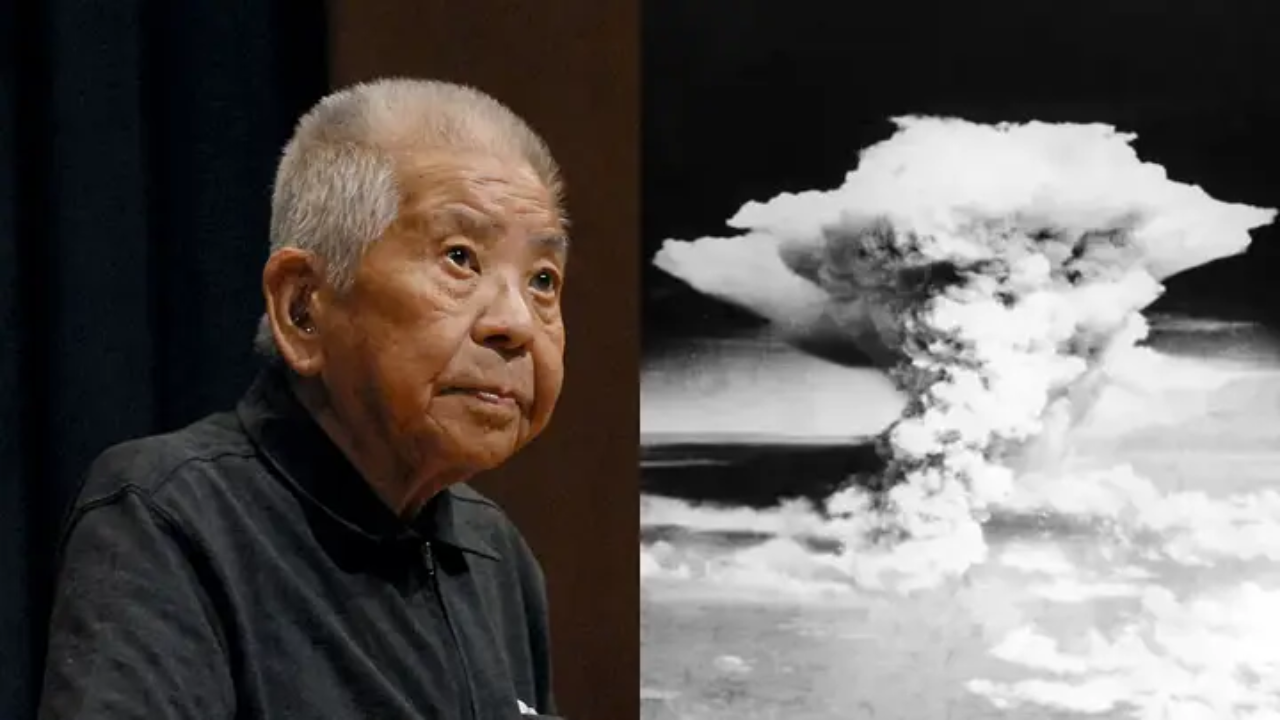
Yamaguchi later described the flash not as a light, but as the glare of a gigantic magnesium flare igniting directly inside his eyeballs. There was no sound at first—light travels infinitely faster than thunder—only a blinding, white-hot silence that instantly blistered the skin off the left side of his face and arms. He threw himself into a roadside ditch, jamming his thumbs into his ears and squeezing his eyes shut just before the shockwave arrived.
The wind hit like a solid wall of concrete. It sucked him upward off the ground, spun him through the air like a dry leaf, and slammed him down into a nearby potato patch.
When he opened his eyes, the morning was gone.
In its place hung a towering, churning column of black ash and radioactive debris that blotted out the sun, turning 8:15 AM into a suffocating, toxic midnight. Black rain—thick, oily, and heavy with fallout—began to fall from the bruised sky. Yamaguchi’s eardrums were ruptured. His skin hung in gray, weeping ribbons from his left arm and cheek. His hair was singed down to the scalp. Yet, driven by a single, primitive instinct to reach his wife, Hisako, and their infant son, Katsutoshi, he crawled out of the dirt and began walking toward the burning ruins of the train station.
The Arithmetic of Impossible Odds
By sheer, desperate luck, he found his two colleagues, Iwanaga and Sato, alive amid the rubble. The three men spent a horrifying night huddled in an air-raid shelter, listening to the moans of the dying and watching fires consume the wooden city. The next morning, August 7, they boarded one of the few functional trains heading south, crossing the shattered landscape toward their home city of Nagasaki.
When Yamaguchi arrived in Nagasaki on August 8, he was unrecognizable. Swathed in thick, clumsy bandages from head to toe, smelling of burnt flesh and antiseptic, he stumbled through his front door. His mother initially thought he was a ghost. His wife wept as she tended to his weeping burns, grateful beyond measure that her husband had beaten the odds and escaped the apocalypse.
We like to believe that survival earns you a reprieve. Deep down, humans operate on an unspoken, superstitious ledger: if you survive a plane crash, lightning will not strike you on the walk home; if you beat cancer, the ceiling will not cave in on your hospital bed. We view catastrophe as a lightning bolt—random, violent, and statistically exhausted once it strikes.
Yamaguchi believed his war was over. He was wrong.
On the morning of August 9, despite his wife pleading with him to stay in bed, Yamaguchi dragged his bandaged, feverish body into the Mitsubishi offices in Nagasaki. Duty, in 1945 Japan, was heavier than pain. At 11:00 AM, he stood in front of his director, a man named Chikao, trying to describe what had happened in Hiroshima three days earlier.
Look at the scene from the director’s perspective. Here was a junior engineer, wrapped like a mummy, claiming that a single American bomb had vaporized an entire metropolis of 350,000 people. To a logical mind in 1945, the claim sounded like head-trauma delirium. A single bomb could destroy a city block, perhaps a factory complex, not an entire city.
"You're an engineer," the director snapped, exasperated by what sounded like hysterical exaggeration. "Calculate it! How could one bomb destroy a whole city?"
Yamaguchi opened his mouth to answer.
At 11:02 AM, the white light returned.
Two Miles From Ground Zero, Twice
Let us pause to examine the physics of this second nightmare. The bomb dropped on Nagasaki, "Fat Man," was a plutonium implosion weapon—even more powerful than the uranium device used at Hiroshima, yielding roughly 21 kilotons. Due to heavy cloud cover over the primary target of Kokura, the B-29 bomber Bockscar had diverted to its secondary target, Nagasaki, releasing the weapon over the Urakami Valley.
Yamaguchi was standing once again roughly two miles from the hypocenter.
When the flash seared through the office windows, Yamaguchi did not need to calculate anything. His body remembered the sequence before his brain could process the terror. Flash. Silence. Shockwave. He dropped flat onto the floorboards seconds before the blast wave blew out the steel-framed windows, sending shards of glass screaming across the room like shrapnel and tearing his bandages clean off his raw, healing skin.
The walls buckled. Plaster rained down in choking clouds. Because he was inside a reinforced concrete stairwell rather than out in the open street, the building absorbed the brunt of the thermal radiation that had burned him three days prior. He survived the initial blast without new fatal burns, though a fresh, massive dose of ionizing radiation slammed straight through his already compromised cells.
When the dust settled, Yamaguchi staggered out into the ruined streets of his own hometown, gripped by a cold, suffocating dread. He had survived twice. Now, he had to find out if his wife and infant son were dead.
He ran toward his neighborhood, stepping over downed power lines and burning timbers, his lungs rasping in the smoke. When he reached his street, his heart stopped. His house was gone—flattened into splinters by the shockwave. Panic clawed at his throat as he began tearing through the wreckage with his bare, blistered hands, shouting for Hisako and Katsutoshi.
Then, from a nearby hillside tunnel, he heard a voice.
Minutes before the bomb fell, Hisako had left the house with their baby to buy burn ointment for her husband’s Hiroshima wounds. When the air-raid sirens wailed, she had ducked into a tunnel shelter dug into the mountainside. Once again, a small, unplanned detour—an errand born out of love and injury—had saved their lives.
The Invisible Fallout
If this were a Hollywood script, the story would end there, with a tearful embrace on a hillside as the war drew to a close six days later. Real life, however, does not offer clean cinematic fade-outs. Survival is not a single event; it is a long, grueling endurance test fought inside the bloodstream.
In the weeks following Japan’s surrender, Yamaguchi’s hair fell out in clumps. His burns turned gangrenous, festering in the late summer heat without antibiotics. He ran a relentless, terrifying fever, vomiting violently as acute radiation sickness ravaged his bone marrow and digestive tract. Every time he closed his eyes, he was back in the black rain.
Consider the psychological weight of becoming a nijū hibakusha—a double atomic bomb survivor. In postwar Japan, survivors faced a quiet, cruel stigma. People feared that radiation sickness was contagious, or that survivors carried tainted blood that would pass genetic deformities to their children. Employers hesitated to hire them; families refused to let their sons and daughters marry them.
For decades, Yamaguchi chose silence.
He buried his trauma beneath the quiet routine of an ordinary life. He worked as a translator for the American occupation forces, taught middle school, and eventually returned to Mitsubishi to design tankers once more. He raised three children—though all of them would suffer from chronic, unexplained illnesses throughout their lives, a silent inheritance from the skies of August 1945. His wife, Hisako, eventually succumbed to liver and kidney cancer in 2008, a disease widely linked to the black rain she had walked through in Nagasaki.
Why did Yamaguchi wait until he was nearly ninety years old to speak publicly about what he had endured?
Because grief needs time to harden into purpose. In 2005, his son Katsutoshi—the baby who had survived Nagasaki inside that mountain tunnel—died of cancer at age fifty-nine. Watching his child waste away from the delayed poison of a war ended sixty years earlier broke something open in Yamaguchi. Silence was no longer a shield; it was complicity.
The Weight of a Single Witness
In 2006, frail and walking with a cane, the ninety-year-old engineer traveled to New York to address the United Nations. He stood before diplomats in tailored suits—men and women who discussed nuclear deterrence in clean, abstract terms like "strategic parity" and "tactical yield"—and laid bare the human cost of their vocabulary.
"I have experienced the horror of the atomic bombs twice," he told the assembly, his voice steady despite his fragile frame. "I survived to tell the truth about what happens when nuclear weapons are used. It is my destiny to keep talking about it until the world realizes that these weapons must never exist."
In March 2009, just months before his death at age ninety-three, the Japanese government formally recognized Tsutomu Yamaguchi as the only person officially certified to have survived both the Hiroshima and Nagasaki bombings. (While roughly 165 people are believed to have been affected by both blasts, Yamaguchi remains the sole individual verified by government records at both hypocenters.)
It is tempting to look at Yamaguchi’s life as a miracle of statistical anomaly—a man who beat one-in-a-million odds twice in seventy-two hours. We love stories of extreme luck because they reassure us that human beings are resilient, that we can walk through fire and emerge intact.
Look closer, though, and the story flips on its head.
Yamaguchi’s survival was not a triumph of human engineering or willpower. It was a razor-thin accident of geography and timing—a forgotten wooden stamp on a desk, a concrete stairwell, a wife stepping out for burn ointment. Remove any one of those microscopic variables by sixty seconds or fifty yards, and Tsutomu Yamaguchi vanishes into the ash alongside more than two hundred thousand other human beings whose names we never learned.
The real lesson of his life is not that a human being can survive two nuclear detonations. It is how terrifyingly fragile every single life is beneath the shadow of weapons designed to erase cities in a blink.
Months before he died of stomach cancer in January 2010, lying in a Nagasaki hospital bed surrounded by his surviving daughters, Yamaguchi was asked what it felt like to carry the memory of two apocalypses for over sixty years. He did not speak of politics, treaties, or military strategy. He simply looked down at his scarred, trembling hands—the same hands that had dug through the splintered ruins of his home looking for his child—and whispered a quiet, urgent plea:
"Pass on the baton."