There are players who rent space in a club's history, and then there are players whose bones become the mortar of the stadium walls.
When Franco Baresi passed away at the age of sixty-six, the seismic shock that rolled across European football was not manufactured by social media algorithms or corporate PR statements. It was the heavy, collective silence of people realizing that a monument had quietly turned to dust. The statistics will be recited like liturgy over the coming days. Seven hundred and nineteen appearances. Six Serie A titles. Three European Cups. A World Cup winner's medal earned at twenty-two, and a heartbreaking runner-up finish twelve years later in America, where he played a final just twenty-two days after tearing his meniscus, defending with a terrifying, hobbled grace.
Numbers lie. Or at least, they whisper when they should scream.
To understand Baresi, you have to go back to a damp, cold morning in Lombardy in 1974, when a slight, quiet teenager walked through the gates of AC Milan's youth facility. They called him Piscinin. The Little One. He was too short for a central defender, too slight to shoulder the brutal physical toll of Italian center-forwards who treated shins like kindling. Scouts looked at him and saw vulnerability. Baresi looked back with an unblinking, terrifying calm.
He didn't tackle because he had to. He intercepted because he had already lived through the next three seconds of the match in his mind before the ball left the midfielder's boot.
Consider what happens when a young player faces his first true crucible. Most fold. When Baresi was just a teenager, he and his brother were orphaned, forced to grow up in the shadow of unimaginable personal grief. That hollow place inside him was filled not with bitterness, but with an ironclad, unyielding resolve. When AC Milan plunged into the abyss of Serie B in the early 1980s amid match-fixing scandals, superstars packed their bags and fled for safer harbors.
Baresi stayed.
Imagine standing in a burning building while everyone else sprints for the exit, and choosing to sit down on the floor to sweep up the ash. That was Baresi. He wore the captain's armband at twenty-two—an age when modern players are still sorting out their social media branding—and he strapped the soul of a failing giant to his back.
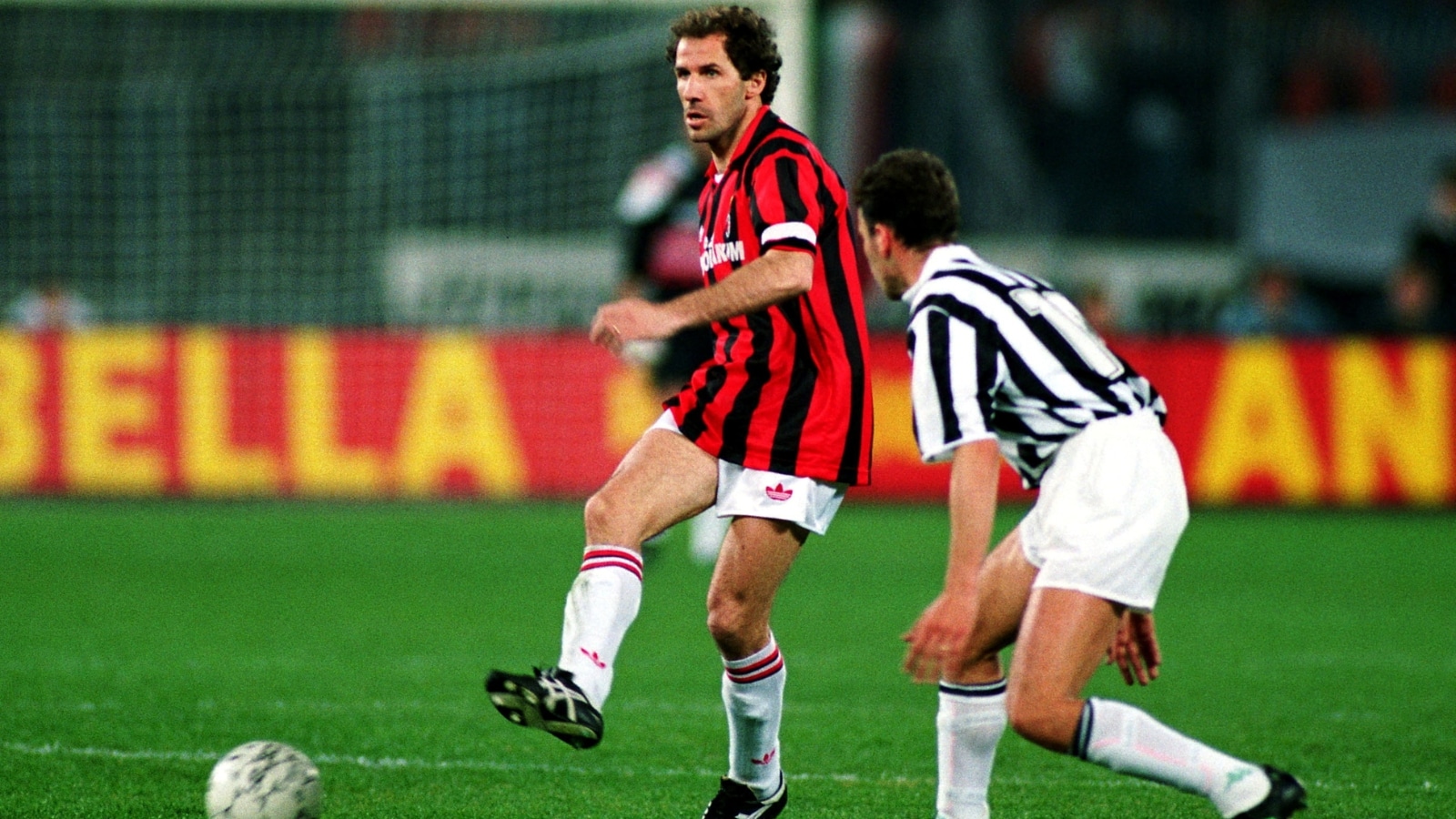
He waited. He suffered through the bleak years of reconstruction. And when the golden dawn broke under Arrigo Sacchi and Fabio Capello, when the San Siro became a roaring cathedral of red and black, Baresi was the quiet architect standing at the center of it all. Flanked later by Paolo Maldini, Alessandro Costacurta, and Mauro Tassotti, he anchored a defensive line that turned the offside trap into high art. Strikers did not just lose matches against Milan; they lost their minds. They ran into a wall constructed entirely of geometry, timing, and quiet authority.
Yet, the most human thing about Baresi wasn't his defensive genius. It was Pasadena, California, in 1994.
Picture the baking midday heat of the World Cup final. Baresi had undergone knee surgery less than a month prior. Medical science said he should have been walking on crutches. Instead, he played one hundred and twenty minutes of flawless, suffocating defense against Romario and Bebeto, collapsing with cramps so severe his legs locked like timber as the final whistle blew. Then came the penalty shootout. He stepped up first for Italy, bloated with exhaustion and physical agony, and skied his shot over the crossbar.
He covered his face with his jersey. He wept.
That image is etched into the collective memory of the sport, not because he failed, but because he dared to carry a nation's weight on a leg that was held together by sheer willpower. He was human. He bled, he missed, he broke. But he never, ever hid.
In his final public appearance earlier this year, a frail but fiercely proud Baresi carried the Olympic torch into the glowing expanse of the San Siro during the opening ceremony of the Winter Games. The stadium rose as one. It was a poetic, heartbreaking curtain call—the eternal captain passing through the arena one last time under a canopy of light and applause, knowing the race was nearly run.
Now, the number 6 shirt hangs in the silent corridors of Milanello, heavy with ghost stories and unspoken reverence.
The club's statement today said that the entire history of AC Milan is in tears. They aren't exaggerating. A piece of the game's conscience died with him. In an era where loyalty is traded for a higher wage packet and clubs are treated like stock portfolios, Franco Baresi remained a fixed point in a spinning universe.
He didn't just play for the badge. He was the ink it was printed with.