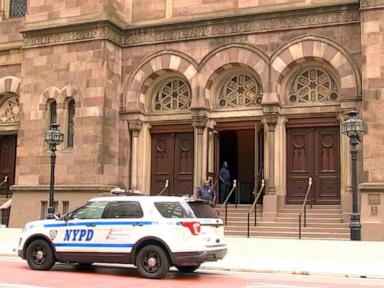
Houses of worship are supposed to be safe havens. Friday night Shabbat services at Central Synagogue in Manhattan shattered that illusion when a local disruption quickly escalated into a violent, bias-motivated attack broadcast live to the world.
Larry Montes, a 46-year-old Bronx resident, didn't just walk into a sacred space and cause a scene. He allegedly targeted worshippers and security staff with explicit anti-Jewish and anti-Black animus. While state charges came down almost immediately, federal prosecutors stepped in hard, filing formal hate crime charges through the U.S. Attorney's Office for the Southern District of New York. This federal intervention highlights a grim truth. When violence breaches the doors of a synagogue, church, or mosque, local charges often fail to capture the full societal weight of the crime.
What Actually Happened Inside Central Synagogue
The incident began just after six in the evening as the congregation gathered for Friday services on Lexington Avenue. Because Central Synagogue livestreams its services, thousands watched the chaos unfold in real time.
Prosecutors state that Montes rushed toward restricted areas, began shouting, and destroyed ritual property—including damaging property valued at thousands of dollars. When security personnel attempted to hustle him out of the sanctuary, the situation turned physical.
Montes allegedly struck a 63-year-old female congregant, knocking her down and leaving her with cuts and forearm injuries. As the security team worked to neutralize the threat, Montes reportedly headbutted and spat on a Black security guard while using racial slurs. An NYPD sergeant working a paid security detail intervened instantly, preventing a far worse tragedy and taking the suspect into custody before anyone suffered life-threatening harm.
The Federal Case Changes the Stakes
State-level charges like assault and criminal mischief as hate crimes carry serious penalties. But federal charges signal a major escalation. The Department of Justice's Civil Rights Division, alongside the FBI and the U.S. Attorney's Office, made it clear that bias-fueled attacks on houses of worship demand federal deterrence.
Montes faces two counts of committing hate crimes and one count of destruction of religious property resulting in bodily injury. Court transcripts from his initial appearance revealed post-arrest statements where he allegedly admitted the assault was motivated by intense religious and racial hatred, explicitly referencing Jewish and Black communities.
When suspects make those kinds of admissions, defense strategies pivot quickly. However, federal hate crime statutes give prosecutors robust tools to bypass standard defense loopholes by proving the attack directly infringed upon civil rights and targeted individuals because of their identity.
Security Realities for Modern Congregations
We live in an era where synagogues and religious centers must operate like fortresses. That reality sucks, but it's true. Central Synagogue had trained security staff and an active police presence on site. That quick response stopped Montes within seconds. Without professional intervention right at the threshold, a chaotic disruption could have turned into a mass casualty event.
Leaders across New York, including Mayor Zohran Mamdani and Governor Kathy Hochul, rushed to condemn the violence, offering standard reassurances about keeping religious communities safe. Condemnations matter, but synagogues need more than political sympathy. They need hardened infrastructure, active threat training, and close coordination with local law enforcement task forces.
Security audits are no longer optional for urban religious institutions. If you manage or attend a house of worship, you have to ask hard questions about access control, livestream safety protocols, and emergency response times. Ignoring these vulnerabilities leaves congregants exposed to individuals driven by erratic behavior and deep-seated bigotry.
The legal system will now run its course with federal and state courts holding Montes accountable for his actions. But the rest of us are left dealing with the uncomfortable reminder that sacred spaces remain prime targets for hatred.