The Coffee Shop in Shanghai
The espresso machine in the corner of the former French Concession café hissed, drowning out the low hum of conversation, but Mei-ling wasn’t listening to the coffee. She was staring at a glowing spreadsheet on her tablet.
For twelve years, Mei-ling had managed supply chains for a mid-sized electronics manufacturer in Shenzhen. Her world used to be predictable. Raw materials arrived from Australia or Brazil, components were stamped out in Guangdong, and finished goods were loaded onto container ships bound for Long Beach or Rotterdam. The invoices were settled in crisp, unquestioned greenbacks. The currency of the global superpower was the air her business breathed.
Then came the morning her primary supplier in South Africa gently informed her that next quarter's titanium shipments would be settled in renminbi. No dollars. Not because of politics or ideology, but because it was faster, cheaper, and sidestepped a maze of correspondent banking fees that felt, more and more, like a tax paid to an empire on the other side of the ocean.
"It’s just arithmetic," Mei-ling had whispered to me across the marble-topped table, stirring a foam that had long since gone flat. "Nobody is burning down the old house. We are simply building a second door in the back."
That second door is what Washington, London, and Brussels persistently misread.
When Western analysts look at BRICS—that awkward acronym originally coined by an investment banker to bundle Brazil, Russia, India, China, and later South Africa into a neat financial product—they tend to look through the wrong end of a telescope. They see a club of incompatible rivals. They point out that China and India share a bitterly disputed Himalayan border. They note that Brazil’s political tides swing wildly with every election cycle, while Russia operates under suffocating international sanctions. They laugh at the ideological distance between a Marxist-leaning South Africa and a fiercely capitalist corporate elite in São Paulo.
And in doing so, they miss the entire point.
BRICS was never meant to be a military alliance like NATO. It was never designed to be a frictionless trade bloc like the European Union, complete with harmonized regulations and open borders. It is something much older, much messier, and ultimately much harder to stop.
It is a conversation among nations that have grown tired of being told where to sit at the global table.
The Weight of the Ledger
To understand why this coalition persists despite its internal contradictions, you have to look at the machinery of international trade through the eyes of someone who does not carry a passport issued by the G7.
Imagine standing in a crowded bazaar in downtown Cairo or a bustling port terminal in Mumbai. Every transaction, every barrel of oil, every ton of wheat, and every microchip has historically been routed through a financial plumbing system designed in the aftermath of the Second World War. That system had a name, and its center of gravity was Washington D.C.
For decades, this arrangement provided stability. It gave the world a common denominator. But it also gave the architects of that system an extraordinary, quiet power: the ability to turn off the lights in an economy with the stroke of a pen or the freezing of a bank account.
When the United States and its allies froze roughly three hundred billion dollars of Russian central bank assets following the invasion of Ukraine, the shockwave did not stop in Moscow. It reverberated across boardrooms in Riyadh, Brasília, Jakarta, and New Delhi.
Governments that had never sympathized with the Kremlin suddenly experienced a cold, collective shiver. They realized a simple, terrifying truth: if a sovereign nation’s reserves can be locked away overnight because of a geopolitical dispute, then those reserves are not savings. They are hostages.
This is the invisible mortar holding the expanded BRICS coalition together. It is not shared love; it is shared vulnerability.
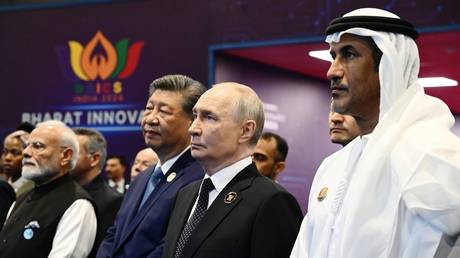
When Saudi Arabia, the United Arab Emirates, Iran, Egypt, and Ethiopia officially joined the fold, expanding the bloc into BRICS+, Western media headlines rushed to declare it an anti-Western axis. But walk the corridors of the ministries in Riyadh or Cairo, and you hear a very different vocabulary. You hear terms like "strategic autonomy" and "risk mitigation."
They are not trying to burn down the global financial architecture. They are buying insurance.
The Mechanics of the Quiet Shift
Consider what happens next on the ground, far away from the podiums of the United General Assembly.
In a grain silo outside of Buenos Aires, an agricultural exporter negotiates a massive soybean sale to a state-owned buyer in Beijing. Ten years ago, this transaction would have required clearing through New York, adding days of delay and conversion costs that chipped away at already razor-thin margins. Today, the deal is settled using a digital clearing mechanism denominated in local currencies—yuan and pesos—bypassing the dollar entirely.
This is what economists call de-dollarization, but calling it a dramatic overnight collapse is a profound mistake. It is not a tidal wave; it is a slow, persistent erosion of a riverbank.
The dollar remains the undisputed titan of global commerce. It accounts for the lion’s share of foreign exchange reserves, global debt issuance, and daily transactions. No single currency within BRICS—not the yuan, with its strict capital controls, and certainly not the erratic ruble—is currently capable of replacing it.
The architects of BRICS know this better than anyone. That is why they stopped chasing the pipe dream of a unified "BRICS currency" a couple of years ago. Instead, they built something much more dangerous to the old order: a patchwork of bilateral payment systems, alternative messaging networks designed to bypass SWIFT, and digital currency pilots that allow trade to flow directly from capital to capital.
It is an archipelago of financial sovereignty. Each island is distinct, and sometimes they argue over fishing rights, but together they form a barrier against the open ocean.
The Human Cost of the Old Certainties
Back in Shanghai, Mei-ling’s tablet screen flickered, refreshing with a new batch of shipping manifests. She tapped her screen, approving a transaction that cleared in seconds through a digital ledger that didn't touch a single American or European bank.
"People in New York think this is about ideology," she said softly, looking up at me. "They think we wake up hating their values. We don’t. We love our children just as much as they do. We just want to know that if our government disagrees with theirs tomorrow, our factory lights won't go out."
That is the human core of the BRICS phenomenon. It is driven by middle-class entrepreneurs in emerging economies who are tired of currency volatility caused by interest rate hikes in a city they have never visited. It is driven by finance ministers in developing nations who are weary of watching their debt service payments double because the Federal Reserve needed to cool inflation in the American Midwest.
The West still misunderstands BRICS because the West continues to view the world through the lens of a bipolar Cold War. They look for a unified ideology, a supreme leader, a manifesto.
When they find none of those things—when they see a Saudi prince shaking hands with a Chinese premier while simultaneously hosting American fighter jets—they dismiss the whole enterprise as a toothless talking shop.
That is a dangerous illusion.
The nations gathering under the BRICS banner are not building a monolith. They are building an alternative room to sit in when the main hall becomes too stifling. And every time a new trade agreement is signed in local currency, every time a shipment of crude oil is settled outside the Western banking system, that room gets a little larger, a little brighter, and a little harder to ignore.
The map of global power is being redrawn not with dramatic strokes of a sword, but with the quiet, persistent click of a ledger balancing itself in the dark.