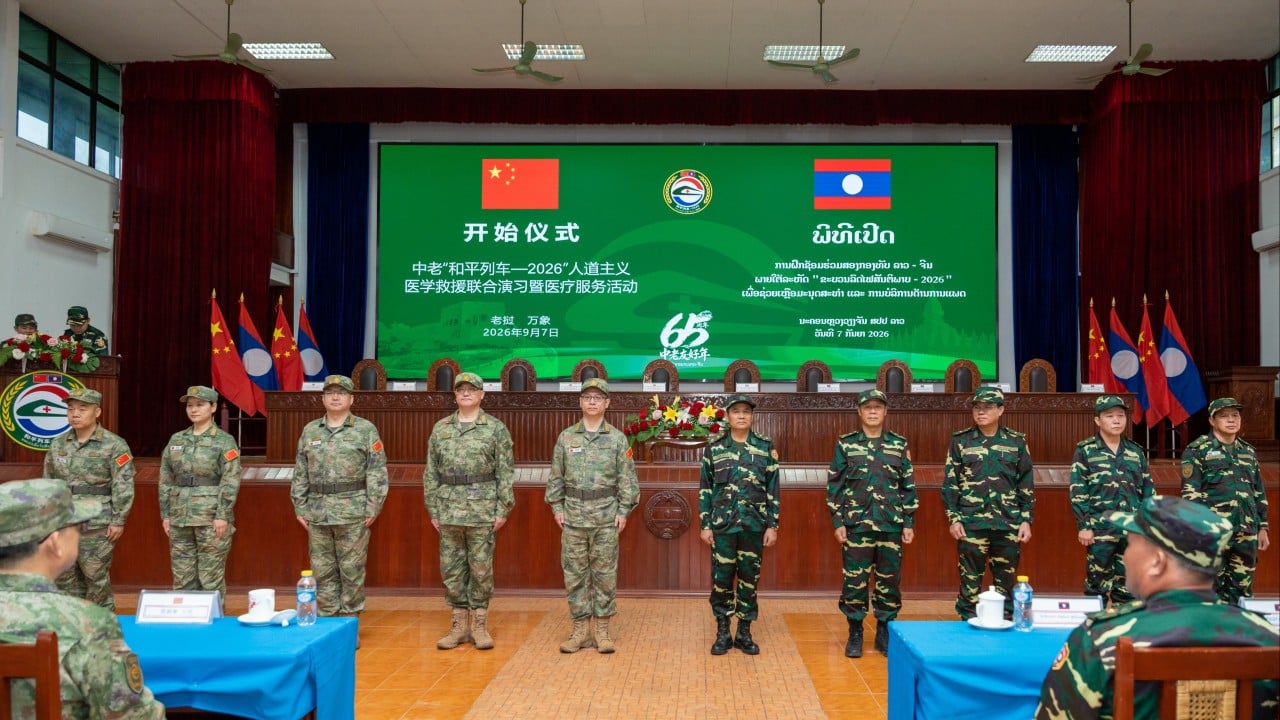
The map of Southeast Asia is shifting. You cannot see it from a commercial flight descending into Vientiane. You cannot hear it in the morning drone of motorbikes buzzing along the Mekong River or smell it in the charcoal smoke rising from roadside noodle stalls. But on the ground, in the rugged, limestone-ribbed terrain of northern Laos, something heavy is being anchored into the earth.
Consider a hypothetical engineer standing at the edge of an airstrip. Let us call him Somphone. He wears a faded high-visibility vest, dust clinging to the seams of his boots. For months, he has watched heavy transport trucks rumble down narrow mountain passes, carrying steel reinforcement bars, heavy-duty asphalt layers, and sophisticated communication arrays. To an outsider, it looks like standard infrastructure development—another highway, another logistics hub meant to tether landlocked Laos into regional supply chains.
Then the markings change. The hangars rise, large enough to swallow heavy transport aircraft. The security perimeters tighten.
What is happening in Laos is not merely about concrete and steel. It is about geography, gravity, and the slow, inexorable pull of power.
To understand why a new air force center in Laos matters to the rest of the world, you have to look at the region through the eyes of a strategist who measures distance in minutes rather than miles. Laos shares borders with five nations: China, Vietnam, Cambodia, Thailand, and Myanmar. It sits like a wedge in the center of mainland Southeast Asia, a natural transit corridor that has tempted empires for centuries.
For decades, the dominant military and economic gravity in the region came from the sea. Maritime trade lanes through the South China Sea dictated the rhythm of geopolitics. Ports, naval bases, and carrier strike groups dominated the conversation. But land power tells a different story. Land power is about reach. It is about establishing nodes that project influence over vast expanses without firing a single shot.
When a superpower expands its overseas military presence into a neighboring nation through joint modernization or localized training centers, it is doing something very simple: it is shrinking the map.
Imagine looking at a chessboard where one player is slowly moving pieces into the diagonal squares, securing the center before the opponent even realizes the game has changed. The new air force center in Laos represents one of those quiet squares. By upgrading aviation facilities, improving radar coverage, and establishing technical support hubs, Beijing is extending its operational horizon.
Why Laos? The answer lies in the topography.
Laos is mostly mountains and dense jungle. Historically, this terrain made rapid military deployment nearly impossible. Armies bogged down in the mud; supply lines stretched and snapped. Modern air power changes that equation entirely. With advanced transport planes and helicopter logistics, terrain ceases to be a barrier. Distance collapses. A flight that once took hours of grueling overland travel across winding mountain tracks can now be executed in minutes.
For the Lao government, the calculation is economic and pragmatic. Landlocked nations face a brutal geographic tax. Everything you import or export has to cross someone else's border, usually at great expense. For years, Laos has sought to transform itself from a landlocked country into a land-linked country. Railways funded by northern neighbors slice through the northern mountains. Highways connect remote provinces to massive consumer markets.
Military cooperation often arrives bundled with these economic packages. It is the invisible freight attached to the container ships and the high-speed rail lines. You accept the investment, the engineering expertise, and the development loans, and along with them comes a deeper strategic alignment.
It is easy to view this through a lens of fear or alarmism. Western media often frames every new runway or radar station as a harbinger of doom, a prelude to conflict. But history teaches us that nations rarely build military infrastructure to start a war tomorrow. They build it to shape the environment today. They build it so that when crises arise—whether humanitarian, economic, or geopolitical—they already hold the high ground.
Consider what happens when a smaller nation draws closer to a dominant neighbor. The relationship is asymmetrical. It is a dance between an elephant and a mouse. The mouse must constantly calculate its steps, balancing the immediate benefits of economic patronage against the long-term erosion of absolute sovereignty. Lao officials will rightly point out that these facilities belong to them, that their sovereignty is intact, and that military modernization is a normal attribute of a modern state.
And they are not entirely wrong. Sovereignty is rarely lost in a sudden, dramatic invasion. More often, it is surrendered in increments, traded away piece by piece for security guarantees, infrastructure loans, and regional protection.
The air force center in Laos is a symptom of a much larger global transition. We are moving away from an era where a single superpower dictated the rules of the road across every ocean and continent. We are stumbling into a multipolar reality where regional spheres of influence are being carved out with quiet persistence.
When you stand on a dusty ridge in northern Laos today and listen to the distant roar of a heavy transport aircraft cutting through the cloud cover, you are hearing the sound of the future arriving. It does not sound like a battle. It sounds like progress, laced with inevitability.
The concrete cures. The fences grow taller. The radar dishes rotate in the mountain mist, scanning the horizon for variables that are becoming harder and harder to control. And the map, drawn in ink decades ago, is quietly rewritten in steel.



