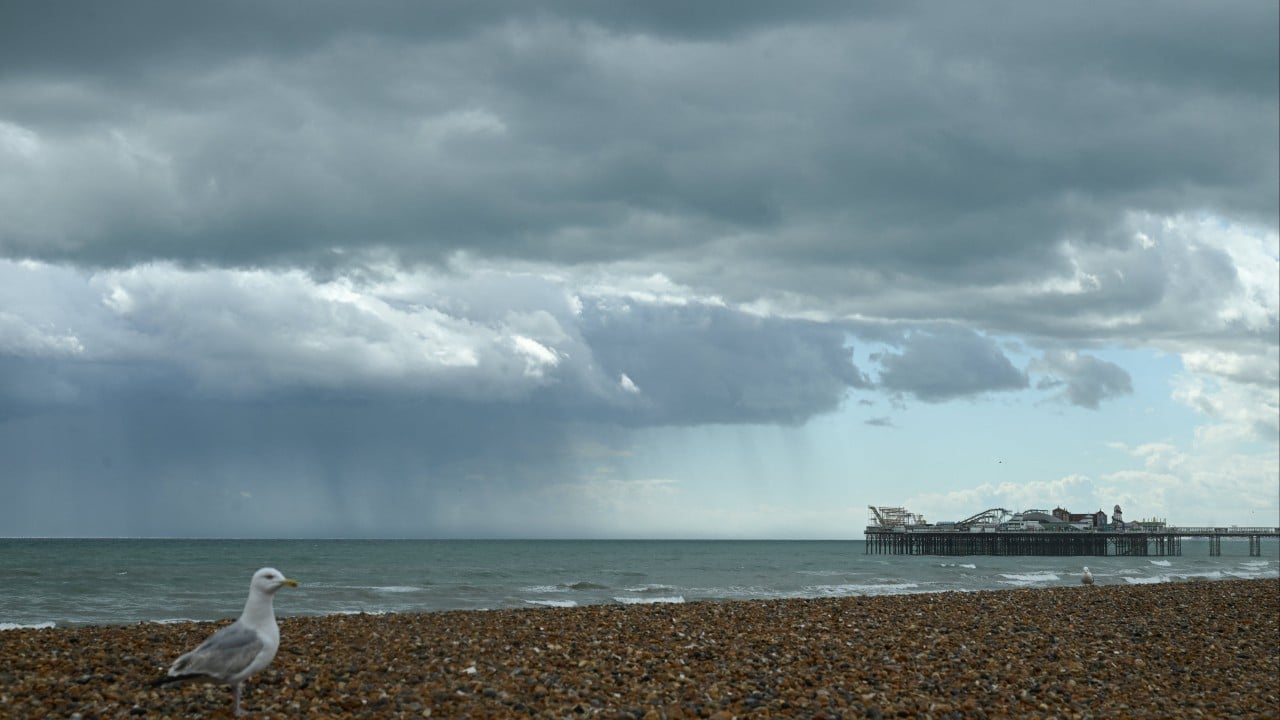
The recovery of three female casualties from the waters off Brighton constitutes a catastrophic failure of the maritime safety-survival chain. While media narratives focus on the emotional weight of such events, a rigorous analysis identifies a breakdown in three distinct operational phases: the Detection Window, the Environmental Exposure Curve, and the Extraction Efficiency. When these three variables align negatively, the probability of a successful Search and Rescue (SAR) outcome drops toward zero. Understanding this incident requires moving past the surface-level reportage and examining the structural mechanics of maritime risk management in high-traffic coastal zones.
The Mechanics of the Detection Window
The primary determinant of survival in a maritime incident is the duration between the initial distress event and the arrival of professional assets. This is the Detection Window. In the Brighton case, the recovery of three bodies suggests a significant delay in the notification phase or an inability to localize the subjects before they succumbed to environmental stressors.
Coastal surveillance relies on a multi-modal sensor network comprising visual observers, radar, and Automatic Identification Systems (AIS). However, human beings in the water represent "non-cooperative targets." They lack AIS transponders and possess a negligible radar cross-section.
- Sea State Interference: As wave height increases, the ability of surface-based radar to distinguish a human head from "sea clutter" diminishes.
- Visual Limitations: From a shoreline or vessel perspective, a human head is approximately 0.07 square meters of visible surface area. In a turbulent English Channel environment, this makes visual acquisition statistically improbable beyond a few hundred meters without high-altitude thermal imaging.
- Thermal Crossover: During specific times of day, the temperature of the water and the temperature of the human body (as seen through infrared) can reach a point of "thermal crossover," where sensors struggle to differentiate the subject from the background environment.
The Environmental Exposure Curve
The English Channel is a hostile thermal environment. Survival is not a binary state but a decaying function of time against water temperature. At the temperatures typically found off the UK coast (averaging $10^\circ C$ to $15^\circ C$ depending on the season), the physiological response follows a predictable, lethal trajectory.
Cold Shock Response
The first 60 seconds of immersion trigger the "Cold Shock Response." This is a physiological reflex characterized by gasping and hyperventilation. If a person’s mouth is underwater during these involuntary gasps, they aspirate water immediately. This stage accounts for a high percentage of "instant" drownings before any rescue asset can be deployed.
Cold Incapacitation
Between 5 and 15 minutes of immersion, the body prioritizes core temperature by constricting blood flow to the extremities. Muscles and nerves in the arms and legs cool rapidly, leading to a loss of manual dexterity and the inability to swim or hold onto flotation devices. This "swim failure" occurs long before hypothermia sets in.
Hypothermia and Loss of Consciousness
True hypothermia—the drop in core body temperature below $35^\circ C$—takes longer, often over 30 minutes to an hour. However, in the absence of high-buoyancy personal flotation devices (PFDs), the loss of consciousness during this phase leads directly to airway submersion. The recovery of multiple bodies simultaneously indicates that the subjects likely reached the "Cold Incapacitation" or "Hypothermia" thresholds concurrently, suggesting a shared immersion event.
Structural Failures in Coastal Risk Mitigation
The Brighton incident highlights a mismatch between public accessibility and emergency response density. The "Pillars of Coastal Safety" are built on the assumption of rapid intervention, yet these pillars are frequently undermined by structural bottlenecks.
- The Information Gap: Incident reporting often relies on "vague sightings" by members of the public. This creates a high noise-to-signal ratio for HM Coastguard. Without precise GPS coordinates, SAR assets must execute "Expanding Square" or "Creeping Line" search patterns, which are time-consuming and resource-intensive.
- Asset Allocation and Launch Latency: The RNLI and Coastguard helicopters operate with high efficiency, but the "launch-to-on-scene" time is fixed. If the immersion event occurs at the edge of a response radius, the Environmental Exposure Curve will almost always outpace the SAR assets.
- The Multi-Casualty Complexity: Managing a single person in the water is a standard operation. Managing three distinct casualties requires an exponential increase in coordination. Recovery vessels must stabilize one individual while maintaining visual contact with the others—a task that becomes nearly impossible in high winds or deteriorating light.
The Geography of Risk: The English Channel Bottleneck
Brighton is situated along one of the world's busiest shipping lanes. This creates a high-density maritime environment where the risks are not limited to recreational swimming.
The interaction between tidal flows and underwater topography near the Sussex coast creates "rip currents" and unpredictable "longshore drifts." These physical forces act as a conveyor belt, moving casualties away from their point of entry faster than shore-based observers can track. The "Drift Vector" is calculated based on:
$$D = (W \times C_w) + T$$
Where $D$ is the total drift, $W$ is wind velocity, $C_w$ is the windage coefficient of the object, and $T$ is the tidal current. For a human body, which is mostly submerged, the tidal current ($T$) is the dominant force. In the English Channel, these currents can exceed 3 knots, meaning a casualty can be moved several kilometers in a single hour.
Policy and Operational Implications
To prevent the recurrence of multi-casualty events, the focus must shift from "Rescue" to "Early Detection and Barrier Analysis." Relying on the bravery of lifeboat crews is a reactive strategy that fails when the math of immersion wins.
- Autonomous Surveillance: Implementation of shore-linked UAVs (drones) equipped with AI-driven thermal detection could close the Detection Window. These systems can be deployed faster than helicopters and can hover over a localized area to provide a continuous visual fix for surface vessels.
- Localized Current Mapping: Real-time public access to high-resolution tidal data at high-risk entry points. If the "Drift Vector" for a specific hour is high, the area should be operationally cordoned or heavily monitored.
- Standardization of "Cold Water Literacy": Public safety campaigns often fail because they emphasize "danger" rather than "mechanics." The public must understand that "Swim Failure" occurs in minutes, regardless of swimming ability.
The recovery of these three women is not merely an isolated tragedy; it is a data point confirming that our current coastal safety margins are razor-thin. When environmental conditions, detection delays, and physiological limits intersect, the outcome is mathematically predetermined.
The strategic imperative for maritime authorities is the aggressive integration of automated detection technology to truncate the time between immersion and localization. Until the Detection Window is reduced to under ten minutes, the English Channel will remain a high-fatality environment for any unplanned immersion. Operations must prioritize the deployment of persistent, sensor-rich surveillance over traditional reactive patrolling to shift the odds back in favor of human survival.