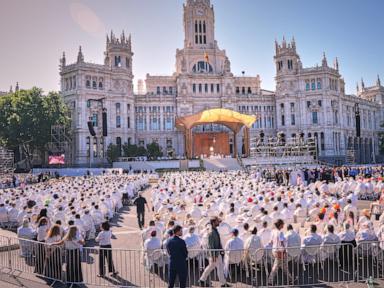
More than one million people packed the streets of Madrid. It was loud, hot, and completely overwhelming. When Pope Benedict XVI visited Spain for World Youth Day, the sheer scale of the turnout caught global media outlets completely off guard. Most secular commentators predicted a muted response in a rapidly secularizing Europe. They were wrong.
When a crowd hits seven figures, it ceases to be just a religious service. It becomes a massive logistical puzzle and a profound sociological statement. Millions of people do not show up in the scorching heat just to hear a speech they could stream on their phones. Understanding why these massive events still draw historic numbers tells us something vital about our human need for shared experiences.
The Reality of Managing One Million People in Madrid
Planning for a million people is a nightmare. Most cities struggle when a football stadium lets out 80,000 fans. Scale that up by more than ten times, and the infrastructure begins to bend. During the iconic Cuatro Vientos airfield Mass, organizers had to deal with a sudden, violent rainstorm that knocked out the sound system and damaged some of the temporary structures.
The logistics behind the scenes required years of coordination between the Vatican, municipal police, emergency medical services, and transit authorities.
- Over 10,000 volunteers managed crowd control and water distribution.
- Emergency services treated thousands of attendees for heat exhaustion before the storm hit.
- The metro system ran at maximum capacity for days without a total breakdown.
Many critics pointed to the heavy taxpayer cost of securing such a massive event during economic uncertainty. Spanish authorities countered that the influx of international tourists brought a massive boost to local hospitality businesses. Hotels, restaurants, and convenience stores saw record-breaking revenue over the week-long event.
The Secularization Myth and the Power of Visible Community
For decades, sociologists argued that Europe was leaving religion behind for good. Spain, traditionally deeply Catholic, saw a massive cultural shift toward secularism following its transition to democracy in the late twentieth century. Church attendance numbers among youth had been dropping steadily.
Then a million young people showed up.
This creates a fascinating paradox. While weekly parish attendance might be declining, the desire for high-stakes, communal expressions of faith is actually growing. People want to feel part of something larger than themselves. Sitting alone in a pew can feel isolating. Standing in an airfield with a million peers from every continent creates an entirely different psychological effect. It validates their identity in a world that often ignores or ridicules it.
The iconic procession of traditional religious floats, known as pasos, bridged the gap between ancient Spanish culture and modern youth culture. These heavily carved, centuries-old artworks were brought out of their home cities, like Seville and Valladolid, specifically for the event. Seeing these historical artifacts surrounded by tech-savvy teenagers created a striking visual contrast. It proved that ancient traditions can still command massive attention if presented on a grand scale.
What Event Organizers Can Learn from the Vatican
You don't need to be organizing a papal visit to learn from the success of the Madrid gathering. Whether you are planning a massive music festival, a political rally, or a tech conference, the core human motivators remain identical.
First, prioritize shared discomfort as a bonding tool. That sounds counterintuitive. It is true, though. The attendees who endured the blistering heat and the sudden torrential downpour together formed tighter bonds than those who stayed in air-conditioned hotels. Psychologists call this the shared adversity effect. It turns a crowd of strangers into a community.
Second, embrace high production values alongside deep tradition. The event succeeded because it paired massive video screens and state-of-the-art pop stages with ancient liturgy and historical art. It did not try to be entirely modern, nor did it stay stuck completely in the past.
If you want to experience the energy of a historic public gathering without the intense logistical headaches, start small. Look into local cultural processions or major regional festivals in your area. Observe how the organizers handle crowd flow, and notice the specific moments that cut through the noise to capture the crowd's absolute attention.