Conventional naval architecture remains anchored to a century-old industrial paradigm. Traditional maritime manufacturing requires fixed shipyards, specialized tooling, intensive fiberglass layup, and extensive pools of skilled manual labor. For expeditionary and forward-deployed military forces, this centralized model creates severe operational vulnerabilities. When a maritime platform is damaged in a contested theater, the logistics chain required to deliver a replacement hull stretches thousands of miles back to continental industrial bases.
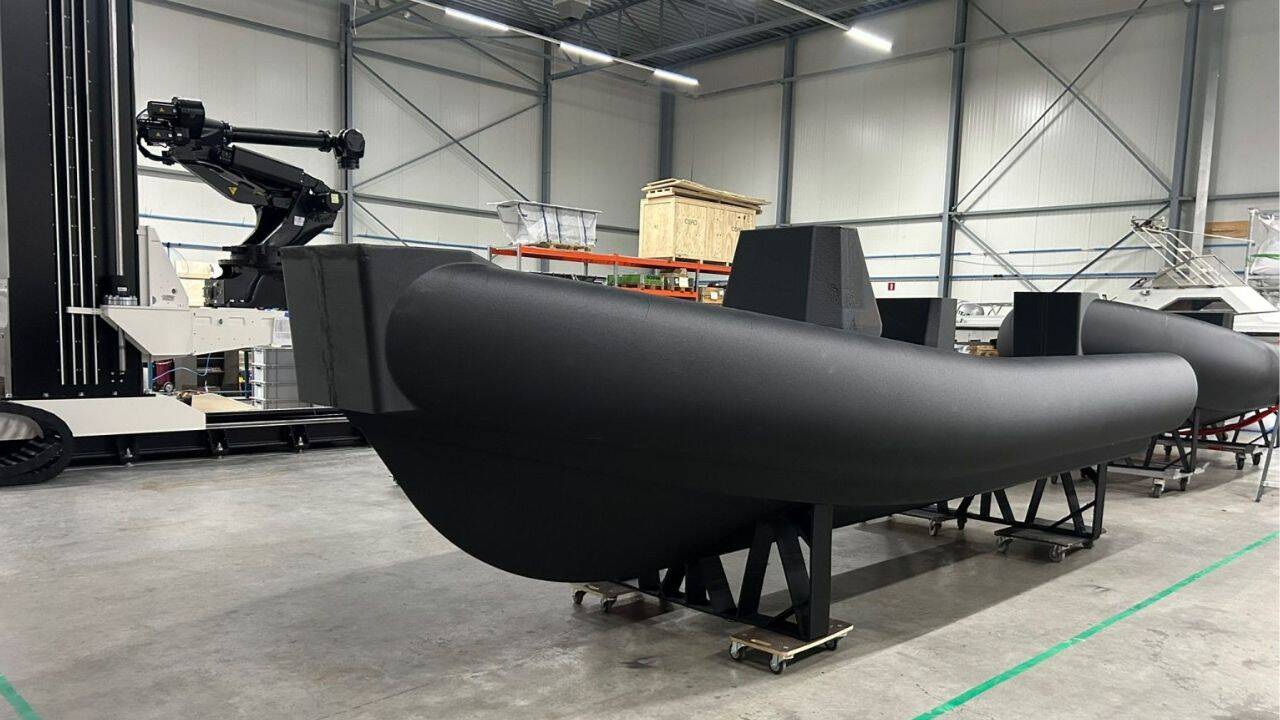
Voltage Vessels, a Hawaii-based advanced materials and manufacturing startup, has introduced an alternative structural paradigm centered on large-format additive manufacturing, recycled polymers, and basalt fiber reinforcement. By submitting a six-meter rigid-hull inflatable boat (RHIB) and uncrewed aerial and surface assets for United States defense evaluation, the firm has forced a technical examination of how tactical marine assets are sourced, built, and deployed. Analyzing this shift requires deconstructing the underlying material science, the logistics economics of distributed fabrication, and the electromagnetic profile of volcanic mineral composites.
The Material Physics of Basalt Reinforced Thermoplastics
The core innovation of this manufacturing model is not the printer itself, but the feedstock composition. Designated as Eclipse X9, the proprietary composite blends recycled polyethylene terephthalate glycol (PETG) with chopped basalt fibers derived from volcanic rock.
In structural composites, performance is dictated by the transfer of load from a continuous or semi-continuous matrix to a high-modulus reinforcement fiber. Basalt fiber is produced by crushing and melting volcanic igneous rock at approximately 1,500 degrees Fahrenheit, then extruding the melt through platinum-rhodium bushings to form continuous filaments. Unlike carbon fiber or fiberglass production—both of which involve intensive chemical synthesis and energy-heavy precursor processing—basalt manufacturing requires minimal chemical additives, positioning it as an environmentally stable alternative with high thermal and chemical inertness.
Independent testing conducted by the University of Maine Advanced Structures and Composites Center quantified the mechanical characteristics of the material under standardized project protocols. Key material metrics demonstrate distinct performance advantages over standard print-grade thermoplastics:
- Tensile strength along the primary print direction reaches approximately 108.2 megapascals, compared to baseline marine print materials like HDPro which register roughly 49.2 megapascals.
- Bending strength measures 112.98 megapascals, outperforming wood-filled and standard PETG variants by a factor of nearly two.
- Environmental durability testing involving prolonged saltwater immersion exceeding 24 months demonstrated a retention of greater than 90 percent of structural strength, paired with a water absorption rate below 0.4 percent.
The low water absorption rate is critical for marine structures. High moisture intake in polymer matrices leads to plasticization, dimensional swelling, and interfacial debonding between the fiber and the matrix. By maintaining a stable interface, the composite resists the cyclical degradation common to marine operational environments.
Electromagnetic and Operational Signatures
Beyond mechanical strength, military adoption of marine platforms relies heavily on electromagnetic compatibility. Traditional naval construction utilizes aluminum or carbon fiber. Aluminum presents high radar reflectivity, requiring specialized stealth shaping or radar-absorbent coatings. Carbon fiber composites, while strong and lightweight, are electrically conductive; they reflect radio frequency energy and can severely interfere with onboard communications, sensor suites, and navigation arrays.
Basalt fiber composites possess a low dielectric constant and are fundamentally non-conductive and non-magnetic. This yields distinct operational attributes for uncrewed surface vessels and autonomous maritime systems:
- Radar transparency minimizes the backscatter cross-section without requiring secondary absorbent layers.
- Radio frequency permeability ensures that internal or flush-mounted antennas for satellite communications, GPS, and telemetry operate without attenuation or signal distortion caused by hull shielding.
- Resistance to galvanic corrosion eliminates the electrochemical degradation that occurs when dissimilar metals interact in saltwater environments, reducing maintenance intervals for autonomous units deployed for long-duration missions.
The Economics of Distributed Maritime Logistics
The strategic rationale for additively manufactured hulls extends beyond material performance into the economics of the supply chain. Traditional military procurement operates on a centralized scale economy: hulls are built in high-volume, fixed-location facilities in the continental United States, then shipped via strategic airlift or sealift to operational theaters.
In a contested logistics environment—such as the Indo-Pacific—this model introduces high latency and vulnerability. A centralized supply chain breaks down when maritime chokepoints are threatened or transport assets are constrained.
The distributed manufacturing model resolves this bottleneck through digital inventory management:
- Design files are transmitted securely over standard military networks to regional fabrication nodes, eliminating the physical transport of finished hulls.
- Large-format industrial gantry printers, such as those produced by CEAD, utilize local feedstock to extrude structural components on demand.
- Production scaling targets up to 15,000 metric tons of annual compounding output from domestic and regional partner nodes, translating to millions of filament equivalents capable of supporting localized fabrication networks.
This framework shifts capital expenditure away from massive shipyard infrastructure toward modular, mobile production cells.
End-of-Life Material Loops
Military supply chains generate significant logistical footprints regarding waste disposal and asset retirement. Traditional fiberglass and carbon fiber composites are notoriously difficult to recycle, frequently ending up in landfills or requiring energy-intensive incineration.
Because Eclipse X9 is built upon a thermoplastic PETG matrix rather than a thermoset resin (such as epoxy or polyester), the material can be reheated and remelted without suffering catastrophic molecular degradation. Thermoset composites permanently cure through chemical cross-linking, rendering them unreformable. Thermoplastics allow damaged hulls, obsolete hulls, or manufacturing scrap to be mechanically shredded, re-compounded, and extruded into new assets. This closes the material loop in forward operating bases where waste management presents an operational hurdle.
Strategic Outlook for Defense Integration
Integrating additively manufactured basalt-composite hulls into formal military architecture requires overcoming institutional conservatism within defense procurement channels. Military specifications are historically optimized for traditional metals and autoclave-cured laminates, requiring lengthy validation cycles before operational deployment.
The ongoing evaluations of 6-meter rigid-hull inflatable boats and uncrewed drone prototypes mark the transition from academic material testing to operational stress-testing. If these platforms clear military certification, the implications will alter naval logistics: manufacturing will decentralize, asset replenishment will compress from months to hours, and the structural dependency on mainland industrial bases will permanently recede.