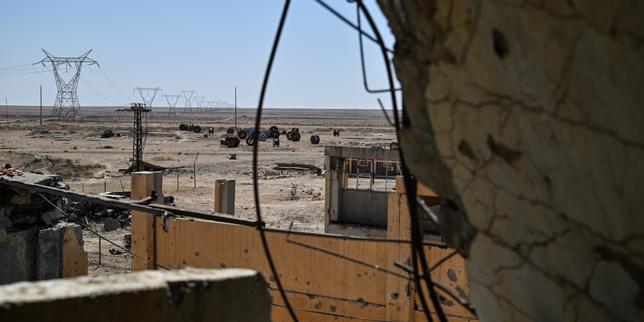
International atomic inspections operate under rigid verification protocols designed to catch undeclared fissile material production before state actors cross the weapons threshold. Recent findings by the International Atomic Energy Agency regarding the Al-Kibar site in the Deir ez-Zor province of Syria confirm that underground cooling infrastructure uncovered during recent excavations matches the physical signature of a graphite-moderated nuclear reactor. This evaluation validates historical intelligence assessments concerning the facility destroyed by Israeli aircraft in September 2007, while exposing structural blind spots in how international safeguards track covert nuclear engineering.
The Architecture of Covert Compliance For a more detailed analysis into this area, we suggest: this related article.
State actors attempting to construct clandestine reactors face a difficult optimization problem: balancing thermal efficiency against visual and electronic signature suppression. A nuclear reactor operating at scale requires massive thermal dissipation systems. At Deir ez-Zor, the blueprint relied on a gas-cooled, graphite-moderated design functionally modeled after North Korea’s Yongbyon architecture.
The primary components identified in the recent IAEA evaluations include: For broader context on the matter, in-depth coverage can be read at BBC News.
- Core cooling channels designed for high-volume fluid circulation without drawing commercial power grid anomalies.
- Structural shielding configured to contain intense neutron flux while avoiding standard heavy-water or light-water pressure vessel footprints.
- Associated fuel fabrication infrastructure capable of producing natural uranium metal elements tailored for low burn-up plutonium extraction.
The detection mechanism relies heavily on environmental sampling of anthropogenic uranium particles and structural remnants. When inspectors gain physical access after decades of concealment, the physical evidence left in subsurface concrete vaults provides an immutable audit trail. Heavy shielding and specialized coolant intake configurations cannot be repurposed for conventional military applications, breaking the plausible deniability defense maintained by the former Syrian regime.
The Verification Bottleneck
The timeline from the initial kinetic strike in 2007 to the definitive confirmation of cooling infrastructure in 2026 highlights a systemic vulnerability in global non-proliferation monitoring. Inspectors face three distinct operational constraints when evaluating clandestine sites:
- Information asymmetry: Sovereign states can bulldoze, cap, or bury reactor foundations under meters of earth and new structural layers before international teams secure access permits.
- Material displacement: Residual yellowcake and nuclear waste can be relocated across multiple unmonitored domestic jurisdictions, decoupling the reactor site from the fuel inventory.
- Geopolitical volatility: Regime transitions and active conflict zones frequently pause investigative access, allowing physical evidence to degrade or fall into non-state actor control.
When the Syrian authorities disclosed the location of several tons of residual nuclear material following recent regime shifts, it exposed the limits of satellite-based remote sensing. While orbital assets can detect earthmoving operations and thermal anomalies during construction, they cannot verify isotopic composition or chemical enrichment levels stored in underground vaults. The transition from remote observation to physical chain-of-custody control remains the most fragile link in international nuclear safeguards.
Strategic Implications for Non-Proliferation Enforcement
The integration of the Deir ez-Zor site and associated yellowcake inventories back into the formal safeguards framework changes the baseline for regional monitoring. Future compliance architecture must shift from reactive site inspections toward continuous automated telemetry and real-time material balance accounting. Intelligence sharing between national security agencies and international inspectors must be systematized to prevent states from exploiting the multi-year latency window between architectural completion and verification. The confirmation of the Deir ez-Zor cooling infrastructure proves that physical engineering leaves permanent signatures, but the speed of detection must match the velocity of illicit proliferation to prevent structural fait accompli scenarios.