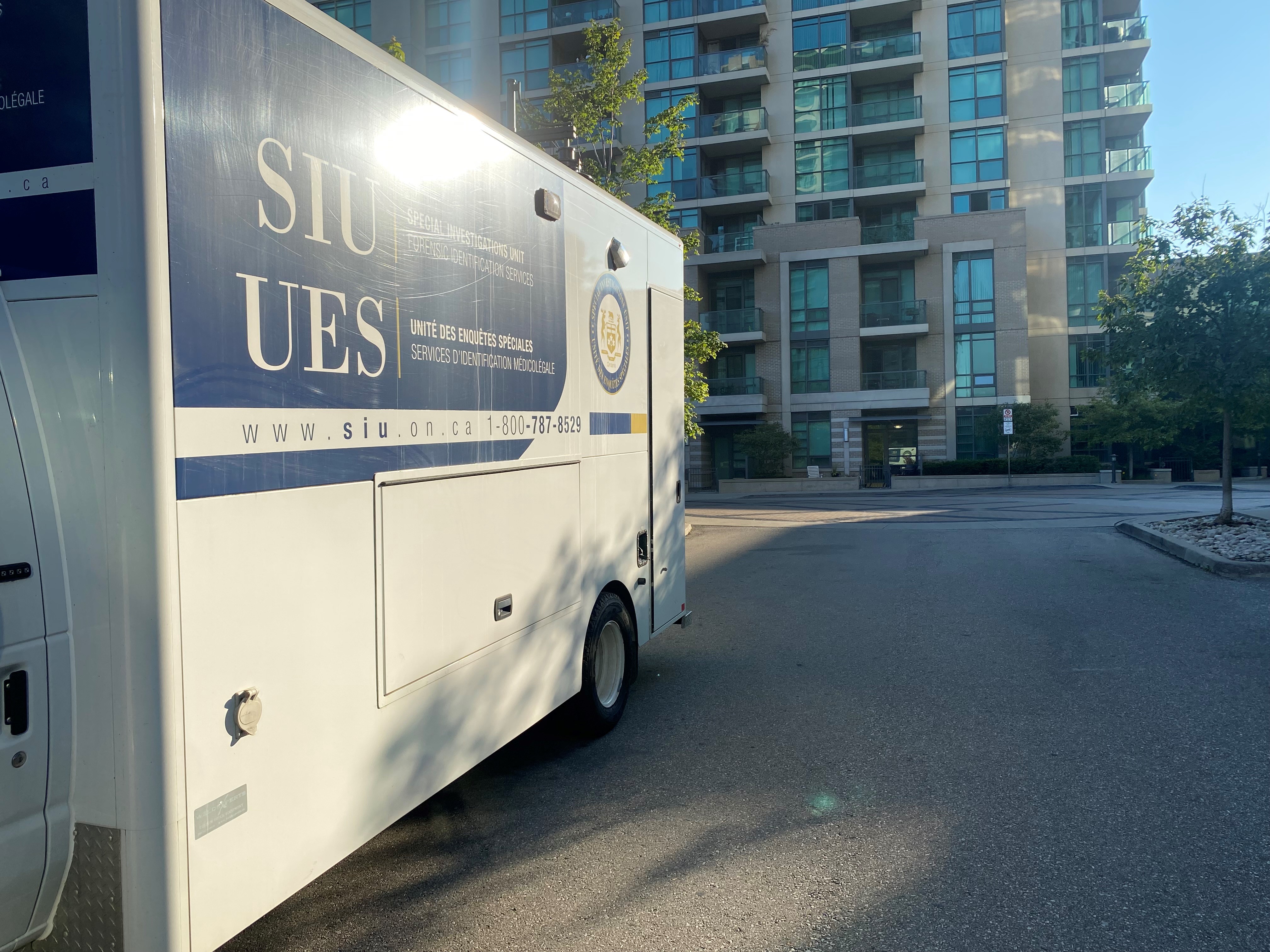
The standard for evaluating police conduct in fatalities involving height-based trauma rests on a binary determination of agency: did the officer’s actions initiate the terminal descent, or did the officer’s presence fail to prevent an autonomous act? In the case of the New Year’s Day death in a Toronto high-rise, the Special Investigations Unit (SIU) focused its inquiry on the operational distance between police presence and the subject’s physical trajectory. The determination of "clearance" hinges not on moral outcome, but on a strict audit of the legal duty of care versus the subject’s exercise of self-determination in high-stress environments.
The Tri-Component Framework of the SIU Mandate
To evaluate the decision to clear the officers involved, one must deconstruct the investigation into three functional pillars. These pillars dictate whether a criminal charge of negligence or manslaughter is sustainable under the Criminal Code of Canada.
- Tactical Proximity and Interaction: This measures the physical distance and the nature of the engagement at the moment of the incident. In high-rise scenarios, the SIU evaluates if an officer’s physical contact—such as an attempted restraint—directly contributed to a loss of balance or a forced fall.
- The Continuity of Crisis Intervention: This examines the timeline from the first point of contact to the terminal event. The objective is to identify any "active interference" that escalated the subject’s risk profile beyond the baseline established by their initial state of crisis.
- Statutory Compliance (Section 25): Under the Criminal Code, officers are protected if they act on reasonable grounds and use only as much force as necessary. The SIU must determine if the officers’ presence was legally justified and if their subsequent inaction (failing to stop a fall) constitutes a "marked departure" from the standard of care.
Behavioral Dynamics in Vertical Environments
The specific physics of high-rise deaths complicates the attribution of fault. When a subject is positioned on a balcony railing or an exterior ledge, the "Point of No Return" is a variable dictated by center of gravity and sudden shifts in muscle tension.
From a strategic standpoint, an officer entering a confined space—such as a studio apartment or a balcony—introduces a new stimulus into a volatile system. The SIU’s report indicates that the subject in this instance had already accessed the balcony before police made entry. This temporal sequence is the primary insulation against police liability. If the subject creates the height risk independently of police interaction, the burden of "prevention" is high, but the burden of "non-interference" is higher.
The psychological phenomenon of "avoidance-avoidance conflict" often dictates the subject’s movement. If the subject views the police as a greater threat than the fall, the police presence itself becomes a catalyst. However, legal frameworks do not penalize officers for the subject’s subjective perception of threat, provided the officers adhere to standard entry and communication protocols.
Quantifying the Standard of Care in High-Stress Negligence
Criminal negligence requires a "marked and substantial departure" from what a reasonable person would do in similar circumstances. In the context of a high-rise fall, the "Reasonable Officer Standard" is applied through the following variables:
- Verbal De-escalation Efficacy: Did the officers use language that heightened or lowered the subject's cortisol levels? In this case, the SIU found that the interaction was brief and directed toward safety, rather than confrontational or aggressive.
- The Temporal Gap: The time between the subject’s movement toward the edge and the officer’s ability to intervene. If the interval is less than the human reaction time (typically 0.2 to 1.5 seconds depending on the complexity of the movement), physical intervention is deemed impossible.
- Safety Trade-offs: An officer is not required to risk their own life by lunging for a subject on a high-altitude ledge. The SIU recognizes the "No Sacrifice Requirement," which acknowledges that the failure to perform a high-risk physical save does not constitute negligence.
The Structural Deficit of Response Time
The bottleneck in these fatalities is rarely the intent of the officers, but rather the physics of the environment. A fall from a high-rise balcony (typically 20+ stories) occurs in a timeframe that precludes any post-event intervention.
$$t = \sqrt{\frac{2h}{g}}$$
Using the formula for free fall where $h$ is height and $g$ is the acceleration due to gravity ($9.8 m/s^2$), a fall from 60 meters (approximately 20 floors) takes roughly 3.5 seconds. For an officer to prevent this, they must be within arm's reach before the descent begins. In this specific investigation, the SIU noted the officers were positioned inside the unit while the subject was already outside. This physical barrier creates a functional impossibility of intervention, which serves as a primary logical basis for the lack of charges.
Deconstructing the SIU’S Evidence Logic
The SIU’s "clearance" is the result of a deductive process that eliminates three potential theories of liability:
1. The Theory of Provocation
The investigation looked for evidence that the officers’ entry into the room was conducted with such "unnecessary aggression" that it forced the subject over the edge. The absence of drawn weapons or physical shouting, corroborated by witness testimony or audio-visual evidence, negates this. The police entered to "check the welfare," a standard peace officer duty that establishes a lawful presence.
2. The Theory of Omission
Liability can arise if an officer has a duty to act and fails to do so. However, the law distinguishes between a "duty to protect" and a "requirement to succeed." If the subject’s actions are so sudden that no intervention could have altered the outcome, the omission is not a causal factor. The SIU determined the subject moved "deliberately and quickly," a phrasing that identifies the subject as the sole actor in the causal chain.
3. The Theory of Excessive Force
The SIU’s forensic audit found no physical evidence of a struggle. In high-rise fatalities, the presence of bruising or DNA under the fingernails would suggest a physical altercation that might have led to the fall. The "clean" forensic report on the subject’s body—save for the trauma related to the impact—further isolates the police from the terminal event.
Systemic Constraints in Mental Health Policing
The recurring nature of high-rise deaths during "wellness checks" reveals a systemic friction between law enforcement mandates and mental health crises. Police are trained for "command and control," which is a linear approach to volatility. Mental health crises are non-linear.
The clearance of the Toronto officers highlights a specific legal reality: the system is designed to punish misconduct, not misfortune. When a subject chooses a high-altitude exit, the police are often relegated to the role of witnesses rather than actors. This creates a data gap where the outcome is tragic, but the process is deemed legally flawless.
Strategic Realignment for Oversight Bodies
The SIU's decision-making process operates on a retrospective audit of the "Event Horizon"—the moment the situation became irreversible. To elevate the analysis of such cases, oversight bodies are increasingly moving toward a "Systems Engineering" approach to police accountability. This involves:
- Pre-Entry Risk Assessment: Evaluating whether the choice to enter a high-rise unit was the optimal move, or if "contain and negotiate" from outside the door would have reduced the subject’s perceived pressure.
- Environmental Profiling: Recognizing that high-altitude balconies are "high-lethality zones" that require different engagement rules than ground-level encounters.
The Toronto incident demonstrates that while the officers were cleared of criminal wrongdoing, the incident remains a failure of the "safety net." The legal clearance confirms that the officers did not push the man; it does not address why the presence of authority frequently correlates with the subject’s decision to engage in terminal risk.
Immediate Operational Implications
The finding that no criminal offense was committed in this New Year’s Day death reinforces the protection of "Discretionary Immunity" for officers responding to volatile wellness checks. For municipal strategy, the focus must shift from the litigation of the fall to the architecture of the response. The clearance stands because the causal link between the police's lawful entry and the subject's autonomous descent was broken by the subject's own agency.
Agencies should prioritize the deployment of specialized mental health units (MCIT) as the primary entry team in high-rise scenarios to mitigate the "threat perception" that triggers height-based escapes. This moves the needle from legal clearance to operational prevention. The current investigative framework will continue to clear officers who stand by as a fall occurs, provided they do not physically facilitate it, marking a clear boundary between legal duty and the limits of human intervention.