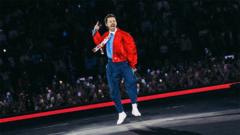
The modern stadium concert is no longer merely a musical performance; it is a complex industrial logistical operation where maximizing ticket inventory directly conflicts with the physical limitations of structural engineering and human anatomy. When a major touring act like Harry Styles alters an ongoing stadium stage design in response to fan complaints, it reveals a fundamental failure in the predictive modeling of sightlines and acoustic dispersion. The financial reality of stadium tours requires a 360-degree or 270-degree bowl utilization to achieve profitability against soaring production overheads. However, when the physical infrastructure of the stage obstructs the view of high-paying tier-one and tier-two seating bowls, the immediate consumer backlash triggers an operational crisis that threatens brand equity and future ticket yields.
To understand why these staging failures occur, live entertainment must be analyzed through a strict spatial framework. The tension lies between maximum capacity utilization and the geometric constraints of the venue.
The Tri-Axis Obstruction Framework
Live touring productions evaluate venue space through three distinct axes, each presenting a unique failure point for audience visibility and experience.
       [Stage / Performance Area]
         /          |          \
        /           |           \
  (X-Axis)       (Y-Axis)      (Z-Axis)
Horizontal      Vertical       Temporal /
 Sightline       Pillar        Dynamic
 Deflection    Obstruction   Displacement
1. Horizontal Sightline Deflection (The X-Axis)
Stadium configurations often rely on a traditional end-stage setup, but modern pop and rock productions push the performance area deep into the floor via thrusts, B-stages, and runways. While this increases proximity for floor-ticket holders, it drastically alters the viewing angle for the permanent seating bowl.
When a performer moves to the furthest point of a runway, the sightline from the side-stage sections compresses. If the primary stage backdrop or LED masking structures protrude even a few inches too far downstage, they create a permanent blind spot for sections adjacent to the stage. The structural boundary of the proscenium arch, originally designed for indoor theaters, fails completely when scaled to an open-air stadium.
2. Vertical Pillar Obstruction (The Y-Axis)
The structural integrity of massive outdoor stages requires heavy-duty steel truss towers to support hundreds of tons of audio arrays, lighting rigs, and automated scenic elements. These load-bearing pillars are non-negotiable for safety, yet their placement frequently ignores the seating geometry of the upper decks.
A pillar that appears negligible on a two-dimensional seating chart becomes a massive visual block when viewed from a high-altitude, steep-angled stadium seat. The problem worsens when production teams wrap these steel towers in black scrim for aesthetic consistency, effectively doubling the visual footprint of the obstruction.
3. Temporal and Dynamic Displacement (The Z-Axis)
The most complex failure occurs when a stage is technically clear during static testing but becomes obstructed during dynamic execution. This displacement happens when moving scenic elements, automated LED screens, or variable lighting cues lower into the sightline of the upper tiers midway through a performance.
Furthermore, the physical presence of support staff, camera operators on tracks, and security barriers creates a fluid zone of obstruction that standard static seating algorithms fail to predict.
The Economics of In-Motion Staging Rectification
Altering a stage design while a global stadium tour is underway is an operational nightmare that carries severe financial penalties. The decision to modify staging elements is never a purely empathetic response to fan feedback; it is a calculated risk-mitigation strategy designed to prevent mass refund demands, negative press cycles, and litigation.
The cost function of mid-tour staging adjustments comprises three primary variables:
- Sunk Capital in Custom Fabrication: Touring stages are precision-engineered months in advance using specialized aluminum and steel alloys. Shaving down a masking panel, shortening a runway, or relocating a support tower requires immediate trackside engineering re-certification. Any physical modification renders thousands of dollars of custom fabrication obsolete.
- Logistical Compression and Freight Expediting: Stadium tours operate on razor-thin temporal windows. Ships, trains, and fleets of semi-trucks move components in a tightly orchestrated choreography. Modifying a stage requires fabricating new parts mid-tour, which introduces expediting fees. If a replacement truss must be flown via air freight instead of ground transport to meet a load-in deadline, logistics costs escalate exponentially.
- Labor Hours and Local Crew Training: Touring crews memorize load-in and load-out procedures until they achieve maximum mechanical efficiency. Introducing a structural change breaks this muscle memory. It requires rewriting the rigging plots, retraining the local stagehand crews at each venue, and adding hours to the load-in window, which directly increases local labor costs and union overtime fees.
The Breakdown of Predictive Seating Software
The occurrence of obstructed views on high-profile tours exposes a critical vulnerability in the ticketing and venue-mapping software utilized by major promoters. The industry standard relies heavily on idealized CAD (Computer-Aided Design) files provided by stadium owners. These files often lack updated structural data regarding post-construction retrofits, safety railings, or field-level slope variations.
The primary breakdown occurs during the data-integration phase between the production design team and the ticketing engine. The production designer builds the stage in an isolated digital environment optimized for visual impact.
When this design is overlaid onto the venue's seating chart, the software uses basic ray-tracing algorithms to determine sightlines. These algorithms treat the human eye as a single fixed point in space and the obstruction as a perfectly transparent wireframe.
The software fails to account for several real-world variables:
- Human Anthropometry: Seating algorithms assume an average sitting height, failing to account for the variance in human stature or the reality that audience members stand, lean forward, and hold up mobile devices during a performance.
- Acoustic Arrays as Visual Obstructions: Massive speaker columns (PA arrays) are frequently omitted from initial seating-chart blocks because their final trim height and angle are adjusted on-site based on atmospheric conditions and humidity. A PA array lowered just five feet lower than planned can wipe out the visibility of an entire upper-deck section.
- The Scalability Illusion: A stage design that passes sightline checks in a 15,000-seat indoor arena will fail catastrophically when scaled up to an 80,000-seat football stadium, where the distances between the seat and the stage magnify every millimeter of structural obstruction.
Operational Execution for Sightline Optimization
To eliminate the recurring issue of mid-tour structural modifications, live entertainment companies must shift from a reactive crisis-management model to a predictive engineering protocol.
[Phase 1: Dynamic Ray-Tracing]
       │
       ▼
[Phase 2: Variable Capacity Ticketing]
       │
       ▼
[Phase 3: Real-Time On-Site Verification]
Phase 1: Implement Dynamic Ray-Tracing with Volumetric Occlusion
Production designers must abandon static 2D sightline checks in favor of dynamic 3D ray-tracing that simulates the entire performance sequence. This simulation must include the full range of motion for all automated scenic elements, lighting trusses, and camera jibs.
The software must calculate volumetric occlusion—the total three-dimensional space blocked by an object—rather than simple linear sightlines. If an element blocks more than 5% of the primary performance zone from any given seat coordinate, that seat must be flagged automatically within the ticketing database.
Phase 2: Establish Variable Capacity Ticketing Protocols
Promoters must move away from rigid, pre-determined seating blocks. Instead, a tiering system based on variable capacity should be deployed. Sections adjacent to the stage or behind the sound-mix position must be held back from the initial on-sale window.
Only after the physical stage is built, rigged, and laser-verified in the first three venues of a tour should these high-risk seats be priced and released to the public. This eliminates the need for forced seat relocations, which damage consumer trust and disrupt venue operations on the night of the show.
Phase 3: Deploy Real-Time On-Site Verification Technology
During the first load-in of a tour, rigging teams should utilize LiDAR (Light Detection and Ranging) scanners to map the stage against the actual stadium bowl. This creates a real-world digital twin of the environment.
Any variance between the theoretical CAD model and the physical reality can be identified instantly, allowing engineers to micro-adjust truss trim heights, speaker angles, and fabric masking before the doors open to the public, neutralizing complaints before they manifest on social media infrastructure.


.jpg?width=1200&auto=webp&trim=0%2C100%2C0%2C100)
