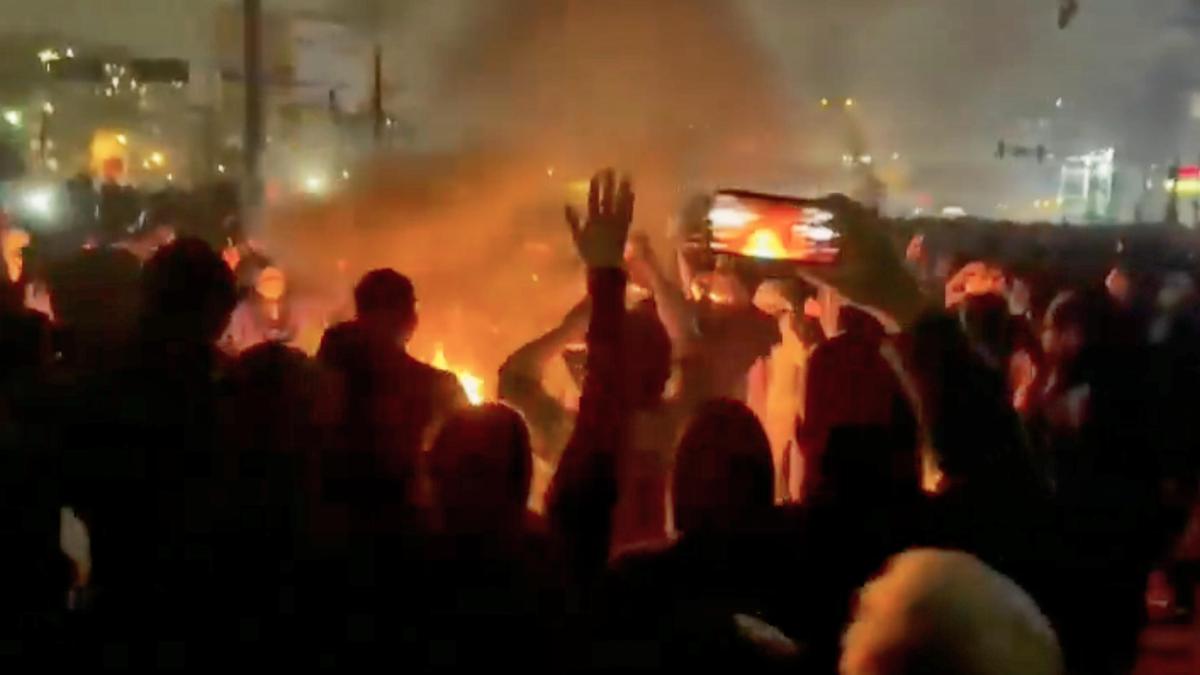
On June 1, 2026, the Iranian judiciary, via its official media outlet Mizan, announced the executions of Mehrdad Mohammadinia and Ashkan Maleki. Nominally convicted of arson against the Jafari Mosque in Tehran’s Gisha neighborhood and destroying public property during the mass demonstrations of December 2025 and January 2026, these individuals represent the latest data points in a highly calculated domestic deterrence model.
The state's execution framework is not merely punitive; it operates as an active system of information control and cost imposition designed to neutralize domestic unrest while the regime navigates a broader regional conflict. By analyzing the structural timing, the strategic legal framing, and the underlying domestic friction points, we can map out how the Islamic Republic uses capital punishment as a core tool to preserve regime survival.
The Cost Function of Domestic Dissidence
Autocratic regimes maintain stability by manipulating the cost-benefit equation for potential dissidents. When the perceived benefit of systemic change outweighs the immediate physical or capital cost of protest, mobilization occurs. The Iranian security state operates on a structural model designed to artificially spike the cost of dissidence through strategic, high-impact state violence.
                  [Domestic Economic Grievances]
                                │
                                ▼
                    [Civil Disobedience/Protest]
                                │
                                ▼
            ┌───────────────────┴───────────────────┐
            ▼                                       ▼
  [Immediate Kinetic Cost]               [Delayed Juridical Cost]
  - Mass arrests (Up to 40,000)          - Secret capital trials
  - Direct lethal force (~7,000 dead)    - Accelerated executions (June 1)
            │                                       │
            └───────────────────┬───────────────────┘
                                ▼
                  [Maximized Cost of Dissidence]
                                │
                                ▼
               [Suppression of Future Mobilization]
This cost function is divided into two distinct operational phases:
- Immediate Kinetic Cost: Applied during the active mobilization phase. In the January 2026 protests, this materialized as a direct, lethal crackdown resulting in an estimated 7,000 deaths and up to 40,000 detentions. The goal is the immediate clearing of geographical flashpoints.
- Delayed Juridical Cost: Applied post-mobilization. The June 1 hangings of Mohammadinia and Maleki, performed in secret and without standard familial notifications, serve as the secondary phase. This mechanism demonstrates to the populace that the state's memory exceeds the public's attention span, maintaining a high baseline of fear long after street-level energy subsides.
The structural vulnerability of this model lies in its diminishing returns. If economic deprivation reaches a critical threshold, the baseline cost of non-action (poverty, starvation, systemic collapse) approaches parity with the cost of state retribution, neutralizing the deterrent effect.
The External-Internal Blame Pivot
The ideological justification for the June 1 executions introduces a highly specific strategic narrative: the externalization of domestic failure. The judiciary’s media arm explicitly stated that the actions of the executed individuals "served as a pretext for military aggression" by external adversaries in February 2026.
This framing serves a dual-purpose institutional objective. First, it reclassifies domestic economic grievances—the original catalyst for the December 2025 protests—as components of asymmetric foreign warfare. By shifting the root cause from state economic mismanagement to foreign sabotage, the regime seeks to invalidate the moral legitimacy of the protest movement.
Second, the mechanism creates a legal and psychological shortcut for the domestic population. Dissent is no longer treated as political non-conformity; it is structurally codified as treason. By linking internal property damage, such as the arson of the Jafari Mosque, directly to external kinetic strikes against Iranian territory, the judiciary establishes a direct causal chain between localized protest and national security vulnerability. This allows the state to justify the complete bypass of due process, executing defendants via expedited Revolutionary Court proceedings within highly compressed timelines.
Execution Velocity as a Geopolitical Variable
The frequency and timing of capital punishment in Iran correlate directly with external military and economic pressure. The data tracking Iran’s execution metrics reveals an acceleration curve that matches the escalation of external threats.
| Chronological Period | Documented Executions | Primary Geopolitical Variables |
|---|---|---|
| Calendar Year 2025 | 1,639 | High-intensity regional proxy engagements; severe domestic inflation. |
| Q1 2026 (Jan–March) | Accelerated Post-Protest Baseline | Peak domestic mobilization (January 8); outbreak of direct conflict with external states (February). |
| Q2 2026 (April–June) | Targeted Security Executions | Implementation of a fragile ceasefire; ongoing negotiations regarding the Strait of Hormuz blockade. |
The execution of political prisoners like Mohammadinia and Maleki—identified by human rights organizations as Kurdish activists—peaks precisely when the regime is engaged in sensitive external negotiations. As Iranian officials exchange diplomatic proposals regarding a 60-day ceasefire extension and the potential lifting of the U.S. maritime blockade on Iranian ports, the internal apparatus increases its execution velocity.
This is a defensive signaling mechanism. To prevent foreign intelligence services and domestic opposition groups from interpreting external diplomatic flexibility as internal structural weakness, the regime intensifies its domestic security crackdowns. The executions on June 1 signal to both domestic underground networks and foreign negotiators that the state’s internal command-and-control apparatus remains fully uncompromised by external military friction.
Structural Fault Lines in the Iranian Security Framework
The reliance on capital punishment exposes three critical structural bottlenecks within the current Iranian governance model.
The first limitation is the erosion of narrative monoculture. The state’s effort to attribute all domestic unrest to external intelligence actors faces a profound credibility deficit among a digitally connected youth demographic. When the state uses forced confessions to fast-track hangings, it reinforces the perception of systemic judicial illegitimacy rather than confirming foreign subversion.
The second limitation is the minority flashpoint risk. Mohammadinia and Maleki were identified as Kurdish political prisoners. Executions that disproportionately target ethnic periphery groups (such as Kurds or Baluchs) systematically compound grievances in regions that are already economically marginalized and heavily militarized. Rather than dampening dissent, this concentrates localized resentment, increasing the probability of armed insurgent responses along Iran's border zones.
The third limitation is the economic dead end. Capital punishment can suppress the visible symptoms of domestic instability but cannot address the structural drivers. With the economy facing persistent inflation, widespread infrastructure damage from recent kinetic conflicts, and ongoing supply chain blockades, the material incentives for public unrest remain active.
The strategic play for the Iranian regime moving forward is clear: it will continue to utilize highly publicized, rapid-succession executions as a low-cost, high-visibility defense mechanism to freeze domestic mobilization while it seeks sanctions relief or a stabilized geopolitical equilibrium. For external analysts and policy architecture teams, tracking the velocity of these executions provides a real-time diagnostic tool for assessing the regime's perceived internal vulnerability; an escalating execution rate indicates a state actively overcompensating for profound structural fragility.