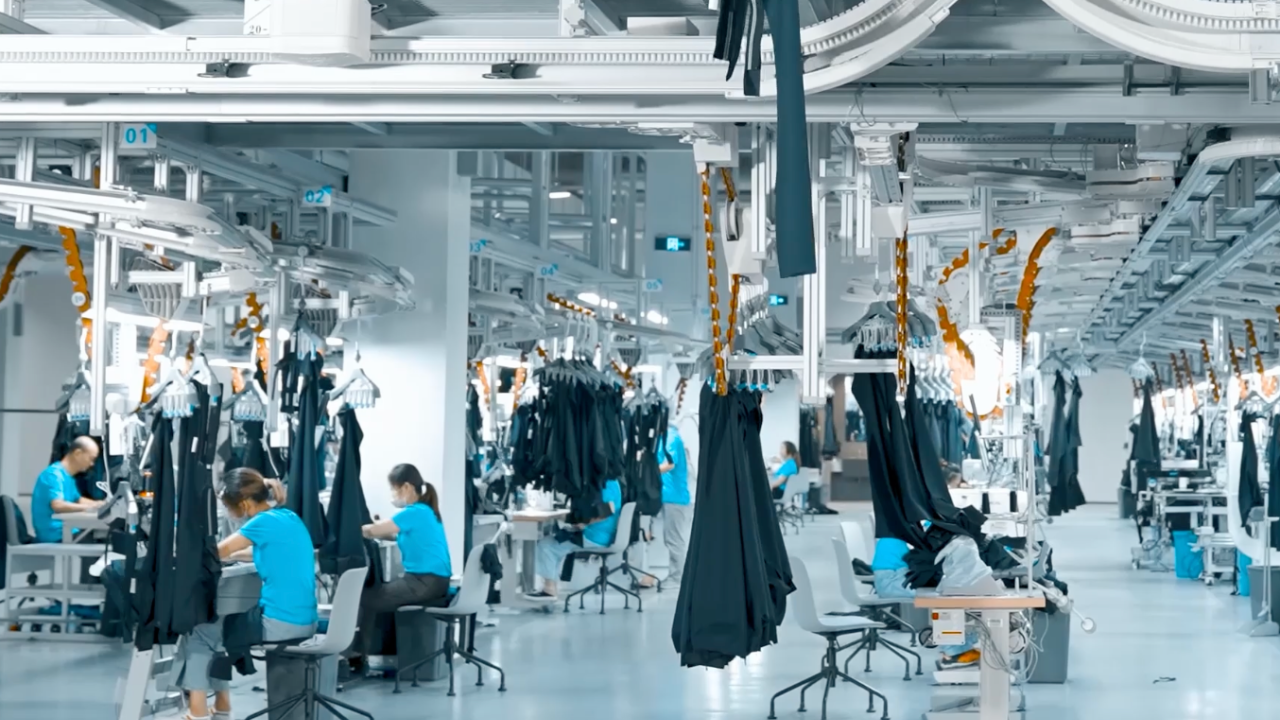
China’s industrial policy has transitioned from automating continuous-process heavy manufacturing to algorithmic orchestration in high-variance consumer goods. Under the Ministry of Industry and Information Technology (MIIT) "Smart Manufacturing Pilot Demonstration" framework, the initial wave of "flagship" AI factories targeted steel, petrochemicals, and automotive assembly—sectors characterized by low product mix, high capital intensity, and predictable physical tolerances. The current expansion into apparel, cosmetics, and consumer electronics represents a fundamentally harder engineering problem: applying deterministic machine learning models to chaotic, trend-driven supply chains where batch sizes approach one.
The Structural Shift from Continuous Process to High-Variance Production
To understand why moving AI from a blast furnace to a garment factory requires a complete architectural overhaul, we must examine the underlying operational physics of both environments.
In heavy industry, the objective function of an AI deployment is process stabilization and yield optimization. A steel rolling mill produces uniform slabs; sensors monitor temperature, pressure, and metallurgical composition in real time. Machine learning models adjust parameters within narrow, well-defined thermodynamic boundaries. The economic return comes from marginal reductions in energy consumption, scrap rates, and unscheduled downtime across massive fixed assets.
Consumer goods—specifically fast fashion, footwear, and bespoke personal care—operate under an inverted set of constraints. Demand is volatile, product lifecycles are measured in weeks rather than decades, and physical materials behave non-linearly. Fabric stretches, dyes react differently to ambient humidity, and consumer preferences shift based on algorithmic social media trends rather than long-term infrastructure cycles.
Applying AI to these sectors requires shifting the computational bottleneck from the factory floor to the upstream and downstream interfaces:
- Demand Sensing and Generative Design: Instead of reacting to quarterly wholesale orders, flagship consumer factories ingest real-time e-commerce clickstream data, social media engagement metrics, and return rates. Computer vision and natural language processing models extract micro-trends—such as specific lapel widths, color hex codes, or fabric textures—and feed them directly into generative CAD systems.
- Dynamic Line Balancing: In a traditional garment factory, retooling a sewing line for a new style incurs significant changeover penalties. AI-driven factories use automated guided vehicles (AGVs), overhead smart hangers, and modular workstations to route individual pieces dynamically. Each garment carries an RFID tag that dictates its specific assembly sequence, allowing a single production line to manufacture dozens of distinct SKUs simultaneously without halting operations.
- Deformable Object Manipulation: Rigid-body robotics solved automotive welding decades ago. Manipulating limp, deformable textiles remains one of robotics' hardest problems. Chinese flagship facilities bypass full humanoid dexterity by combining specialized end-effectors with high-speed machine vision that predicts fabric drape and tension in real time, compensating for material slip before the needle strikes.
The Economics of Consumer-to-Manufacturer (C2M) Architecture
The foundational business model underpinning these factories is Consumer-to-Manufacturer (C2M). C2M eliminates the traditional wholesale, distribution, and retail inventory layers that historically buffered manufacturers from demand volatility.
In a conventional retail model, brands forecast demand six to nine months in advance, place bulk orders to achieve economies of scale, and absorb the financial penalty of unsold inventory through markdowns. The cost of capital tied up in working inventory and the margin erosion from clearance sales routinely exceed the actual unit cost of manufacturing.
C2M inverts this cost structure by trading higher unit manufacturing complexity for near-zero inventory risk:
- Small-Batch Testing: A factory produces an initial run of 100 to 200 units of a newly generated design within 48 to 72 hours.
- Algorithmic Market Validation: Those units are listed on domestic platforms (such as Douyin, Pinduoduo, or Taobao) with targeted traffic allocation. Conversion rates, add-to-cart ratios, and early return reasons are tracked hourly.
- Automated Reorder Triggering: If a SKU crosses a predefined algorithmic threshold for velocity and margin, the system automatically reserves raw material capacity, schedules machine time, and scales production to 10,000 units. If it fails, production terminates immediately, capping financial exposure at the cost of the initial micro-batch.
This model relies on geographic clustering. A flagship factory in Guangdong or Zhejiang does not operate in isolation; it sits at the center of a dense, hyper-local supplier network. Zippers, buttons, specialized yarns, and packaging must be delivered within two to four hours of an automated ERP trigger. The AI system's scheduling algorithms extend beyond the factory walls, managing multi-tier supplier lead times as a single continuous queuing problem.
The Three Technical Pillars of the Modern Flagship Facility
When MIIT designates a facility as a "flagship" or "lighthouse" factory in the consumer sector, the operational architecture generally rests on three integrated systems.
1. Multimodal Quality Inspection Systems
Human visual inspection in textiles and consumer electronics suffers from rapid cognitive fatigue, leading to error rates that spike after 45 minutes on shift. Flagship factories deploy line-scan cameras paired with multi-spectral lighting and deep learning defect-detection models.
In fabric weaving, high-resolution optical sensors scan bolts of cloth at speeds exceeding 60 meters per minute, identifying broken threads, dye inconsistencies, or weave distortions down to 0.1 millimeters. Crucially, the system does not merely flag defects; it maps their exact X-Y coordinates onto a digital twin of the fabric roll. Downstream automated laser cutters then ingest this defect map and dynamically re-nest garment patterns to cut around the flaws, maximizing material yield without human intervention.
2. Predictive Maintenance on High-Speed, Low-Margin Assets
Unlike a $50 million turbine in a power plant, an industrial sewing machine or injection molding press is relatively inexpensive. Historically, factories ran these machines to failure because the cost of predictive sensor suites exceeded the replacement cost of the asset.
The drop in MEMS (Micro-Electro-Mechanical Systems) sensor costs and edge-computing power has altered this calculus. Flagship factories now retrofit legacy machinery with acoustic and vibration sensors. Anomaly detection algorithms identify bearing wear, needle deflection, or pneumatic pressure drops hours before mechanical failure occurs. In a C2M environment where delivery windows are measured in hours, an unscheduled line stoppage carries an opportunity cost far higher than the hardware value of the broken machine.
3. Closed-Loop Digital Twins for Process Simulation
Before a physical sample is cut or molded, flagship facilities simulate the entire production run inside a physics-informed digital twin. In cosmetics manufacturing, where mixing emulsions requires precise thermal and shear profiles, digital twins model fluid dynamics to determine optimal agitator speeds and heating curves for new formulations.
This eliminates physical trial-and-error batches. By simulating the manufacturing process alongside the supply chain logistics, operators identify potential bottlenecks—such as curing times or packaging line speeds—before committing raw materials.
Operational Limitations and Structural Vulnerabilities
Despite the efficiency gains demonstrated by state-backed pilot facilities, scaling this model across China’s broader manufacturing base faces severe economic and technical friction.
Capital Expenditure Asymmetry: The financial ROI of a flagship AI factory is heavily skewed toward large enterprises with access to subsidized state credit or massive platform ecosystems. A mid-sized garment manufacturer operating on 4% to 6% net margins cannot easily absorb the upfront capital expenditure required for automated overhead logistics, digital twin integration, and sensor retrofitting. Without guaranteed order volume from a major e-commerce platform to keep the automated lines running at high utilization rates, the fixed depreciation costs of the AI infrastructure rapidly erode unit economics.
The Data Silo Bottleneck: Algorithmic optimization requires clean, standardized, real-time data across the entire value chain. While the flagship factory itself may be fully digitized, its tier-two and tier-three raw material suppliers often operate on legacy ERP systems, spreadsheets, or manual paper ledgers. When a dye house delays a shipment due to an unlogged equipment failure, the flagship factory’s predictive scheduling algorithms break down, forcing human planners to intervene manually.
Overfitting to Algorithmic Trends: When manufacturing becomes entirely subservient to real-time clickstream data, product development suffers from extreme homogenization. Recommendation algorithms favor incremental variations of proven designs over radical innovation. Factories optimized for C2M fast-following excel at capturing immediate micro-trends, but they struggle to build long-term brand equity or create entirely new product categories, trapping manufacturers in a high-velocity, low-margin race to the bottom.
Strategic Implications for Global Supply Chains
The expansion of China’s AI factory blueprint from heavy industry to consumer goods fundamentally alters the competitive dynamics of global manufacturing. For decades, Western brands and competing manufacturing hubs in Southeast Asia relied on a simple arbitrage: low-complexity, labor-intensive goods moved to lower-wage countries like Vietnam, Bangladesh, and India, while high-tech, capital-intensive manufacturing remained in developed economies or advanced Chinese coastal hubs.
AI-driven flexible automation disrupts this trajectory by neutralizing the labor-cost advantage of developing nations in apparel and consumer goods. When a facility in Guangzhou can design, cut, sew, inspect, and ship a custom batch of garments in 72 hours with minimal direct labor, a factory in Dhaka offering 30% cheaper wages but requiring a 90-day lead time becomes economically uncompetitive for trend-sensitive inventory.
Western brands and supply chain operators must abandon the assumption that consumer goods manufacturing will naturally migrate out of China due to rising domestic wages. Competing against C2M flagship factories requires bifurcating supply chain strategy:
- Segregate Core vs. Volatile SKUs: Maintain predictable, evergreen baseline inventory (e.g., basic white t-shirts, standard hardware components) in low-cost, traditional manufacturing hubs where economies of scale still govern unit cost.
- Invest in Regional Micro-Factories: For trend-driven, high-margin, or localized products, Western retailers cannot rely on ocean freight from Asia to compete with domestic C2M speeds. They must deploy localized, automated micro-factories near major consumption centers in North America and Europe, replicating the C2M software stack to compress physical transit times.
- Standardize Supplier APIs: Technology investment must shift away from isolated factory floor robotics toward supply chain interoperability. Building standardized data pipelines with raw material suppliers is the prerequisite for any algorithmic scheduling system to function without human overrides.