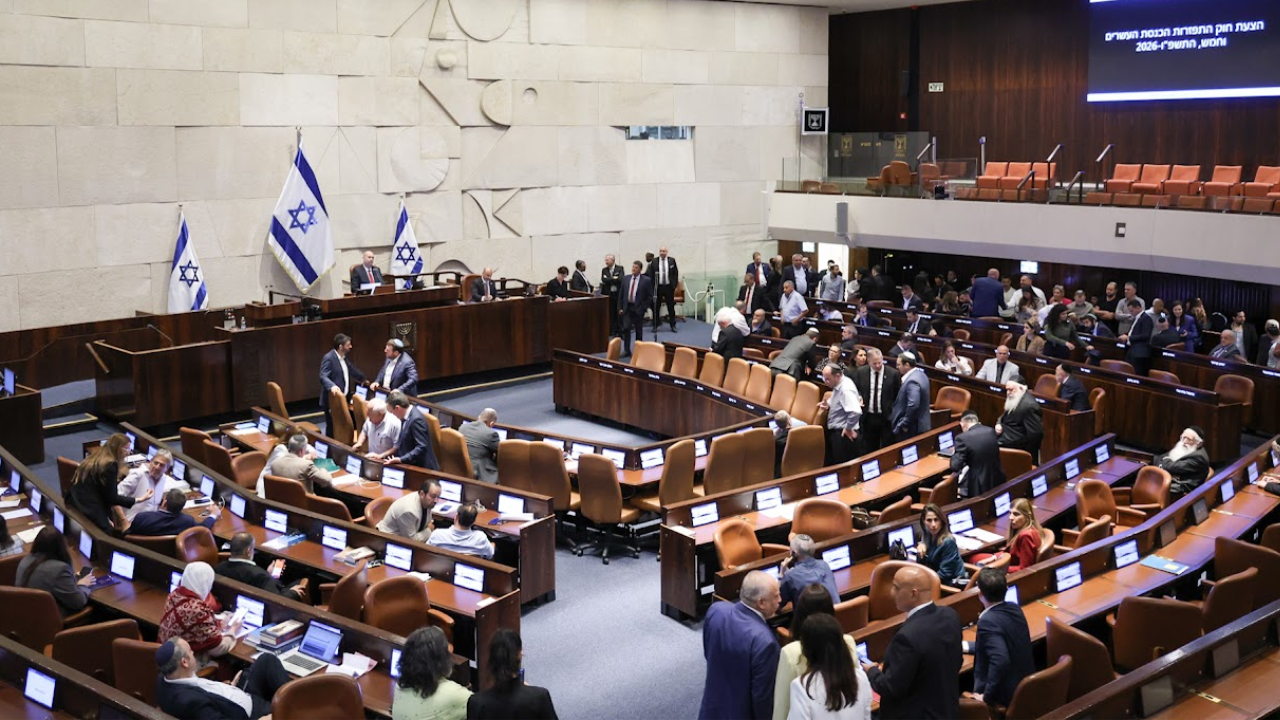
The 110-0 preliminary vote in the Israeli Knesset to advance a bill for its own dissolution is not an isolated political event, but the structural consequence of a destabilized governing architecture. While conventional commentary focuses on immediate party rivalries, the legislative maneuver exposes a deeper systemic vulnerability: the critical dependency of Prime Minister Benjamin Netanyahu’s right-wing bloc on ultra-Orthodox (Haredi) minority factions. When the state can no longer fund or legally defend the legislative carve-outs demanded by these factions, the coalition's core utility function collapses, rendering early elections structurally inevitable.
To understand the trajectory of this legislative process and its eventual outcome, the situation must be broken down into its functional mechanisms: the mathematics of the coalition crisis, the dual-track legislative bottleneck, and the competing optimization strategies of the primary political actors.
The Cohesion Equation: The Strategic Impossibility of Haredi Conscription Exemptions
The immediate catalyst for the dissolution bill is the failure of the government to codify a permanent military draft exemption for ultra-Orthodox yeshiva students. This issue represents an irreconcilable policy bottleneck within the Israeli political system, governed by a rigid legal and arithmetic framework.
The Baseline Constraints
- The Legislative Target: The ultra-Orthodox parties—primarily United Torah Judaism (UTJ) and Shas—require a legally sound law to exempt approximately 80,000 eligible Haredi men aged 18 to 24 from compulsory military service.
- The Judicial Veto: In June 2024, Israel's High Court of Justice ruled that the historical de facto exemptions lacked a legal basis, making any new exemption bill subject to strict judicial review regarding the principle of equality under the law.
- The Coalition Floor: The governing coalition relies entirely on the 18 seats controlled by the ultra-Orthodox factions to maintain its 64-seat majority in the 120-seat Knesset.
This creates a structural paradox. The ultra-Orthodox factions refuse to support routine coalition legislation or maintain the government without a guaranteed draft exemption. Conversely, passing a legally bulletproof exemption is politically impossible. Moderate wings of the Likud party, represented by figures like Foreign Affairs and Defense Committee Chairman Yuli Edelstein, recognize that passing a broad exemption during an ongoing multi-front conflict carries an unsustainable domestic political cost.
When the prime minister informed Haredi leaders that the coalition lacked the necessary votes to pass the exemption bill before the end of the session, the utility of the coalition for the ultra-Orthodox parties dropped to zero. Rather than facing a slow erosion of their political leverage, UTJ and Shas opted to force an early election cycle, attempting to maximize their power before a potential complete shift in the domestic political landscape.
Dual-Track Dissolution: Mapping the Legislative Velocity
A preliminary vote does not instantly dissolve parliament; instead, it initiates a highly technical legislative pipeline. The current situation is uniquely complex because the Knesset simultaneously advanced two distinct dissolution mechanisms, creating a dual-track strategic environment.
The Coalition Variant vs. The Opposition Variant
| Feature | The Coalition Bill | The Opposition Bill (Blue and White) |
|---|---|---|
| Sponsor | Government / Likud Whip | Blue and White (Benny Gantz / Pnina Tameno-Shata) |
| Timeline Mandate | Date set by House Committee; no less than 3 months post-final passage | Rigidly mandates elections exactly 90 days from final passage |
| Strategic Function | Allows the coalition to retain control over scheduling and committee speed | Serves as an un-yielding fallback if the coalition attempts to stall |
| Max Legislative Horizon | Must occur before the legal statutory deadline of October 27, 2026 | Explicitly accelerates the timeline toward a late August or early September ballot |
The concurrent advancement of both bills creates a dual-track bottleneck that shifts the balance of leverage in the plenum. The opposition's bill prevents the government from using its own bill as a stalling tactic. If the coalition attempts to freeze its version in committee to buy time for a backroom deal on the conscription law, the opposition can push its own version forward. To become law, either bill must clear the Knesset House Committee or Constitution Committee, followed by three successive formal readings in the plenum, requiring an absolute majority of at least 61 votes in the final reading.
Strategic Optimization: Actor Motivations and Campaign Timelines
The zero-vote opposition to the preliminary readings indicates that every major faction calculated that an immediate transition to an election footing served its distinct tactical interests.
The Ultra-Orthodox Calculus: Calendar Optimization
The Haredi parties are actively lobbying for an election date in early September 2026. This preference is driven by seasonal voter optimization. A September vote places the campaign and the immediate post-election coalition negotiations directly before the Jewish High Holy Days (Rosh Hashanah and Yom Kippur). Historically, this period maximizes religious mobilization and voter turnout within ultra-Orthodox communities, while secular voter turnout often drops due to seasonal travel and holidays.
The Netanyahu Defensive Play: Breaking the October 7 Linkage
For the prime minister, managing the election calendar is an exercise in damage control and narrative disruption. The legal default election date is October 27, 2026. This date is politically hazardous for the ruling party because it sits immediately adjacent to the anniversary of the October 7, 2023 Hamas attacks.
An election held in late October would inevitably turn into a referendum on the intelligence and operational failures of that day. By pulling the election forward to early September, the premier hopes to position the campaign narrative around recent military campaigns against Hezbollah and Iran, where recent polling indicates his personal suitability metrics have rebounded from a low of 32% to as high as 47%.
The Opposition Objective: Consolidation and Structural Reform
For the opposition blocs, led by Yair Lapid (Yesh Atid), Benny Gantz (Blue and White), and Yair Golan (The Democrats), the dissolution of the Knesset is an opportunity to lock in the government’s structural fragmentation. Current polling data from May 2026 indicates that the parties comprising the current coalition would drop to roughly 51 seats, well short of the 61-seat threshold needed to govern.
The opposition's primary challenge is structural consolidation. To capitalize on the coalition's collapse, centrist, left-wing, and right-wing anti-Netanyahu factions must build a unified voting bloc despite deep ideological differences regarding economic policy and the Palestinian issue.
Technical Limitations of the Political Calculus
While the current trajectory points toward early elections, several critical operational variables could disrupt this momentum before the third reading of the dissolution bill is finalized.
- The Security Volatility Vector: The entire political timeline remains subordinate to the security environment. A major escalation on the northern front or a direct confrontation with Iran would instantly freeze the legislative process. Under Israeli emergency protocols, security crises trigger a rally-around-the-flag effect that makes dissolving parliament logistically and politically unfeasible.
- The Pre-Election Legislative Rush: Before the final vote to dissolve, the current coalition is racing to pass highly contentious structural reforms, including a bill designed to split the role of the Attorney General and limit executive oversight. The opposition’s ability to delay these bills in committee will dictate whether the coalition decides to stall or accelerate the final dissolution readings.
- The Re-Negotiation Loophole: A preliminary vote is a declaration of intent, not a binding legal status. Until the third reading passes with 61 votes, the government remains intact. This leaves open a narrow window for a last-minute compromise on the Haredi draft issue, though the rigid legal boundaries set by the High Court make a viable compromise mathematically and legally improbable.
The Strategic Play
The advancement of the Knesset dissolution bills marks the structural end of the current governing alignment. The government's survival strategy has exhausted its options; it can no longer balance the legal demands of the judiciary with the political demands of its ultra-Orthodox partners.
The definitive strategic move will play out in the Knesset House Committee over the coming days. The opposition will try to force the 90-day fixed timeline of its own bill to guarantee an August ballot, while Likud will attempt to leverage the flexible timeline of the coalition bill to secure a mid-September date.
Expect the coalition to deliberately stall the final readings just long enough to push through its defensive judicial legislation, before consenting to an early September election. This timeline allows the current leadership to avoid an election defined by the October 7 anniversary, while leaving the ultra-Orthodox factions with no choice but to bet their political future on a highly volatile summer campaign.