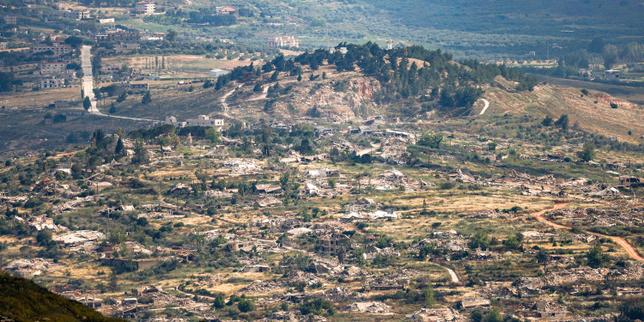
The statement by the Lebanese Prime Minister accusing Israel of a "scorched earth policy and collective punishment" highlights a fundamental misalignment between political rhetoric and kinetic reality. In asymmetric warfare, state actors and non-state actors operate under entirely different strategic constraints, cost functions, and validation metrics. Evaluating the escalation along the Israel-Lebanon border requires stripping away emotional narratives to analyze the underlying operational frameworks: attrition mechanics, targeting logic, and the structural vulnerabilities of the Lebanese state.
The conflict is not a series of random, punitive strikes; it is a highly calculated, resource-intensive campaign governed by precise military objectives. To understand the trajectory of this escalation, one must examine the systematic destruction of specific infrastructure networks, the degradation of command structures, and the geopolitical leverage points that dictate the actions of both the Israel Defense Forces (IDF) and Hezbollah.
The Tri-Border Strategic Framework
The operational theater spanning southern Lebanon, northern Israel, and the Golan Heights operates under a three-part equilibrium. Each element dictates how kinetic actions translate into political leverage.
- The Deterrence Equation: For nearly two decades, stability was maintained through a mutual understanding of ruinous costs. This equilibrium broke down when northern Israel became uninhabitable due to persistent low-intensity fire, shifting the Israeli strategic objective from status-quo maintenance to the active elimination of a localized threat.
- The Sovereignty Paradox: The Lebanese state exercises nominal sovereignty over its territory, yet lacks a monopoly on the legitimate use of force. This structural deficit allows Hezbollah to operate a parallel military apparatus, effectively decoupling the civilian population's security from the decisions of the central government in Beirut.
- The Asymmetric Cost Function: A state actor calculates cost in terms of economic disruption, international diplomatic capital, and troop preservation. A non-state proxy actor, heavily subsidized by external patrons, calculates cost through ideological resilience, supply line continuity, and the long-term attrition of the adversary's civilian morale.
This structural divergence explains why political denunciations from Beirut have zero impact on operational outcomes. The Lebanese government lacks the coercive capacity to enforce compliance on Hezbollah, rendering its diplomatic appeals a form of signaling rather than a functional policy tool.
Targeting Logic and Architectural Degradation
The phrase "scorched earth" implies indiscriminate destruction designed to render territory permanently uninhabitable. A rigorous analysis of strike data and target profiles reveals a different operational reality: a systematic, intelligence-driven campaign targeting specific layers of military architecture.
The Subterranean and Tactical Layer
The primary objective of the current kinetic campaign is the neutralization of the Radwan Force—Hezbollah’s elite offensive unit—and its cross-border infiltration infrastructure. This involves targeting tunnel networks, ammunition storage facilities embedded in civilian structures, and concealed launching positions. The geographical focus is concentrated within a specific corridor running from the Blue Line to the Litani River. The destruction of civilian property in these zones is a direct function of urban masking, where military assets are deliberately co-located within civilian infrastructure to complicate the adversary's targeting matrix.
The Command and Logistics Layer
Simultaneously, deep-theater strikes targeting the Beqaa Valley and Beirut’s southern suburbs (Dahiyeh) focus on degrading the command-and-control apparatus. This involves eliminating high-value targets, disrupting communication nodes, and cutting supply lines originating from the Syrian border.
The mechanism here relies on information dominance. By targeting the leadership echelon, the operational speed of the non-state actor is drastically reduced, forcing local commanders to operate in isolation without centralized strategic coordination.
The Economic Bottleneck and State Fragility
The escalation occurs against the backdrop of an already collapsed Lebanese economy. This compounding crisis creates a severe vulnerability that fundamentally alters how the conflict impacts the civilian population compared to previous confrontations, such as the 2006 war.
Lebanon’s financial system possesses no resilience. The absence of foreign exchange reserves, a dysfunctional banking sector, and hyperinflation mean the state cannot fund civil defense, emergency medical response, or large-scale internal displacement infrastructure. The cost of conflict is therefore amplified not by the absolute volume of kinetic ordnance delivered, but by the structural inability of the host state to absorb any economic shock.
[Kinetic Strike Matrix] -> [Displacement of Civilians] -> [Total Strain on Public Infrastructure]
                                                                   |
[Zero Fiscal Reserves]  <- [Collapse of Essential Services]   <----+
The displacement of hundreds of thousands of residents from southern Lebanon into Mount Lebanon and Beirut creates acute friction points. It exacerbates sectarian tensions, overburdens a crumbling electrical grid, and paralyzes municipal services. The strategic implication is clear: the domestic political pressure on the Lebanese state increases exponentially faster than the military degradation of the non-state actor, creating a dangerous disconnect between political vulnerability and military capability.
Limits of the Current Attrition Strategy
While the military superiority of the state actor is absolute in terms of firepower and intelligence collection, the strategy of systematic degradation faces distinct structural limitations.
First, air power alone cannot permanently clear territory or prevent low-profile, mobile rocket launches. The reliance on stand-off precision strikes yields diminishing returns once the primary static infrastructure is eliminated. Remaining assets become highly decentralized, shifting to opportunistic, small-team tactics that are exceptionally difficult to detect and neutralize from the air.
Second, the attrition of leadership personnel does not automatically trigger the collapse of an ideologically committed, decentralized organization. Non-state networks are built for survivability; redundant command structures allow lower-tier officers to assume control rapidly, maintaining tactical continuity even when the strategic leadership is severed.
Finally, the international diplomatic cost functions as a hard ceiling. As civilian casualties and displacement numbers rise, the diplomatic capital of the state actor depreciates, triggering external pressure for a cessation of hostilities before the defined military objectives—such as the complete demilitarization of the southern border zone—are fully realized.
The Operational Path Forward
Achieving long-term stability along the Blue Line requires moving past the current kinetic stalemate through a dual-track strategy focused on structural enforcement and political decoupling.
- Enforcement of Resolution 1701 with Kinetic Backing: The historical failure of United Nations Security Council Resolution 1701 stems from the lack of an enforcement mechanism. Any durable settlement requires the deployment of a robust international or Lebanese military force equipped with a mandate to actively dismantle non-state military infrastructure south of the Litani River, rather than merely monitoring violations.
- Decoupling State Sovereignty from Proxy Agendas: The Lebanese state must leverage the current degradation of Hezbollah's leadership to reassert control over its national security policy. This requires filling the presidential vacuum, reforming the security sector, and conditioning international financial reconstruction aid on the strict monopolization of arms by the Lebanese Armed Forces.
Without these structural adjustments, any cessation of hostilities will merely serve as a re-arming interlude, guaranteeing a resumption of the conflict once the asymmetric cost functions realign.