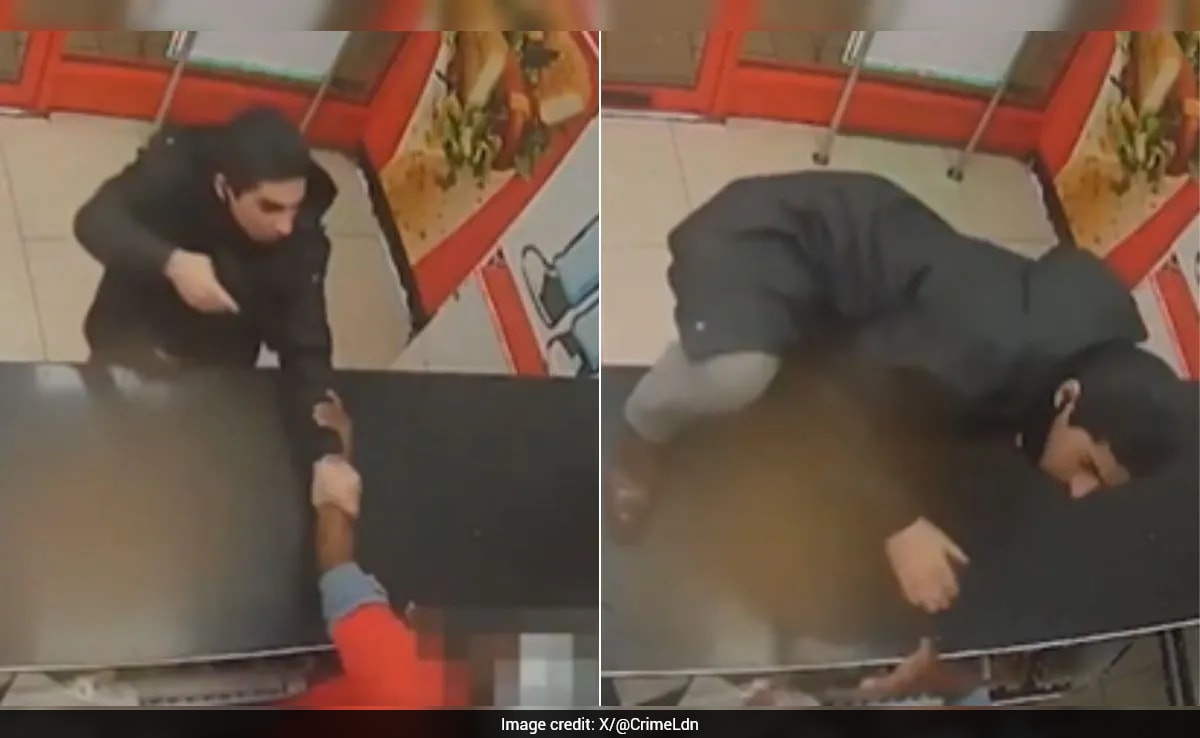
The intersection of perceived service failure and irrational risk-taking creates a volatility gap where the cost of a reaction far outweighs the utility of the desired outcome. In the case of an individual wielding an imitation firearm over a condiment error at a fast-food establishment, the breakdown occurs across three distinct vectors: cognitive dissonance in consumer expectations, the legal taxonomy of "imitation" versus "actual" threat, and the mandatory sentencing structures of the UK criminal justice system. Analyzing this event requires moving past the absurdity of the "wrong sauce" narrative and focusing on the systematic application of the Firearms Act 1968 and the Sentencing Council’s guidelines for public order offenses.
The Asymmetry of Value and Risk
The primary driver of this incident is a catastrophic failure in the actor's internal cost-benefit analysis. In a standard commercial transaction, the value of the goods (a sauce packet, worth approximately £0.20 to £0.50) is negligible. However, when the consumer perceives a breach of the "service contract," the emotional response can bypass rational calculation. This leads to a state where the individual seeks "justice" or "rectification" through a show of force.
The asymmetry is quantified by the delta between the desired outcome (correct sauce) and the potential liability (a multi-year custodial sentence). The legal system does not weight the provocation—the missing sauce—against the response; it evaluates the response as a standalone threat to public safety. When an imitation firearm is introduced, the transition from a civil dispute to a criminal felony is instantaneous and irreversible.
Legal Classification of Imitation Firearm Offenses
Under Section 16A of the Firearms Act 1968, the possession of a firearm or imitation firearm with intent to cause fear of violence is a serious indictable offense. The law intentionally ignores the lethality of the object. The "Harm" metric in sentencing is determined by the victim’s perception and the potential for a wider breach of the peace.
The Perception-Reality Parity
The legal framework operates on the principle that if a reasonable person believes the threat is lethal, the psychological and societal damage is identical to a situation involving a live weapon.
- Visual Equivalence: Modern imitation firearms, particularly those modeled after Glocks or Berettas, are visually indistinguishable from their functional counterparts to the untrained eye.
- Tactical Response Risks: The presence of an imitation firearm necessitates a tactical response from police (often involving Armed Pre-Action Protocols), which increases the probability of a lethal outcome for the offender, bystanders, or officers.
- Victim Trauma: The Sentencing Council recognizes that the physiological response of a service worker facing a muzzle is independent of whether the chamber contains a lead projectile or a plastic pellet.
Structural Breakdown of the Sentencing Matrix
The UK sentencing guidelines for such offenses are governed by two primary variables: Culpability and Harm. In the specific case of the fast-food threat, the court applies a grid-based approach to determine the "starting point" for a custodial sentence.
Culpability Factors (Level A or B)
The use of a weapon to threaten a worker in their place of employment typically elevates the offense to High Culpability.
- Premeditation: While the grievance (the sauce) was spontaneous, the decision to carry an imitation firearm in public suggests a degree of planning or "habitual carriage," which courts view with extreme prejudice.
- Targeting: The targeting of "vulnerable" workers—those in public-facing roles with limited means of escape—acts as an aggravating factor.
Harm Categories
The court assesses whether the harm was "Category 1" (Serious physical or psychological harm) or "Category 2" (Lower levels of distress). In retail or fast-food environments, the disruption to business operations and the collective trauma of the staff often push the offense into a higher harm bracket. The baseline custodial sentence for "Possession with intent to cause fear" typically ranges from 18 months to 5 years, depending on the presence of mitigating factors like mental health history or immediate guilty pleas.
The Cognitive Dissonance of Service-Based Aggression
The "Wrong Sauce" catalyst serves as a case study in displaced aggression. The offender is rarely reacting solely to the condiment; rather, the service failure acts as a "last-straw" trigger for unrelated stressors. However, the legal system provides no "stress-based" discount for brandishing a weapon.
The escalation follows a specific path:
- The Trigger: A perceived lack of agency or respect (the incorrect order).
- The Escalation: The shift from verbal complaint to physical intimidation.
- The Climax: The deployment of the weapon to re-establish a dominant hierarchy.
- The Legal Capture: The immediate transition from "dominant consumer" to "defendant" as the state’s monopoly on violence is invoked via the police.
The Operational Cost to the Service Sector
Beyond the criminal proceedings, these incidents impose significant "hidden" costs on the fast-food industry. These are not merely social costs but direct operational burdens:
- Labour Retention: Violent incidents are the leading non-wage-related driver of staff turnover in the Quick Service Restaurant (QSR) sector.
- Security Overhead: High-risk locations must invest in Grade-A CCTV, physical barriers, and occasionally private security, which compresses already thin margins.
- Insurance Premiums: A recorded firearm incident on-site can lead to a 15-25% increase in public liability insurance premiums.
Psychological Deterrence vs. Reality
The sentencing of the individual to a multi-year term serves a specific function of General Deterrence. The state aims to communicate to the public that the "Value of the Grievance" is irrelevant to the "Weight of the Punishment."
However, the efficacy of this deterrence is limited by the "Heat of Passion" defense—not as a legal strategy, but as a biological reality. Individuals who reach the level of brandishing a weapon over a condiment have moved past the point where they are calculating the odds of a three-year prison stay. They are operating in a state of pre-frontal cortex bypass, where the immediate need for "retribution" overrides long-term survival instincts.
Future Implications for Public Space Interaction
This incident signals a narrowing of the "tolerance band" for public outbursts. As urban centers become more heavily surveilled and police response times for "firearms" calls are prioritized through AI-driven dispatch systems, the window between an outburst and an arrest is closing.
For the strategy of the legal system, the priority remains the de-normalization of carrying imitation weapons. The "wrong sauce" case is not a curiosity; it is a data point in a broader trend of declining civil discourse and the increasing "weaponization of the trivial."
The strategic play for the judiciary is to maintain a zero-variance policy on imitation firearms. By refusing to acknowledge the "absurdity" of the motive (the sauce) as a mitigating factor, the court reinforces the principle that the weapon—and the fear it generates—is the only relevant metric. The offender’s subjective frustration does not mitigate the objective threat to the public order.
Individuals engaging in high-stakes reactions to low-stakes service failures are essentially "shorting" their own freedom. The market of the criminal justice system eventually corrects these positions with custodial sentences that reflect the state's interest in protecting the sanctity of the public square over the consumer's desire for a specific condiment.



