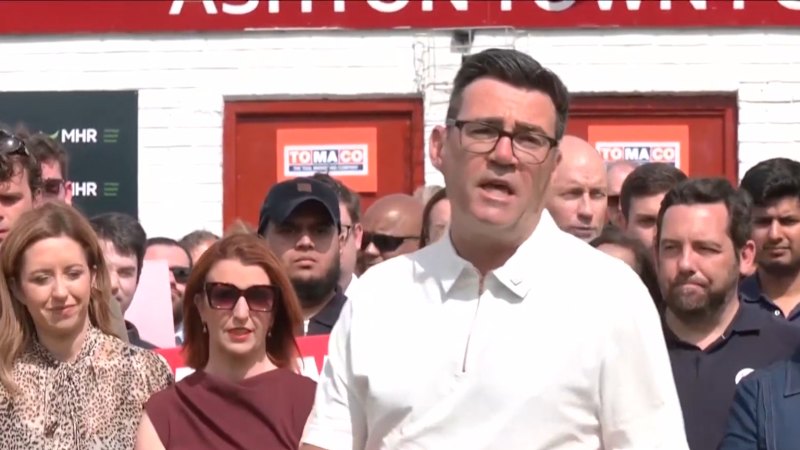
A political mandate won via a historical landslide is structurally distinct from institutional durability. Prime Minister Keir Starmer’s declaration that he will contest any formal challenge to his leadership represents a classic gamble on institutional incumbency rules, yet it miscalculates the systemic forces driving party-political shifts. The friction between an unpopular executive relying on formal parliamentary frameworks and a challenger capitalizing on regional executive popularity creates a highly predictable cost function for the governing party. When the Greater Manchester Mayor Andy Burnham secured 55% of the vote in the Makerfield by-election, he translated a localized executive brand into a liquid national parliamentary asset, establishing a dual-power dynamic within the Labour Party that cannot be resolved through appeals to a two-year-old electoral mandate.
The current instability within the executive branch is not merely a product of personal rivalries or isolated polling dips; it is the structural consequence of an asymmetry between electoral machinery and delivery mechanisms. Understanding this friction requires breaking down the modern political survival function into its constituent operational components.
The Tri-Centric Model of Party Control
An incumbent leader’s structural stability depends on maintaining equilibrium across three primary distinct vectors: parliamentary party discipline, wider membership favorability, and public electoral viability. When any single vector drops below a critical threshold, the entire architecture becomes unstable.
- The Parliamentary Party Threshold: Under existing party rules, a challenger requires the signatures of 20% of the Parliamentary Labour Party (PLP) to formally trigger a leadership contest—approximately 81 lawmakers given current seat distributions. With over 100 lawmakers now publicly calling for the executive to step aside, this threshold is structurally breached, rendering the formal activation of a contest a matter of logistical timing rather than probability.
- The Membership Favorability Premium: Formal internal elections are decided by the wider party membership base, where the incumbent’s historical policy pivots have depleted their baseline capital. Public polling instruments reveal a stark net favorability differential: the incumbent sits at minus 46 points, while the principal challenger, despite a recent dip to minus 11 points, maintains a superior net positioning among both the electorate and party activists.
- The External Electoral Threat: The primary driver of parliamentary dissent is the seat-retention anxiety of backbench lawmakers. The sustained pole position of populist insurgencies like Reform UK in national polling over the past 12 months acts as a direct threat to backbench survival. The Makerfield result demonstrated that a localized, populist-left platform can decisively suppress the Reform UK vote share to 34.5%, presenting a viable defensive blueprint that the current Downing Street operation has failed to replicate nationally.
This institutional vulnerability has catalyzed a three-way factional split. The incumbent relies purely on the executive apparatus; the principal challenger represents regional re-industrialization and cost-of-living prioritization; and a tertiary faction led by former Health Secretary Wes Streeting positions itself on a pro-growth, economically competitive axis designed to protect corporate investment while arguing for employment tax reductions.
The Operational Bottleneck of Leadership Contests
The decision by the executive to resist an orderly transition and instead force a protracted campaign imposes severe transaction costs on state administration. A standard leadership selection timeline introduces a multi-week paralysis across several core government operations.
Legislative Stagnation
Civil service capacity is finite. When a governing apparatus shifts its focus toward inner-party factional management, the legislative pipeline narrows. Major structural reforms—specifically NHS waiting list interventions, cross-border security frameworks, and child poverty reduction initiatives—are delayed as department heads redirect intellectual capital toward managing backbench alignment and voting blocks.
Policy Uncertainty Metrics
Capital markets discount political instability. The divergence in economic philosophy between the three factions introduces immediate policy risk for long-term investments. The tertiary faction’s advocacy for an equalized capital gains and income tax framework contrasts sharply with the principal challenger’s focus on utility bill suppression and state-led re-industrialization. This policy variance creates an informational vacuum, prompting domestic and foreign enterprise to delay capital deployment until regulatory certainty is re-established.
The Bureaucratic Hold Problem
Senior civil servants operate under explicit neutrality and continuity mandates. When an executive’s tenure is severely compromised, the bureaucratic apparatus defaults to risk-averse operational standstills. Long-term strategic planning is abandoned in favor of short-term maintenance, effectively freezing state execution until the leadership vector resolves.
The Mechanics of Strategic Deterrence
To counter this multi-front encroachment, the Downing Street apparatus has deployed a defensive strategy anchored in procedural friction. The primary tactic involves attempting to synchronize or sequence any leadership challenge with the secondary municipal by-election required to replace the Greater Manchester mayoralty. By insisting that the party cannot afford to manage a national leadership campaign and a massive regional mayoral contest simultaneously, the executive attempts to increase the immediate operational cost of dissent.
This procedural defense contains an inherent flaw: it assumes the challenger’s faction operates within the same risk parameters as the executive. For the insurgent faction, a brutal and unpleasant campaign is not a downside to be avoided, but an essential mechanism to thoroughly test the challenger’s platform before presenting it to the wider electorate. The offer of a senior cabinet post to the principal challenger was a classic co-optation maneuver designed to internalize the dissent. Its immediate rejection confirms that the challenger perceives the current executive brand as structurally insolvent, viewing any association with the current cabinet as an unnecessary dilution of their personal brand equity.
The Strategic Path Forward
The mathematical reality of parliamentary math and favorability trends indicates that the executive's strategy of pure containment is unsustainable over a multi-month horizon. To prevent total legislative paralysis and mitigate structural damage to the party's brand before the 2029 national election, a specific sequence of actions must be executed.
The deputy leadership must intervene to transition the conflict from an open-ended media proxy war into a closed-door arbitration process. A controlled room containing the three primary stakeholders—the incumbent, the principal challenger, and the tertiary pro-growth faction—is required to negotiate a structured transition timeline. The objective of this arbitration cannot be the preservation of the current executive; instead, it must focus on minimizing the duration of the transition window.
The incumbent must leverage their remaining institutional leverage to secure policy continuity guarantees on core 2024 manifesto commitments, specifically regarding European Union alignment and macroeconomic stability, in exchange for setting a definitive exit date post-weekend. Simultaneously, the challenger's faction must concede to an expedited campaign format that prevents a protracted public debate over fiscal policy, thereby preventing a market-damaging bidding war on un-costed spending pledges. Failure to execute this managed transition by the start of the next legislative week will guarantee that backbench anxiety forces a chaotic, unmanaged challenge, resulting in permanent damage to government stability and institutional trust.