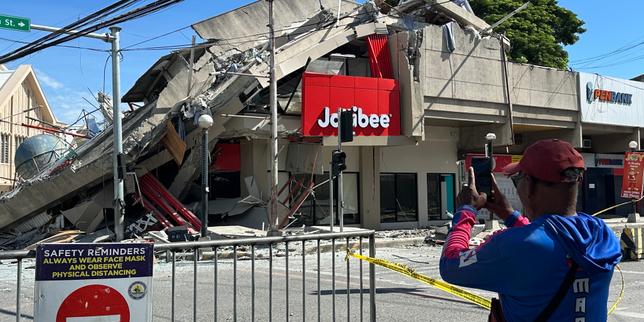
The destruction of commercial infrastructure during major Philippine earthquakes is not a random occurrence of natural fury, but a predictable consequence of structural vulnerability, specific geological compounding, and localized engineering deficits. Media coverage frequently prioritizes the sensational imagery of collapsing restaurants and buckling roads, treating these failures as isolated tragedies. A rigorous structural audit reveals that these incidents are systemic, occurring at the intersection of high-velocity seismic waves and vulnerable localized building typologies. Understanding the exact failure modes of these structures requires decoupling the seismic force into its component vectors and analyzing how low-rise commercial properties fail under specific lateral loads.
The Philippines sits atop the western fringe of the Pacific Ring of Fire, a region dominated by active subduction zones and complex fault systems, most notably the Philippine Fault Zone (PFZ). When these fault segments slip, they release energy that propagates as seismic waves. The impact on built environments depends on a three-part matrix: tectonic force, geotechnical amplification, and structural resistance.
The Triple-Vector Failure Matrix
The collapse of low-rise commercial structures, such as roadside restaurants and retail hubs, follows a distinct mechanical progression. Media footage often captures the final stage of a collapse—the total pancaking of a roof or floor—but misses the initial structural compromises that trigger the failure sequence.
1. The Soft-Story Deficit in Commercial Real Estate
The most critical vulnerability in modern commercial architecture is the soft-story phenomenon. To maximize floor space, parking access, or aesthetic appeal, the ground floors of retail buildings and restaurants often feature wide, open spaces with minimal interior partition walls. The upper levels, conversely, are frequently divided into storage rooms, offices, or residential units with dense configurations of masonry walls.
This creates a stark asymmetry in lateral stiffness. When horizontal seismic shear waves (S-waves) strike the foundation, the ground floor deforms excessively compared to the rigid upper levels. The structural response concentrates the entire seismic demand on the ground-floor columns. If these columns lack sufficient cross-sectional area or steel reinforcement, they undergo plastic deformation, losing their capacity to support vertical loads. The rigid upper structure then falls vertically, crushing the weakened ground level instantly.
2. Non-Ductile Concrete Detailing
Concrete is highly effective under compression but inherently brittle under tension. To withstand seismic activity, concrete elements must be detailed for ductility—the ability to deform under extreme stress without total catastrophic failure.
In many rapidly constructed commercial buildings, the detailing of reinforcing steel fails to meet ductile standards. Two specific deficiencies drive structural collapse:
- Inadequate Stirrup Spacing: Stirrups are the steel loops wrapped around longitudinal rebar in columns and beams. Under seismic loading, columns experience intense shear forces. If stirrups are spaced too far apart, the concrete core within the column undergoes shear cracking and bursts outward, causing the longitudinal rebar to buckle.
- Insufficient Hook Bends: Standard engineering specifications require stirrup hooks to be bent at 135 degrees into the core of the concrete. When 90-degree hooks are used instead, they easily pull open during the violent cycling of an earthquake, stripping the column of its confinement and leading to a sudden loss of load-bearing capacity.
3. Geotechnical Amplification and Liquefaction
The structural integrity of a building is inextricably linked to the engineering properties of the soil beneath it. Many coastal and riverine commercial districts in the Philippines are built on loose, saturated, alluvial soils.
During an earthquake, these soils experience a phenomenon known as liquefaction. The rapid, cyclical shaking increases the pore water pressure within the soil to a point where it equals the overburden pressure. Effectively, the soil loses its shear strength and behaves like a heavy liquid.
When liquefaction occurs, foundations lose their bearing capacity. This triggers differential settlement, where one side of a building sinks deeper than the other. The resulting tilt introduces a massive eccentric load on the structural frame, generating severe P-delta effects—secondary bending moments caused by the vertical load acting on a displaced structure—that rapidly exceed the design tolerances of the columns.
Structural Interdependencies and Chain-Reaction Damage
The destruction observed in urban and semi-urban corridors during Philippine earthquakes is rarely confined to a single isolated structure. Infrastructure systems operate as an interconnected web; the failure of one node accelerates degradation across adjacent systems.
[Seismic Event]
       │
       ├──> Soft-Story Collapse ──> Structural Debris ──> Roadway Blockage
       │
       └──> Soil Liquefaction ──> Mainline Pipe Rupture ──> Loss of Water Pressure
                                                                     │
                                                                     ▼
                                                         [Inability to Suppress Fires]
The Masonry Infill Paradox
A common construction method in the Philippines involves using non-structural concrete hollow blocks (CHBs) to fill the gaps between reinforced concrete frames. Engineers often treat these walls as non-load-bearing elements during design. However, during an actual seismic event, these infill walls interact dynamically with the frame.
In the initial stages of shaking, masonry infill increases the stiffness of the frame. But as the shaking intensifies, the brittle CHB walls crack and fail prematurely. If this failure occurs unevenly across the structure, it creates an unintended "short-column effect." The remaining intact walls restrict the lateral movement of a column over most of its height, forcing all the seismic shear into a small, exposed section of the column. This localized shear demand routinely exceeds the column's capacity, resulting in sudden, catastrophic shear failure.
Secondary Hazards and Utility Decoupling
The immediate collapse of structural frames is only the primary phase of hazard manifestation. The secondary phase involves the rupture of utility lifelines, which frequently causes greater long-term economic and human loss than the shaking itself.
Flexible structural frames are designed to sway to dissipate seismic energy. However, if the mechanical, electrical, and plumbing (MEP) systems crossing structural joints lack flexible couplings, they sever instantly. Ruptured electrical conduits spark against surrounding debris, while severed gas or fuel lines provide immediate acceleration vectors for fire. Simultaneously, sub-surface ground deformation ruptures municipal water mains, dropping line pressure to zero and rendering localized fire suppression systems entirely useless.
Limitations of Current Mitigation Frameworks
Addressing these systemic vulnerabilities requires acknowledging the structural limitations inherent in regional compliance and enforcement mechanisms. While the National Structural Code of the Philippines (NSCP) features advanced seismic design provisions aligned with international standards, a significant gap exists between theoretical code compliance and empirical field execution.
The primary bottleneck is the lack of rigorous, independent third-party inspection during the concrete pouring and steel tying phases of private commercial construction. Minor deviations on-site—such as adding excess water to a concrete mix to make it easier to pour, which drastically lowers its ultimate compressive strength—are difficult to detect once the material cures. Furthermore, the extensive inventory of legacy structures built prior to modern code revisions presents an ongoing, unquantified collapse risk that cannot be mitigated by new regulations alone.
Systemic Intervention Protocol
Mitigating structural collapse risks across seismically active zones requires a shift from reactive emergency response to predictive, engineering-led intervention. The following protocol outlines the critical actions necessary to harden commercial infrastructure against future catastrophic failures.
Mandatory Structural Retrofitting Priorities
- Steel Jacketing of Soft Stories: Existing commercial buildings exhibiting soft-story configurations must undergo mandatory retrofitting. Encasing vulnerable ground-floor columns in structural steel jackets or carbon fiber reinforced polymer (CFRP) wraps increases confinement pressure, prevents rebar buckling, and shifts the failure mode from brittle to ductile.
- Installation of Fluid Viscous Dampers: For mid-rise commercial properties, integrating fluid viscous dampers into the structural frame alters the building's dynamic response. These devices absorb a massive percentage of the kinetic energy imparted by seismic waves, reducing inter-story drift and protecting both structural and non-structural components.
Geotechnical Hardening and Foundation Design
- Transition to Deep Foundations in High-Risk Zones: Future commercial developments situated within mapped liquefaction zones must be restricted from using shallow isolated footings. Regulatory frameworks must mandate driven or bored piles that penetrate through loose, liquefiable soil strata to anchor directly into competent bedrock.
- Soil Stabilization Mandates: Prior to construction in alluvial areas, ground improvement techniques—such as jet grouting, vibro-flotation, or the installation of stone columns—must be deployed to densify loose sand deposits, preventing the pore-water pressure buildup that drives liquefaction.