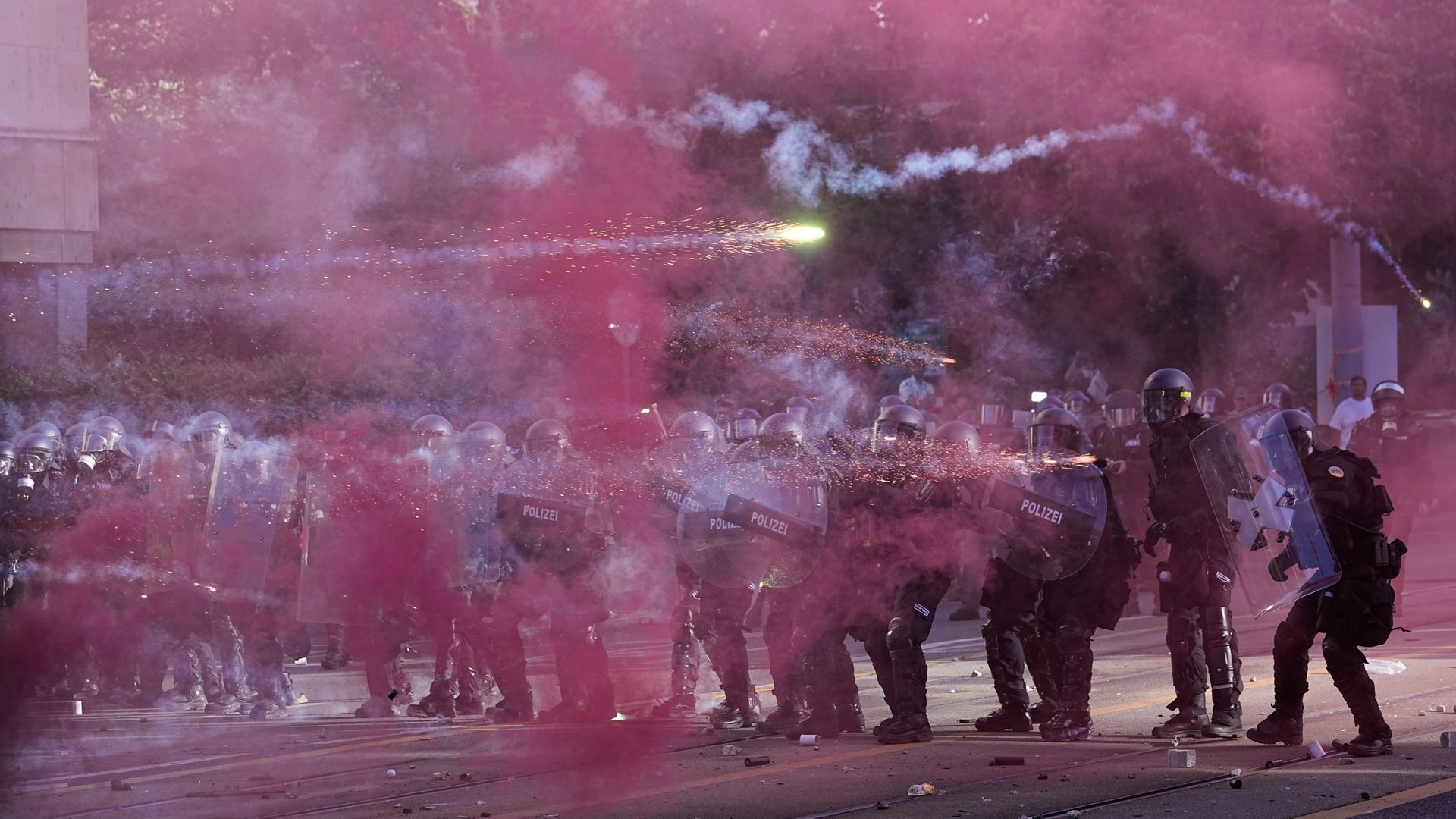
Civil unrest during high-profile geopolitical summits follows a predictable operational pattern driven by friction between asymmetric state-control mechanisms and decentralized activist groups. When Swiss law enforcement clashed with anti-G7 protesters in Geneva, the resulting escalation was not a random outburst of violence, but the logical outcome of specific strategic vulnerabilities. To understand why urban security frameworks fail or succeed during global forums, one must look past the media narrative of chaos and analyze the structural variables: spatial containment failures, tactical asymmetry, and the economic cost function of modern policing.
The core breakdown in summit security almost always stems from a failure to balance deterrence with mobility. Municipalities frequently treat crowd control as a static perimeter problem, whereas modern protest movements operate via decentralized, fluid networks. Examining the operational architecture of these confrontations reveals the precise mechanics of why containment strategies fail, how kinetic escalation occurs, and how state actors must recalibrate their doctrine to maintain civil order without triggering systemic blockades.
The Tri-Zonal Security Framework and Spatial Vulnerability
Large-scale state events rely on a tiered defensive geometry designed to insulate VIPs while allowing the surrounding city to function. When this geometry is compromised, tactical degradation occurs rapidly. The standard containment model segregates the urban environment into three distinct operational rings.
- The Sterile Zone (Inner Ring): This area houses the delegates, venues, and critical infrastructure. It is characterized by hard physical barriers, biometric or strict credential access checkpoints, and a zero-tolerance policy for unauthorized personnel. Security in this zone is absolute and rarely breached.
- The Buffer Zone (Middle Ring): This zone acts as a shock absorber. It encompasses the streets, transit hubs, and transit corridors immediately radiating from the sterile zone. Law enforcement attempts to maintain high visibility and controlled access here, filtering out bad actors while permitting local commerce.
- The Free Assembly Zone (Outer Ring): This is the designated space for sanctioned demonstrations, marches, and media staging. It is highly accessible and relies on soft policing tactics to facilitate free speech.
The structural failure in Geneva occurred at the intersection of the Buffer Zone and the Free Assembly Zone. When decentralized splinter groups bypass designated march routes, they exploit the spatial transition points where police density decreases.
In urban environments, narrow streets and historic architecture act as natural terrain bottlenecks. If a crowd shifts unexpectedly into these corridors, the state's numerical advantage is neutralized. Law enforcement units become structurally rigid, unable to deploy armored vehicles or maintain cohesive skirmish lines, which shifts the tactical advantage to small, highly mobile affinity groups.
The Asymmetry of Engagement: Black Bloc Tactics vs. Bureaucratic Command
The escalation of violence during the Geneva pre-summit demonstrations highlights the tactical mismatch between a hierarchical command structure and a decentralized network. Activist networks frequently employ variant forms of the "Black Bloc" methodology, which is an operational doctrine rather than a cohesive organization.
This methodology relies on a deliberate signature-reduction strategy. By wearing identical black clothing, face coverings, and using umbrellas to shield movements from aerial surveillance, individuals mask their identities and blend into a homogenous mass. This creates an immediate cognitive burden for law enforcement, who are legally and operationally required to identify specific individuals committing property damage before applying targeted force.
[Decentralized Network: Black Bloc] -> Exploits Anonymity & Mobility -> Forces Broad State Response
                                                                             │
[Hierarchical Command: State Police] <- Suffers Delays & Rigidity   <- Kinetic Escalation
This dynamic introduces a severe bottleneck into the police decision-making loop. The command structure operates on a top-down authorization model: field intelligence must flow up to a central command post, which evaluates political and legal risk before issuing orders back down to tactical units. Conversely, decentralized affinity groups operate on autonomous peer-to-peer protocols. They detect gaps in police lines in real-time, communicate via encrypted mesh networks or localized signaling, and execute property destruction or barricade deployment within minutes.
When the state faces this level of agility, the standard operational response is to transition from targeted intervention to area-denial tactics. This includes the deployment of chemical irritants (tear gas, pepper spray), water cannons, and kinetic impact munitions. While effective at clearing geographic space, the use of area-denial weapons inherently radicalizes neutral or peaceful participants within the crowd, expanding the conflict vector and worsening the public relations crisis for the host city.
The Economic and Kinetic Cost Function of Urban Mobilization
The sustainability of any municipal security operation is governed by a strict cost function. Cities hosting international summits face compounding financial and resource strains that diminish tactical effectiveness over time.
$$\text{Total Operational Cost} = C_{\text{labor}} + C_{\text{logistics}} + C_{\text{attrition}} + C_{\text{external}}$$
Where:
- $C_{\text{labor}}$ represents overtime pay, hazard pay, and the mutual aid agreements required to pull officers from neighboring jurisdictions.
- $C_{\text{logistics}}$ covers the procurement of physical barriers, specialized riot gear, non-lethal munitions, and command vehicles.
- $C_{\text{attrition}}$ accounts for equipment damage, officer injuries, and subsequent sick leave.
- $C_{\text{external}}$ calculates the broader economic loss suffered by local businesses due to forced closures, property damage, and supply chain disruptions.
In secondary international hubs like Geneva, the deployment of thousands of public safety officers causes an immediate drain on municipal reserves. To optimize this expenditure, police leadership often implements 12-hour or 18-hour shifts. This introduces cognitive fatigue into the rank-and-file tactical units.
Fatigued officers suffer from diminished situational awareness, slower reaction times, and an increased likelihood of either under-reacting to genuine threats or over-reacting with excessive force. Both outcomes accelerate the breakdown of public order. Furthermore, the reliance on mutual aid units creates interoperability friction. Officers from different regions frequently use incompatible radio frequencies, lack familiarity with local geography, and operate under differing rules of engagement, leading to fragmented tactical lines during a live confrontation.
Systemic Limitations of Modern Crowd Management Doctrines
Western law enforcement agencies generally operate under two competing crowd-control philosophies, both of which exhibit vulnerabilities when applied to ideologically driven anti-globalization protests.
The Negotiated Management Model
This approach prioritizes early communication, pre-approved march routes, and self-policing among protest organizers. It minimizes state visibility to prevent escalation. However, this model collapses when dealing with modern, leaderless movements. When an organization has no formal hierarchy, there are no representatives capable of enforcing agreements on the street. The moderate factions are easily sidelined by radical fringes who view cooperation with the state as an operational failure.
The Strategic Incapacitation Model
Developed as a response to the breakdown of negotiated management, this doctrine focuses on risk mitigation through aggressive space management. It features the heavy use of mass arrests, pre-emptive closures, large-scale kettle maneuvers (surrounding and containing a crowd within a confined space), and strict enforcement of minor infractions.
While highly effective at protecting property and preventing crowds from reaching the Sterile Zone, strategic incapacitation carries a high systemic cost. Kettling operations frequently trap journalists, bystanders, and peaceful demonstrators alongside violent actors, creating significant legal liabilities for the municipality and fueling narratives of state overreach.
Strategic Realignment for Municipal Command Structures
To mitigate the volatility observed in Geneva and similar urban environments, municipal authorities must abandon archaic, static containment strategies and transition to an agile, data-driven operational posture.
First, tactical units must replace rigid skirmish lines with highly mobile, modular snatch squads. Instead of engaging an entire crowd with area-denial weapons, these squads utilize real-time video analytics and drone reconnaissance to pinpoint and isolate specific individuals engaging in criminal activity, removing them from the ecosystem without disrupting the broader demonstration.
Second, the spatial configuration of the city must be managed dynamically. Rather than deploying permanent physical barriers that paralyze commerce and anger the local populace, police forces should utilize vehicle-mounted, rapid-deployment fencing systems that can be adjusted within minutes based on crowd movement vectors.
Finally, command structures must decentralize their decision-making authority. Field commanders must be empowered to adjust tactical postures and apply specific rules of engagement instantly, eliminating the bureaucratic delay that allows decentralized networks to outmaneuver the state. Until these adjustments are codified into standard policing doctrine, high-profile summits will continue to serve as highly predictable flashpoints for urban warfare.