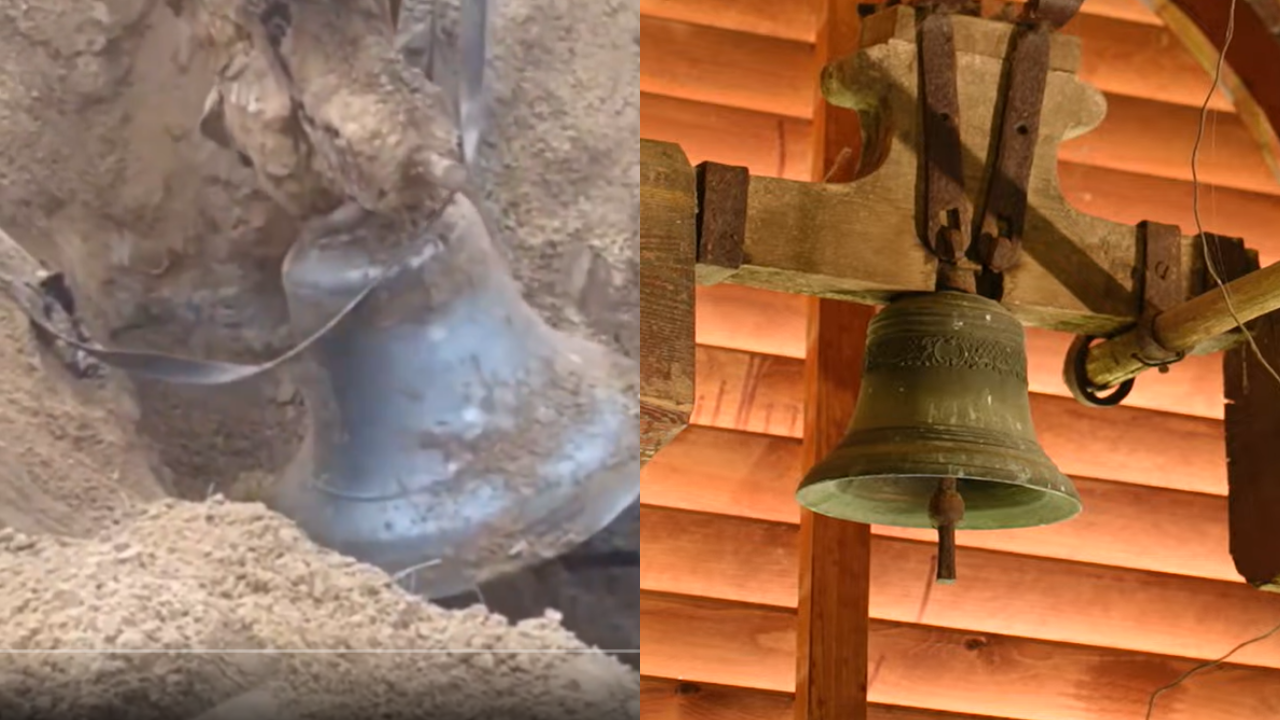
The unearthing of a high-mass bronze church bell buried for 82 years in a rural field demonstrates that wartime asset preservation is not merely an act of desperate concealment, but a structured risk-mitigation strategy. When military occupations threaten community infrastructure, civilian populations rapidly calculate asset vulnerability based on ideological, economic, and strategic military factors. During World War II, the systematic requisitioning of non-ferrous metals by occupying forces created a high-risk environment for cultural property.
To understand why a community would invest significant caloric energy and logistical risk into burying an object weighing hundreds of kilograms, we must look past the emotional narrative and analyze the operational framework of wartime asset preservation. The survival of such artifacts depends on a precise calculation of three variables: the velocity of the enemy advance, the material utility of the asset to the occupier, and the long-term informational security of the concealment site.
The Requisition Incentive Model: Why Bells Were Target Assets
Occupying forces in World War II—particularly the German Wehrmacht and its industrial supply arms—operated under acute resource scarcity. Non-ferrous metals, specifically copper and tin alloys (bronze), were high-priority targets for military supply chains.
A standard church bell is an optimized cache of high-purity industrial alloy, typically consisting of 78% copper and 22% tin. This specific metallurgical composition, known as bell metal, possesses structural properties highly valued in military manufacturing:
- Corrosion Resistance: The high tin content creates a passivating oxide layer, making the alloy valuable for naval hardware, bearings, and bush components exposed to harsh environments.
- Tensile Strength: Bronze alloys are easily repurposed for heavy machinery components, munitions casings, and low-friction gears.
- Smelting Efficiency: Unlike low-grade ores, church bells represent pre-refined, high-density scrap. The energy expenditure required to melt down an existing bronze artifact is a fraction of the thermal energy needed to mine, transport, and smelt raw copper and tin.
Because of this metallurgical utility, the occupying administration established systematic tracking registries for ecclesiastical property. Bells were categorized by historical value, weight, and material composition. Lower-tier categories faced immediate removal, transport, and smelting at central metallurgical plants. The threat was not random looting, but state-sanctioned, industrialized asset stripping.
The Risk Mitigation Matrix: Logistics of Concealment
When a community identifies an asset as a high-probability target for requisition, the decision to conceal it triggers a complex logistical operation. The success of this operation relies on managing three distinct operational risks: physical labor detection, structural degradation, and informational decay.
Physical Labor Detection and Geolocation Selection
The physical act of moving an object weighing between 500 and 1,500 kilograms without mechanized transport requires significant human capital. In a wartime environment characterized by curfews, surveillance, and potential informants, the labor force must be small, highly trusted, and efficient.
The selection of an agricultural field as the burial site satisfies several tactical requirements. First, newly disturbed earth is highly visible from aerial reconnaissance and ground patrols. In an active agricultural zone, plowing, tilling, and ditch-digging provide natural cover for soil disruption.
Second, the depth of the excavation must exceed the standard agricultural plow depth (typically 20 to 30 centimeters) while remaining above the local water table to prevent accelerated structural shifting. The target depth must also account for future landscape alterations. Burying an asset too shallow risks exposure via natural soil erosion or deep-tillage equipment; burying it too deep increases the detection window during the initial excavation phase.
Material Degradation Mitigation
While bronze is highly resistant to atmospheric corrosion due to the formation of a protective copper carbonate patina, subterranean burial introduces distinct chemical risks. Soil chemistry dictates the preservation state of buried bronze:
- Aeration and Moisture: Oxygenated, moist soils accelerate pitting corrosion.
- Acidity: Acidic soils (low pH), often found in areas with high organic matter decay or specific geological compositions, actively dissolve the protective patina, leading to "bronze disease"—a rapid, destructive chloridization process.
- Soil Compaction: Heavy clay soils limit oxygen ingress, creating an anaerobic environment that, while slower to corrode, subjects the object to high physical pressures and shifting forces.
The long-term survival of the asset for over eight decades indicates that the burial environment achieved a state of chemical equilibrium. The formation of a stable, thin oxide layer insulated the underlying alloy from further degradation, neutralizing the environmental vectors that typically destroy buried base metals.
Informational Security and the 82-Year Data Gap
The primary failure point in long-term asset concealment is not material failure, but informational decay. The location data of the hidden asset must be stored and transmitted across generations without exposing the data to adversary intelligence networks.
Communities typically utilize one of two information security models:
| Security Model | Operational Mechanism | Primary Vulnerability |
|---|---|---|
| Centralized Cryptographic Documentation | Recording precise coordinates or landmarks on physical media (maps, ledgers) and hiding the document. | Physical interception by occupying forces; destruction of the document via wartime collateral damage. |
| Decentralized Oral Redundancy | Entrusting the spatial coordinates to a tight-knit cohort of community leaders via oral tradition, relying on landmark association. | High mortality rates among holders of the information; radical alteration of the physical landscape over decades. |
The fact that this specific asset remained interred for 82 years indicates a complete break in the informational transmission chain. The cohort responsible for the burial likely suffered 100% attrition before the cessation of hostilities or the stabilization of the political environment.
When the human storage vectors die without transmitting the coordinates, the data transitions from "secured asset location" to "lost historical anomaly." The asset is then subject to random discovery via agricultural friction—the physical collision between modern deep-earth farming implements and the buried structure.
The Economic and Social Incentive Structure of Recovery
The preservation of a church bell presents an interesting cost-benefit asymmetry for a rural population. Unlike currency, precious gems, or portable machinery, a high-mass bronze bell possesses zero liquidity during a wartime occupation. It cannot be exchanged for food, fuel, or medicine on the black market without immediate detection. Furthermore, its possession carries extreme penalties, including execution or forced labor for complicit parties.
The incentive to preserve the asset is therefore entirely tied to its post-war utility function. In rural networks, the church bell serves as a critical coordination mechanism. It functions as a non-electric communication network for emergency broadcasting, time-keeping, and civic cohesion.
By removing the asset from the immediate reach of the occupier, the community accepts a high short-term security risk to guarantee the survival of their primary post-war communications infrastructure. The asset is viewed as an irreplaceable capital investment; the cost of manufacturing or acquiring a replacement bronze casting in a post-war, hyper-inflationary economic environment would be prohibitively high for a devastated rural economy.
Operational Assessment of Accidental Unearthing
The transition of the asset from hidden to recovered via agricultural activity highlights the limitations of long-term subterranean concealment. Over a timeline exceeding half a century, topography changes. Factors such as topsoil deflation caused by intensive farming, the introduction of heavier, deeper-penetrating modern subsoiling machinery, and shifts in local hydrology modify the depth equilibrium established in the 1940s.
When evaluating the recovery of long-interred assets, organizations must deploy a structured investigation framework rather than treating the event as an isolated anomaly:
- Metallurgical Integrity Assessment: Prior to extraction, the structural stability of the alloy must be analyzed via non-destructive testing (such as ultrasonic testing) to detect internal stress fractures or deep chloridization that could cause catastrophic structural failure under mechanical lifting loads.
- Stratigraphic Context Mapping: The soil layers surrounding the asset must be analyzed to determine if the object shifted vertically over time or if recent land management altered the protective overburden.
- Provenance and Registry Reconciliation: The physical dimensions, inscriptions, and metallurgical signatures must be cross-referenced with pre-war inventory baselines to re-establish the legal chain of custody and determine ownership rights between civic, religious, and private landowning entities.
The discovery serves as a reminder that long-term asset preservation strategies must account for the inevitable decay of human systems. While the material engineering of the concealment successfully protected the physical alloy from the industrial demands of wartime scrap requisition, the informational architecture failed to survive the geopolitical and generational transitions of the post-war era. The preservation was physically successful, but operationally incomplete until accidental mechanical intervention resolved the informational deficit.