The camera shutter clicks, and for a thousandth of a second, the world freezes. We look at these images—a rocket glinting under Florida’s humidity, a ballot box in a dusty Budapest corridor, a golden arch rising above a construction site—and we tell ourselves they are separate stories. We are wrong. They are the same story. It is the story of how we try to anchor ourselves to something permanent while the floor beneath us continues to shift.
The Weight of the Next Giant Leap
Inside a sterile hangar, four human beings are preparing to leave the atmosphere. They aren't just pilots; they are the physical manifestation of a fifty-year-old promise. Artemis II isn't about the moon, not really. It’s about the terrifying realization that we might have forgotten how to be pioneers.
Consider Reid Wiseman, Victor Glover, Christina Koch, and Jeremy Hansen. When they strap into the Orion capsule, they aren't just sitting on top of millions of pounds of propellant. They are sitting on top of a mountain of tax dollars, national pride, and the desperate hope that humanity still has a "forward" gear.
The facts are heavy. This mission will carry them 6,400 miles beyond the far side of the lunar surface. They won't land. They will loop around, a slingshot maneuver powered by gravity and math, before falling back to Earth. It sounds clinical when you read it in a press release. But think about the silence in that cabin when the engines cut out and the only thing between them and the vacuum is a few inches of alloy. They are the first humans to see the entire Earth as a marble in over half a century.
Why now? Because we are bored of the low Earth orbit. We have spent decades circling the block in the International Space Station. Artemis II is the moment we finally put the car in gear and head for the highway. It’s a test of the heat shield, yes, but more importantly, it’s a test of our collective nerve. If this fails, the dream of Mars dies for a generation. The stakes aren't just scientific. They are existential.
The Ballot and the Quiet Revolution
While we look up at the moon, the ground is vibrating in Central Europe. In Hungary, an election isn't just a tally of votes; it is a tug-of-war for the soul of a region that has spent centuries being the buffer between empires.
Imagine a grandmother in a village outside Debrecen. She doesn't care about lunar trajectories. She cares about the price of flour and whether her grandson will be drafted if the border tensions boil over. For her, the "Week in Pictures" isn't a gallery of high-definition wonders; it’s a series of warnings.
The political machinery in Budapest is a masterclass in narrative control. When Viktor Orbán speaks, he isn't just campaigning. He is telling a story about sovereignty in an age where borders feel increasingly porous. The statistics tell us one thing—inflation rates, GDP growth, European Union sanctions—but the faces of the voters in the photographs tell another. They look tired. They look like people who are trying to vote for stability in a world that has forgotten what the word means.
The tension in Hungary reflects a global fracture. We see it in the way the crowds gather, the way the posters are plastered over bullet-scarred brick from older wars. This isn't dry political science. This is the friction of people trying to decide if they want to be part of a global future or a protected past.
The Golden Arch and the Ghost of an Empire
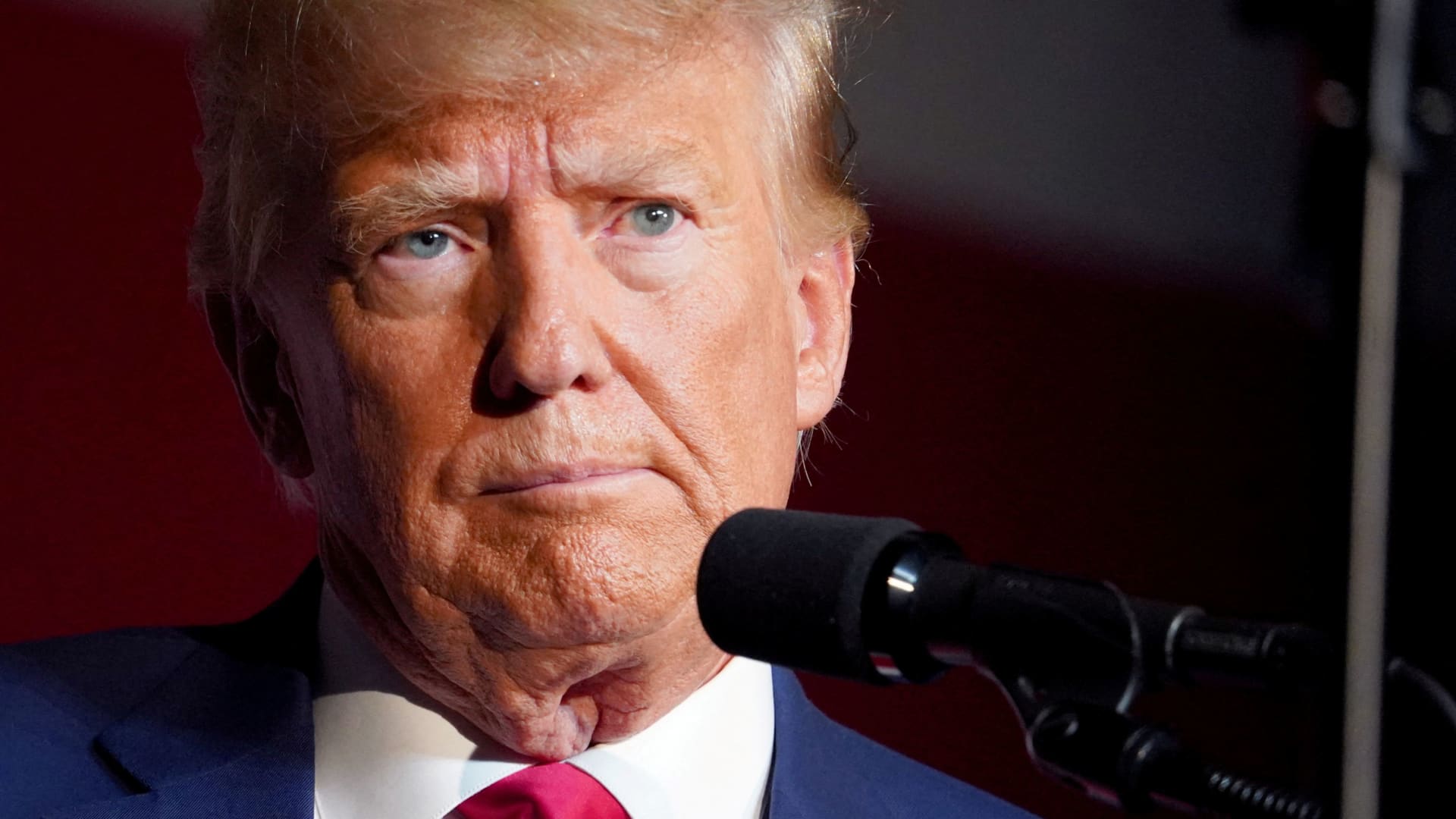
Then there is the arch. Not the one in St. Louis, but the one being courted, debated, and displayed as a trophy in the American political theater. Donald Trump’s fixation on symbols isn't accidental. Symbols are the shorthand of power.
When a skyscraper or a monument is framed in a photograph, it isn't just steel and glass. It is a claim to the land. The "coveted arch" mentioned in the week’s dispatches serves as a reminder that we live in an era of branding. Whether it’s a political movement or a real estate empire, the goal is the same: to leave a mark that can be seen from a distance.
There is a strange symmetry between the Orion capsule and the architectural vanity of a billionaire. Both are attempts to build something that outlasts the person who built it. One uses the language of physics; the other uses the language of ego. Both are obsessed with heights.
The Invisible Thread
What connects a lunar flyby, a Hungarian ballot, and a gold-plated legacy?
Vulnerability.
We build rockets because we are afraid of being stuck on a dying planet. We vote for strongmen because we are afraid of a chaotic world. We build arches because we are afraid of being forgotten.
The images from this week capture a species in transition. We are halfway between the cave and the stars, and we are remarkably clumsy at navigating the space in between. We argue over ballot boxes while the most sophisticated machine ever built sits on a launchpad 4,000 miles away. We obsess over the legal battles of a former president while a woman prepares to become the first female astronaut to leave Earth’s immediate orbit.
The irony is thick enough to choke on. We have the technology to touch the moon, yet we still haven't figured out how to share a continent without threatening to burn it down.
The Mirror in the Sky
When the Artemis II crew looks back at Earth from the dark side of the moon, they won't see borders. They won't see the Hungarian fence or the American courtrooms. They will see a thin, blue line of atmosphere—the only thing keeping us from being a collection of frozen statues in a void.
That perspective is the "hidden cost" of our progress. We spend billions to get that view, hoping it will finally make us realize how small our quarrels are. But as soon as the capsule splashes down in the Pacific, we go right back to the grit and the noise.
The photos of the week aren't just a record of events. They are a mirror. In one frame, we are gods reaching for the heavens. In the next, we are children arguing over the playground.
The metal under our feet—the tanks of the SLS rocket, the ballot boxes of Budapest, the structural steel of the arch—is all the same material. It is cold, hard, and indifferent. It only takes on meaning when we project our fears and our dreams onto it.
Right now, the dream is to go back. Not just to the moon, but to a time when we believed that big projects could unite us. Whether a rocket or a fair election can actually do that remains to be seen. The shutter has clicked. The image is developing. We are just waiting to see if we like the person staring back at us from the glossy page.
Somewhere in the Atlantic, a recovery ship is practicing for a return. In a Hungarian square, a volunteer is scrubbing graffiti off a wall. In a courtroom, a lawyer is checking his watch.
The world turns, and we keep taking pictures, hoping that if we capture enough moments, we might eventually understand the whole. We haven't yet. But the rocket is still on the pad, and the sun is still rising over the Danube, and for now, that is enough of a reason to keep looking.