When the people who actually ran the Pentagon tell you the house is on fire, it's a good idea to listen.
For decades, American foreign policy operated on a simple baseline. No matter who sat in the Oval Office, Washington kept its promises to its friends. If an ally got hit, America had their back. But we're in uncharted waters now. The old guard—the retired four-star generals, the former secretaries of defense, and the chiefs of staff who stood between Donald Trump and the global order—are blowing the whistle with unprecedented urgency. Their warning isn't about political differences. It's about the complete dismantling of alliances that have kept the peace since World War II.
What do these military insiders actually see that terrifies them so much? It boils down to a fundamental clash of worldviews. Where national security experts see alliances as invaluable power multipliers, Trump views them as a bad business deal where America gets ripped off. This transactional approach is shifting from campaign rhetoric to concrete reality, leaving America’s closest partners exposed.
The Men Who Stood in the Gap
To understand how deep this panic goes, you have to look at the people sounding the alarm. These aren't partisan commentators. These are the exact leaders Trump handpicked to run his national security apparatus because of their legendary reputations.
Take retired Marine General Jim Mattis, Trump’s first secretary of defense. Mattis famously resigned because he refused to abandon America's Syrian allies, explicitly writing in his resignation letter that the US must treat allies with respect. Then there's John Kelly, another retired four-star Marine general and Trump’s former chief of staff, who has described Trump’s approach to governance as fundamentally authoritarian and untrustworthy.
Perhaps most damning are the words of General Mark Milley, the former chairman of the Joint Chiefs of Staff. Milley has privately and publicly described the threat to the constitutional and global order as "irreparable". When three of the most decorated military leaders of their generation all conclude that a commander-in-chief is a clear danger to global stability, it isn't noise. It's a distress signal.
The Death of Mutual Trust
The core of any military alliance is a psychological concept called deterrence. You don't necessarily have to fight a war if your enemy believes, without a shadow of a doubt, that attacking your ally means fighting you too.
Trump single-handedly destroys that certainty. Look at his ongoing rhetoric surrounding NATO's Article 5—the foundational clause stating an attack on one member is an attack on all. Trump has repeatedly suggested that the US wouldn't defend countries that don't meet defense spending targets, even dropping hints at summits that American protection is conditional.
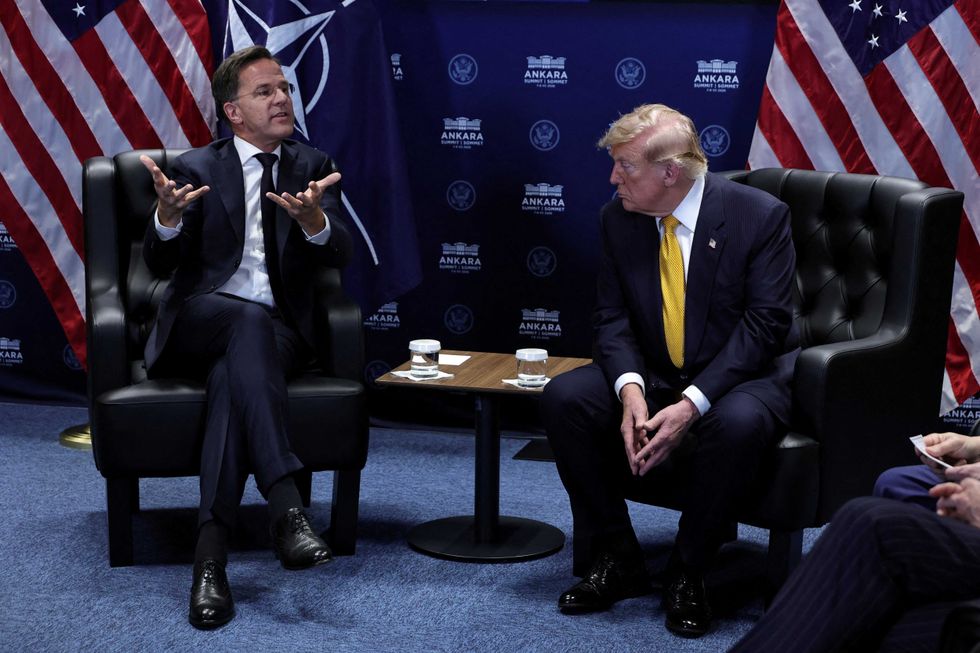
During recent NATO gatherings, the tension has been palpable. While European leaders scramble to present massive defense spending numbers to appease him, Trump has doubled down on erratic geopolitical demands. His bizarre, recurring fixation on taking control of Greenland from Denmark—even threatening troop pullouts from Europe over it—proves to military planners that traditional strategic logic has been replaced by impulsive whimsy.
French President Emmanuel Macron captured the anxiety perfectly when he noted that an alliance is only worth the trust behind it. If a president creates doubt every single day, the alliance is stripped of its substance.
Testing Friends to the Breaking Point
Military insiders point out that Trump’s transactional mindset turns long-term alliances into a series of short-term tests.
He recently admitted to "testing" European allies during the conflict with Iran, expecting them to immediately back American military strikes. When nations like France, Germany, and Italy hesitated to jump into an unprovoked Middle Eastern escalation, Trump used it as justification to trash the alliance entirely, complaining that America spends billions defending countries that "aren't there for us".
This creates a dangerous double standard:
- Allies are expected to show blind loyalty to unilateral American actions.
- America reserves the right to walk away from its treaty obligations at any moment.
This logic fractures relationships with nations that have shed blood alongside American troops for decades. If Washington won't stand by Denmark over Greenland, or Germany over regional security, why would Tokyo or Seoul trust America to stand by them if things go sideways in Asia?
The Scramble for a Post American World
So, what happens next? Allies aren't sitting around waiting to find out if America will honor its word. The direct result of this military alarmism is a massive, frantic effort by America’s partners to decouple their security from Washington.
We are seeing a historic rearming of Europe. Nations are shifting billions into defense budgets not just to make Trump happy, but because they genuinely believe they might have to fight alone. They're building up independent defense industries and forging localized military pacts.
This doesn't make America safer. It isolates it. When the US isolates itself from its allies, it loses access to global intelligence networks, forward-deployed bases, and combined economic power. The current military consensus is clear: a nation without reliable friends is a nation volunteering for vulnerability. If America continues down a path of transactional diplomacy, it will eventually find itself standing completely alone in a hostile world.