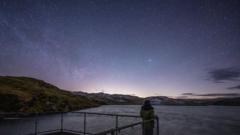
You don't realize how much the orange glow of streetlights has stolen from you until you stand in the middle of the Elan Valley at 2:00 AM. Most of us live under a constant haze of light pollution. We see a few dozen stars on a clear night and think we've seen the sky. We haven't. My trip to rural Wales wasn't just a weekend away. It was a brutal reminder that we’ve traded the infinite cosmos for LED billboards and smartphone pings.
Wales is home to some of the darkest skies on the planet. This isn't marketing fluff. The International Dark-Sky Association (IDA) has officially designated large swaths of the country as International Dark Sky Reserves and Parks. Brecon Beacons, Snowdonia (Eryri), and the Elan Valley are world-class. When I stepped out of my car in a remote corner of Powys, the silence was heavy. Then I looked up.
It wasn't just "stars." It was a thick, chalky smear of light stretching from one horizon to the other. The Milky Way looked like a celestial river of spilled milk and diamond dust. It felt close enough to touch. Honestly, it was slightly terrifying. You feel your own insignificance in your marrow.
Why the Welsh mountains beat your local park every time
Most people try to stargaze from their back garden. That's a mistake. Even if you think it's dark, "sky glow" from nearby towns washes out the faint details of nebulae and distant galaxies. You need a Bortle Scale rating of 1 or 2 to see the universe as our ancestors did.
The Bortle Scale measures the night sky's brightness. A city center is a Class 9. The Elan Valley Estate in Wales sits comfortably at a Class 2. In these conditions, the sky isn't black; it’s crowded. You can’t even find the familiar constellations like the Big Dipper at first because there are too many "extra" stars surrounding them.
The geography of Mid and North Wales creates a natural shield. High peaks and deep, sparsely populated valleys block the light from distant cities like Cardiff or Liverpool. You’re left with raw, unfiltered space. It’s one of the few places in Western Europe where you can still see the Andromeda Galaxy with the naked eye. That’s a collection of a trillion stars located 2.5 million light-years away. Think about that while you’re worrying about your inbox.
The gear you actually need for a night in the dark
Forget the massive telescopes. If you’re a beginner, a telescope is just an expensive way to get frustrated in the dark. It limits your field of view to a tiny patch of sky. To truly "bathe" in starlight, you want the big picture.
I brought a pair of 10x50 binoculars. They’re light enough to hold steady and powerful enough to resolve star clusters that look like blurry smudges to the eye. You see depth. You see the reddish tint of Betelgeuse and the icy blue of Rigel.
What you really need to pack:
- A red-light headlamp. White light ruins your night vision instantly. It takes your eyes about 20 to 30 minutes to fully adjust to the dark. One look at a phone screen or a normal flashlight and you’re back to square one.
- A reclining camping chair. Staring straight up for two hours will wreck your neck. You want to be horizontal.
- Wool layers. Even in August, the Welsh hills get biting cold once the sun drops.
- A plan. Use an app like Stellarium or SkySafari to identify what you’re looking at, but put the phone away once you’ve got your bearings.
Chasing the core and the best time to go
Timing is everything. If you go during a full moon, you’ve wasted your petrol. The moon is a giant light bulb that drowns out the Milky Way. You need to check the lunar calendar and aim for the "New Moon" phase—the window of three days before and after when the moon isn't in the sky.
Seasonality matters too. The "Milky Way season" in the UK runs from late February to October. This is when the galactic core—the brightest, most dense part of our galaxy—is visible above the horizon. In the winter, we’re looking "out" toward the edge of the galaxy. It’s still pretty, but it lacks that dramatic, glowing clouds-of-gas look.
I went in late summer. Around midnight, the core was hanging low in the south. The detail was staggering. You could see the "Great Rift," the dark lanes of dust that sit between us and the galactic center. It’s a 3D experience that no high-res photo can truly replicate.
The psychological impact of total darkness
We aren't wired for 24/7 illumination. Scientists call it "light hunger." There is a documented physiological shift that happens when you spend hours in true darkness. Your heart rate slows. Your perspective shifts.
Standing in a Welsh field, I realized how much mental energy I spend navigating a world designed to grab my attention. Out there, nothing is asking for a click or a like. The stars are indifferent. There’s a profound peace in that indifference. You aren't a consumer or an employee. You’re just a biological entity on a rock spinning through a vacuum.
People often ask if it’s scary. Alone in the dark, every snapping twig sounds like a monster. But once you settle in, the fear turns into awe. You stop looking for what’s in the bushes and start looking at what’s in the heavens. It’s the ultimate reset button for a cluttered mind.
Where to set up your tripod
If you’re heading to Wales, don't just park on the side of a random road. Go to the designated Dark Sky Discovery Sites. These are spots vetted for their darkness and accessibility.
- Craig Goch Dam, Elan Valley: The reflections of the stars in the reservoir water are hauntingly beautiful.
- Llanthony Priory, Brecon Beacons: Seeing the Milky Way framed by the ruins of a 12th-century priory is a spiritual experience, regardless of your beliefs.
- Usk Reservoir: This is a favorite for astrophotographers because it has an incredibly wide-open horizon.
Avoid the coastal areas if the forecast shows even a hint of mist. The inland mountains are your best bet for clear, crisp air.
Stop waiting for the perfect moment
You’ll check the weather app and see "partly cloudy" and think about staying home. Don't. Welsh weather is fickle. Clouds move fast. Some of the best views I had were through gaps in moving clouds, which added a sense of drama and scale to the sky.
Book a cottage in a "dark zone." Make sure the hosts know you’re there for the stars so they don't leave the porch lights on. Get outside by 11:00 PM. Turn off every light source you own. Sit there for thirty minutes in total blackness.
When your eyes finally "click" into night-vision mode and the Milky Way reveals itself, you’ll understand. It’s not just a pretty view. It’s a homecoming.
Your next steps:
- Check the lunar calendar for the next New Moon.
- Download the "Light Pollution Map" app to find the closest Class 2 or 3 sky near you.
- Buy a red-light torch today so you aren't tempted to use your phone.
- Drive toward the mountains and look up.