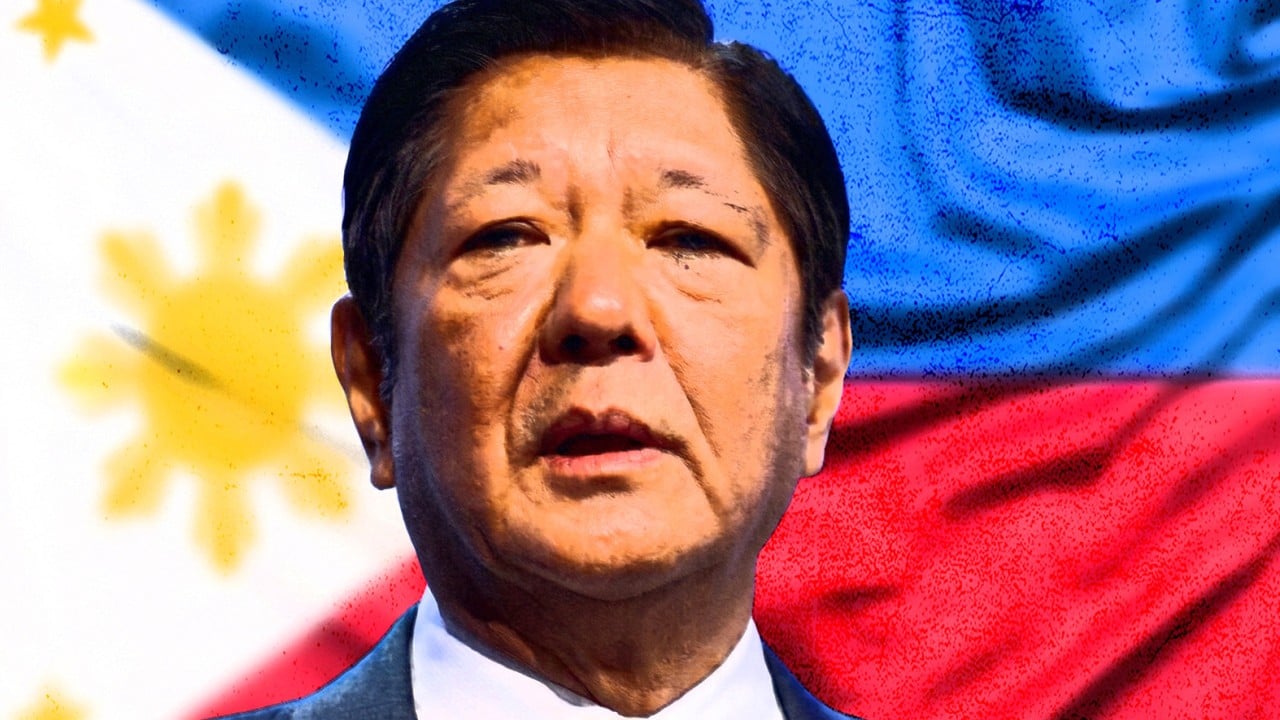
Ferdinand Marcos Jr. promised a "New Philippines" when he reclaimed Malacañang Palace in 2022, pitching an era of unity, cheap rice, and modernized infrastructure. Four years into his six-year term, the reality on the ground is stark. Rather than a structural transformation, the administration has delivered a decelerating economy, a national debt ballooning past 19.6 trillion pesos, and a political civil war with the Duterte dynasty that has paralyzed domestic governance. While Manila successfully pivoted its foreign policy back toward Washington to counter Beijing's aggression in the South China Sea, that geopolitical clarity has failed to insulate Filipino households from stubborn inflation, a record-low peso, and entrenched corruption in public works.
The Economics of Illusion and the Debt Trap
Campaign slogans do not survive contact with supply chains. Marcos Jr. famously floated the aspiration of bringing rice prices down to 20 pesos per kilogram—a benchmark that quickly became a punchline in Manila's wet markets as agricultural output stagnated and global commodity shocks hit home. By late 2026, inflation hovered above 7 percent, driven by fuel, electricity, and transport costs, pushing the Philippine peso past the 64-to-the-dollar threshold for the first time in history.
The numbers tell an uncomfortable story about how the government is keeping the lights on. When Marcos Jr. took the oath of office in mid-2022, the national debt stood at 12.79 trillion pesos. By September 2026, that figure had surged to roughly 19.66 trillion pesos, pushing the debt-to-GDP ratio to 66 percent.
Borrowing money to build roads, ports, and bridges is standard practice for developing economies. The problem in Manila is not the borrowing itself; it is what happens to the capital once it enters the bureaucratic bloodstream.
Under Presidential Decree 1177, a Marcos-era law from 1977 that remains on the books, debt service receives automatic appropriation. Creditors get paid first. Social services, agricultural subsidies, and public health fight over whatever is left. Meanwhile, gross capital formation contracted by over 9 percent in 2026, and industrial output slipped. The administration has relied heavily on headline-grabbing international roadshows, boasting of billions of dollars in foreign investment pledges. Yet pledges are non-binding pieces of paper. Factory floors require reliable power grids, predictable regulations, and clean permitting—areas where the Philippines still lags behind regional competitors like Vietnam and Indonesia.
The Flood Control Scandal and Institutional Rot
If the administration's economic pitch rested on infrastructure modernization, its credibility suffered a self-inflicted wound during the flood-control procurement scandal. For years, billions of pesos were funneled into river-wall projects, dredging operations, and drainage systems across the archipelago. When severe typhoons inundated low-lying communities anyway, the subsequent scrutiny exposed a sprawling network of ghost projects, inflated contracts, and kickbacks embedded deep within the public works apparatus.
The political fallout was immediate. Marcos Jr. attempted to get ahead of the outrage by acknowledging the graft during his annual address to Congress, framing himself as a reformer cleaning up systemic waste. That gamble backfired. Instead of reassuring the public, the admission triggered a freeze in project disbursements as bureaucrats stalled approvals to avoid audit scrutiny. Economic growth forecasts for 2026 were slashed from 6 percent down to the 3 to 4 percent range as public construction ground to a halt.
This exposes a fundamental contradiction in the "Bagong Pilipinas" branding. You cannot rebrand a state apparatus while relying on the exact same patronage networks that hollow it out.
Independent economists estimate that trillions of pesos have leaked out of the Philippine budget over the past decade through procurement manipulation and substandard public works. When a drainage canal collapses two years after completion because a contractor shaved 40 percent off the cement budget to pay off local officials, the state ends up borrowing twice for the same piece of infrastructure. The taxpayer absorbs the interest payments on both loans while wading through waist-deep water every monsoon season.
The Implosion of the UniTeam Alliance
To understand why legislative reform has stalled, you have to look at the marriage of convenience that put Marcos Jr. in power. The 2022 "UniTeam" ticket—pairing the son of the late dictator Ferdinand Marcos with Sara Duterte, daughter of outgoing strongman Rodrigo Duterte—was never built on shared policy goals. It was a transactional cartel designed to consolidate northern and southern voting blocs and lock the opposition out of power.
It took less than two years for the cartel to fracture into open warfare.
Once Marcos Jr. secured the presidency, his administration began systematically dismantling the Duterte political infrastructure. Allegations of confidential fund misuse dogged Vice President Sara Duterte, culminating in her impeachment by the Marcos-dominated House of Representatives. Simultaneously, Manila dropped its blanket hostility toward the International Criminal Court's investigation into Rodrigo Duterte's bloody drug war, signaling to The Hague that the palace would no longer act as a human shield for the former president.
The Duterte camp retaliated with scorched-earth rhetoric, accusing Marcos Jr. of incompetence, drug use, and betraying the electorate. While this dynastic brawl dominates Manila's media cycle, actual governance has become a secondary priority.
The Illusion of a Legislative Supermajority
On paper, Marcos Jr. enjoys an overwhelming legislative supermajority in both chambers of Congress, with only a handful of genuine opposition lawmakers remaining. In a functional democracy, that kind of political capital allows a president to pass difficult structural reforms—overhauling agricultural tariffs, modernizing the power sector, or reforming the civil service.
In the Philippines, a supermajority is a rental agreement, not a loyalty oath. Congressional alliances are held together by budget insertions and local patronage. As Marcos Jr.'s net satisfaction ratings dipped into negative territory in late 2026—with over 80 percent of Filipinos disapproving of his handling of inflation—lawmakers began hedging their bets ahead of future electoral cycles. Passing tough, unpopular economic reforms becomes nearly impossible when the executive branch is spending all its political capital fighting a rival dynasty.
Washington's Favorite Anchor in the Indo-Pacific
If there is one area where Marcos Jr. has executed a decisive break from the past, it is foreign policy. Under Rodrigo Duterte, Manila tilted sharply toward Beijing, shelving a landmark 2016 international arbitration ruling that invalidated China's expansive claims in the South China Sea in exchange for promised Chinese loans that largely failed to materialize.
Marcos Jr. reversed course entirely. Facing relentless harassment of Philippine coast guard vessels and supply boats by Chinese maritime militia around Second Thomas Shoal and Scarborough Shoal, Manila adopted a strategy of assertive transparency. Journalists were invited onto resupply missions to document Chinese water cannon attacks and ramming maneuvers, stripping Beijing of plausible deniability on the global stage.
Manila backed up its diplomatic push with hard security alignments:
- Expanded Base Access: The administration accelerated the Enhanced Defense Cooperation Agreement, granting U.S. forces access to four additional military bases, bringing the total to nine. Three of these new sites sit in northern Luzon, strategically positioned just across the Luzon Strait from Taiwan.
- Multilateral Deterrence: Joint patrols and military exercises expanded beyond the bilateral U.S.-Philippine framework to include Japan, Australia, and European naval assets, effectively internationalizing the defense of the West Philippine Sea.
- Security Assistance: Washington responded with multi-billion-dollar commitments to modernize the Armed Forces of the Philippines, shifting the military's posture from internal counter-insurgency toward external territorial defense.
For defense planners in Washington and Tokyo, Marcos Jr. has been a strategic asset. Yet foreign policy victories carry a steep domestic price tag. Beijing has weaponized trade and tourism in response, throttling Chinese tourist arrivals and quietly squeezing agricultural imports from the Philippines. For a farmer in Mindanao or a resort operator in Cebu, standing up to a superpower does not pay the electricity bill.
The Remittance Crutch and Structural Stagnation
To see the true health of the Philippine economy, look past the GDP press releases and examine the labor market. For decades, the country's ultimate safety valve has been the export of its own people. Overseas Filipino Workers remit tens of billions of dollars annually, propping up domestic consumption and preventing balance-of-payments crises.
Marcos Jr. promised to create an economy robust enough that migration would become a choice rather than a necessity. That goal remains out of reach.
Domestic manufacturing continues to shrink as a share of the economy, crippled by some of the highest electricity rates in Southeast Asia and chronic logistical bottlenecks. Agriculture, which still employs roughly a quarter of the workforce, remains trapped in low-productivity, fragmented landholdings. Without serious investment in cold-chain logistics, irrigation, and rural credit, the Philippines remains dangerously dependent on food imports—leaving the poor completely exposed whenever the peso weakens.
Consider a hypothetical example of how this plays out in a typical provincial household. A family in Central Luzon relies on remittance money from a daughter working as a nurse in London. In 2022, her monthly transfer comfortably covered groceries, school fees, and utility bills. By 2026, even though the weaker peso yields more local currency per British pound, the 7 percent inflation rate on domestic rice, fuel, and electricity has erased the exchange-rate gain. The family is receiving more pesos, yet buying less food.
The Limits of Dynastic Rebranding
The core premise of the "New Philippines" campaign was that historical amnesia could substitute for institutional reform. By wrapping the administration in slick branding, digital modernization initiatives, and high-profile diplomatic summits, the palace hoped to distance the Marcos name from the kleptocracy and martial law era of Ferdinand Marcos Sr.
You cannot PR-manage your way out of structural decay.
The machinery of the Philippine state remains overwhelmingly centralized, slow, and vulnerable to capture by entrenched political families. Whether it is local warlords controlling provincial procurement or national dynasties treating executive power as a family inheritance, the underlying incentives have not changed. When the president's own family history is inextricably tied to the origins of modern Philippine crony capitalism, preaching anti-corruption from the podium rings hollow to an increasingly cynical electorate.
Manila's streets are still choked with traffic, its classrooms remain overcrowded, and its hospitals are hemorrhaging nurses to higher-paying markets abroad. Geopolitical alignment with Washington has secured the perimeter, but it cannot fix a broken tax collection system, audit a corrupt public works department, or lower the price of a sack of rice. Until the Philippine state dismantles the patronage networks that treat public office as a private revenue stream, a "New Philippines" will remain little more than a campaign billboard painted over a crumbling foundation.