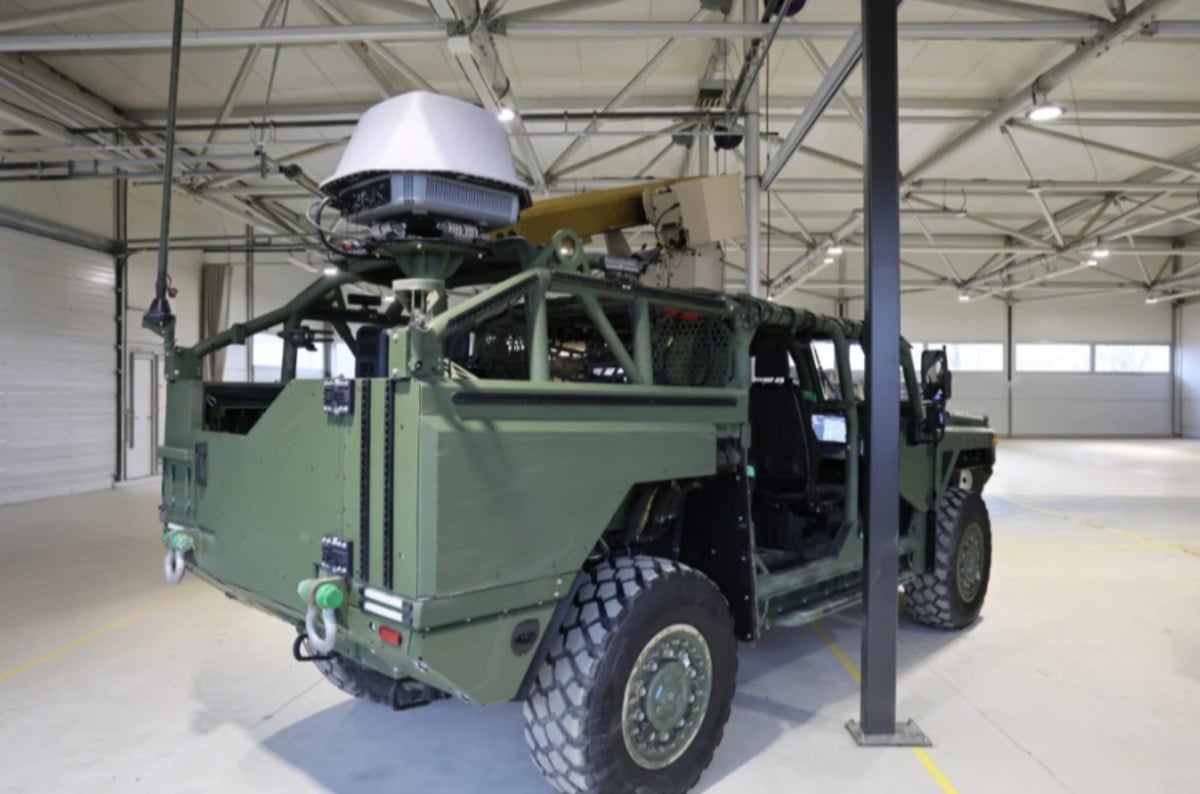
The defense industry loves a good press release about tactical synergy. When DroneShield announced its partnership with Defenture to slap anti-drone jamming tech onto light tactical vehicles, the sector reacted with the usual predictable applause. The narrative sounds perfect: drones are ruining modern battlefields, so putting counter-unmanned aerial system (C-UAS) hardware on highly mobile wheels solves the vulnerability.
It does not. It creates a giant, radiating bullseye.
I have spent years evaluating electronic warfare systems and watching defense contractors bolt expensive, power-hungry sensors onto vehicles that were never designed to support them. This partnership is not a breakthrough. It is a classic defense-sector band-aid that solves a marketing problem while completely misunderstanding the physics of modern electronic combat.
Putting active electronic warfare (EW) jamming gear on a lightweight, fast-moving vehicle is a contradiction in operational logic. The industry is chasing the wrong metric, building a product that solves yesterday's threat while creating a catastrophic vulnerability for tomorrow.
The Physics of the Radiating Target
The fundamental flaw in mobile, active C-UAS platforms comes down to basic radio frequency physics. To jam a drone, you must emit a signal stronger than the control or GPS signal the drone is receiving. You are screaming into the ether.
When an omnidirectional jammer like a DroneShield system is bolted to a Defenture light vehicle and turned on, it does not just block the incoming quadcopter. It turns the vehicle into the brightest radio beacon on the battlefield.
Modern adversaries do not just fly simple commercial drones; they deploy highly sophisticated Electronic Support Measures (ESM). In plain terms, they have passive sensors specifically designed to hunt for your jamming signals.
Imagine a scenario where a light tactical vehicle is moving through a contested area. The crew detects a drone and activates their mobile jammer. The drone drops. Success, right?
Wrong. Two seconds after that jammer fired up, automated direction-finding arrays five miles away triangulated the vehicle's exact GPS coordinates. The drone was a $500 scout; the response is a swarm of loitering munitions or a coordinated artillery strike on a vehicle that lacks heavy armor. You traded a minor annoyance for total annihilation.
The industry sells the illusion of a dome of protection. In reality, active mobile jamming is an invitation to get wiped off the map.
The Mobile Power Lie
Then there is the engineering reality that PR teams conveniently ignore: SWaP-C (Size, Weight, Power, and Cost).
Defenture makes excellent, lightweight, highly agile vehicles. They are built for speed, payload efficiency, and off-road capability. They are not mobile power plants.
Effective electronic warfare requires massive amounts of clean, continuous electrical power. To run multi-band directional jammers, radio-frequency detectors, and optical tracking systems simultaneously, you need heavy-duty alternators, massive auxiliary battery banks, or dedicated generators.
When you cram all that hardware onto an open-top, light tactical vehicle, you ruin its primary asset: agility.
- Weight Penalties: Every pound of batteries and cooling systems strips away the vehicle's payload capacity. You are sacrificing ammo, fuel, and armor for electronics.
- Thermal Signatures: Jammers generate intense heat. A vehicle designed to be stealthy and low-profile suddenly glows like a furnace on any standard thermal imaging sensor.
- Alternator Strain: Standard military vehicle engines cannot constantly supply the wattage required for high-powered EW systems without killing the powertrain or severely reducing operational range.
What you end up with is a vehicle that is too heavy to perform its original mission, too loud on the RF spectrum to hide, and too hot to escape thermal detection. It is a masterpiece of compromised engineering.
Dismantling the Premise of Mobile C-UAS
If you look at the standard questions analysts ask about this technology, the fundamental misunderstandings become obvious. The industry is answering the wrong questions.
Can mobile C-UAS protect convoys on the move?
No. Convoys move along predictable lines of drift—roads, valleys, and clearings. If a mobile jammer is active during a movement, an adversary does not even need visual confirmation to strike. They simply program artillery or anti-radiation missiles to home in on the constant, high-powered jamming frequency moving down the highway. Active jamming while moving is just high-visibility signaling for enemy targeting systems.
Why not just use directional jammers instead of omnidirectional ones?
Directional jamming narrows the beam, reducing the footprint of your signal. But to use a directional jammer, you must first know exactly where the threat is. On a fast-moving, bouncing tactical vehicle, keeping a high-gain directional antenna precisely locked onto a tiny, erratic drone is an algorithmic nightmare. The moment the vehicle hits a bump, the beam slips, the connection reconnects, and the drone drops its payload anyway.
Won't AI-driven targeting solve this problem?
AI can speed up detection, but it cannot override the laws of thermodynamics or wave propagation. An AI-enabled system still needs to emit energy to jam, and it still requires a power source that small vehicles cannot sustain without massive trade-offs. AI is being used as a buzzword to mask the underlying mechanical and physical limitations of the platform.
The Unconventional Alternative: Passive and Dispersed
The fix is uncomfortable for defense primes because it involves spending less money on proprietary hardware and more money on fundamental tactical shifts.
Stop trying to build a rolling fortress. Instead, separate the sensor from the shooter.
If you must use electronic warfare to defeat drones, the transmitter should never be attached to the human beings. The future of survival belongs to passive detection and remote, expendable decoys.
Tactical vehicles should be equipped entirely with passive sensors—radio receivers and acoustic arrays that emit zero energy but listen for drone control signals. If an anomaly is detected, the crew does not flip a switch on their dashboard to jam it. Instead, they deploy an autonomous, low-cost static decoy transmitter hundreds of meters away from their actual position.
The decoy fires up, emits the jamming signal, attracts the enemy's counter-battery fire, and dies alone in a field. Meanwhile, the light vehicle utilizes its speed and low signature to escape the kill zone entirely.
This approach has downsides. It requires meticulous coordination, it increases battlefield clutter, and it forces troops to accept that they cannot instantly vaporize every drone they see with a magic forcefield button. But it keeps people alive.
Bolting high-powered jammers to light tactical vehicles is an attempt to force a legacy, centralized hardware mindset onto a decentralized, asymmetric threat. It serves corporate boards looking for cross-marketing wins far better than it serves the infantry squad trapped in an electronic crosshair.
Throw away the illusion of the mobile shield. If your defense strategy relies on screaming your location to the entire theater of operations just to drop a quadcopter, you have already lost the war. Turn the transmitters off, ditch the weight, and move.