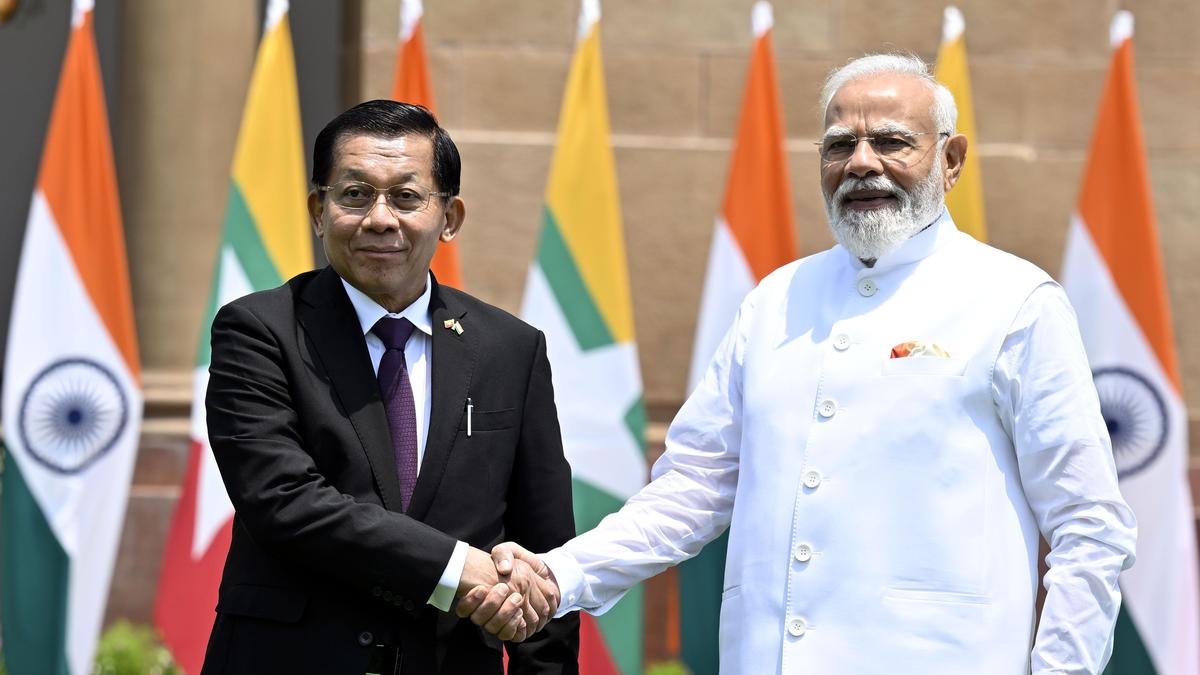
Western capitals are not going to like this. While Washington and Brussels continue their heavy-handed campaign to isolate Naypyidaw, New Delhi just rolled out the red carpet.
Prime Minister Narendra Modi holds talks with Myanmar President Aung Hlaing at Hyderabad House, marking a massive shift in regional dynamics. It is the military-backed leader's first official visit to India since taking over the presidency following the recent parliament elections. For India, this isn't about endorsing a regime. It's about raw survival, border security, and a mad scramble for critical resources.
The West can afford to preach from across the ocean. India cannot. When you share a volatile 1,640-kilometer border, geography dictates your morality.
Foreign Secretary Vikram Misri summarized India's stance perfectly, noting that engagement is the best way forward and history shows disengagement yields zero results. India's objective is blindingly obvious. New Delhi needs stability along its northeastern frontier, and it wants a piece of Myanmar’s massive, untouched rare earth reserves.
Why Realpolitik Trumps Western Sanctions on Myanmar
Let's look at the numbers. Bilateral trade between India and Myanmar hovered around USD 2.15 billion in FY25. Myanmar exported USD 1.53 billion worth of goods to India, while Indian exports lagged at USD 614.3 million. That trade deficit doesn't bother New Delhi as much as what those exports represent. India wants access to Myanmar's critical minerals to secure its tech manufacturing supply chains against a dominant China.
Security is the real driver here. India's northeast is a powder keg. Militancy-hit states like Nagaland and Manipur sit right against the Myanmar border. For decades, Indian insurgent groups have used the dense, trackless jungles of western Myanmar as a safe haven. If New Delhi cuts off the regime in Naypyidaw, those insurgents get a free pass.
National Security Advisor Ajit Doval met with President U Min Aung Hlaing ahead of the main bilateral talks. You don't send your top spy chief to discuss spiritual tourism. They talked about hard security, intelligence sharing, and coordinated border operations.
The Silent War for Critical Minerals
China has been aggressively locking down rare earth mining operations in Myanmar's Kachin state for years. These minerals power everything from your smartphone to electric vehicle batteries and advanced defense systems. India is dangerously late to the party, but this visit shows a desperate attempt to catch up.
The high-level delegation accompanying the Myanmar President includes prominent business leaders and heavy industry ministers. After wrapping up political talks in the capital, the delegation heads straight to Mumbai for industrial site visits and corporate matchmaking. New Delhi is using private capital to anchor its geopolitical interests.
Moving Past the Big Cat Delays and Diplomatic Friction
The trip wasn't completely smooth sailing. President Min Aung Hlaing was originally supposed to land in India to attend the International Big Cat Alliance Summit. That summit got derailed because the broader India-Africa Forum Summit was postponed due to an Ebola outbreak in parts of Africa.
Instead of canceling, both sides salvaged the itinerary. They pivoted the focus entirely to bilateral trade, maritime security in the Bay of Bengal, and regional infrastructure projects like the Kaladan Multi-Modal Transit Transport project.
Critics argue that hosting the general-turned-president lends unearned legitimacy to a government that seized power in the bloody 2021 coup against Aung San Suu Kyi. But foreign policy experts know that isolated regimes don't reform; they just crawl deeper into Beijing’s pocket.
If you want to track where this relationship goes next, watch the border outposts. Your immediate next step to understand this geopolitical chess match is to monitor whether India relaxes its border restrictions or pushes forward with joint military sweeps against insurgent camps in the coming weeks. The diplomatic niceties in New Delhi are over; the real implementation happens in the jungles of the northeast.