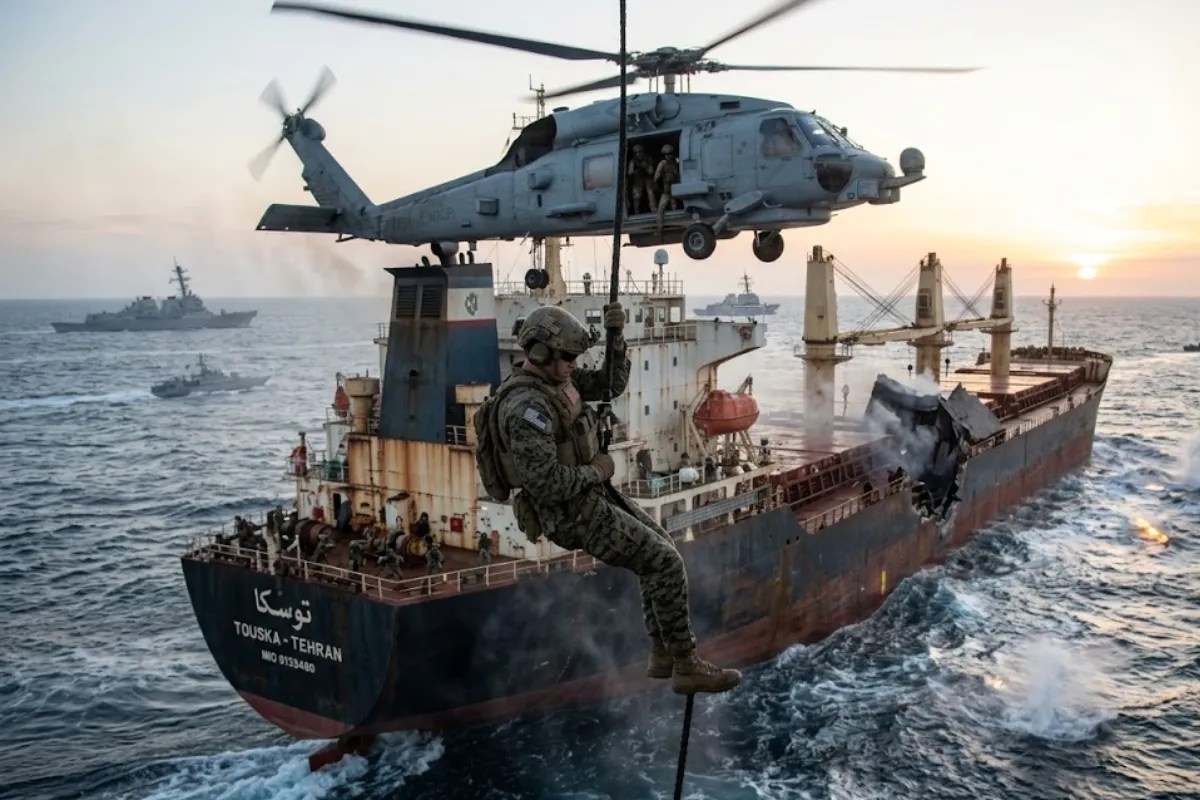
Cinematic camera angles. Ropes dropping from the sky. Men in tactical gear sliding down with surgical precision. The media loves a good show, and the recent U.S. Navy seizure of an Iranian-linked vessel provided exactly that. It was "filmy style" perfection. It was also a textbook example of expensive, performative warfare that does almost nothing to solve the underlying geopolitical rot in the Strait of Hormuz.
While mainstream outlets drool over the spectacle of "Marine Commandos" taking over a deck, they miss the grim reality of the modern maritime theatre. We are watching a multi-million dollar sledgehammer swing at a fly, while the house behind it is quietly being dismantled. If you think a viral video of a boarding party is a sign of dominance, you aren't paying attention to the math.
The High Cost of Performance Art
Let’s talk about the sheer absurdity of the resource mismatch. A single flight hour for an MH-60S Seahawk costs thousands. The training, equipment, and operational overhead for a SEAL or MARSOC team to execute a "fast-rope" insertion is astronomical. Against what? A rusted tanker or a wooden dhow manned by poorly paid crew members?
I’ve sat in rooms where "strategic dominance" was measured in optics rather than outcomes. When we burn high-end kinetic assets on low-level interdictions, we aren't "projecting power." We are bleeding resources to win a 24-hour news cycle. The Iranian Revolutionary Guard Corps (IRGC) understands something the Pentagon seems to have forgotten: Asymmetry is the only metric that matters.
Every time the U.S. Navy stages a high-production-value raid, the adversary wins a quiet victory. They force a superpower to deploy its most elite units for a task that should, in a sane world, be handled by a coast guard cutter or an autonomous drone. They make us play their game of cat-and-mouse, and we pay for the privilege in fuel, airframe fatigue, and human risk.
The Drone Gap Nobody Wants to Discuss
The "filmy" boarding technique is a relic. It belongs in the 1990s. In an era where $20,000 loitering munitions can disable a ship’s bridge or propulsion system, sending humans down a rope is an unnecessary gamble.
The obsession with "boots on deck" is a cultural hangover from the Global War on Terror. It’s a preference for the visceral over the effective. If the goal is to seize a vessel, why are we still risking elite operators in the most vulnerable stage of an operation—the fast-rope—when we could use remote-operated boarding craft or localized electronic warfare to neutralize the ship?
- Vulnerability: A hovering helicopter is a sitting duck for a shoulder-fired missile.
- Scalability: You cannot fast-rope onto fifty ships at once.
- Deniability: Kinetic raids leave a massive footprint. Cyber-maritime interdiction leaves none.
We are stuck in a cycle of "Tactical Porn." It looks great on a 4K monitor, but it doesn’t stop the next ship from being seized three days later. The IRGC operates on a volume model; the U.S. Navy operates on a prestige model. In a long-term conflict of attrition, volume always eats prestige for breakfast.
Dismantling the "Stability" Narrative
The common argument is that these raids "ensure the free flow of commerce." This is a fundamental misunderstanding of how global insurance markets and shipping lanes actually work.
Insurance premiums for transit through the Persian Gulf don't drop because a commando did a cool slide down a rope. They drop when there is a predictable, long-term security architecture that doesn't rely on sporadic, high-stakes interventions. These raids are spikes of activity in a sea of inconsistency.
Imagine a scenario where a city’s police department only responded to crimes if they could film it for a reality show. That’s our current maritime policy. We ignore the thousand daily provocations and then over-react with a cinematic flourish when the cameras are rolling. This creates a "Security Theater" that comforts the public but does nothing to stabilize the freight rates or the safety of merchant sailors.
Why the "Filmy Style" is a Liability
When we describe military operations as "filmy" or "cinematic," we strip them of their strategic seriousness. We treat war like a product. This encourages "Mission Creep" for the sake of the narrative. Commanders start looking for the "hero shot" rather than the most efficient way to achieve an objective.
I have seen operations green-lit because they were "marketable" to Congress or the public, while quieter, more effective options were shelved because they didn't look good in a briefing deck. The Iranian ship seizure was a tactical success—yes, the ship was taken—but it was a strategic non-event. It changed nothing about Iran's ability to disrupt the Strait. It changed nothing about the lack of a coherent Western policy regarding maritime gray-zone conflict.
The Actionable Truth for Maritime Security
If we actually wanted to secure the waterways, we would stop chasing individual ships with helicopters and start building an autonomous, persistent mesh of sensors and interdiction drones.
- Stop the Human-First Approach: Boarding parties should be the last resort, not the lead-off play.
- Invest in Low-Cost Persistence: We need hundreds of small, unmanned surface vessels (USVs) that can shadow every "vessel of interest" 24/7.
- Aggressive Economic Interdiction: Seizing a ship on the water is theater. Seizing the bank accounts and shell companies behind the ship is warfare.
The U.S. Navy is currently a Ferrari being used as a tractor. It’s impressive to look at, but it’s the wrong tool for the job. We are using 20th-century bravado to fight a 21st-century ghost war.
The video of the Marines dropping onto the Iranian ship isn't a display of strength. It is a confession that we have no better way to handle a mid-tier regional power than to keep doing the same high-risk stunts we’ve been doing for thirty years. It’s time to stop clapping for the "filmy style" and start asking why we’re still playing the part of the over-eager extra in someone else’s script.
The ocean is too big for stunts. The stakes are too high for showmanship. Stop looking at the ropes and start looking at the scoreboard. We are losing the war of efficiency, and no amount of "cinematic" boarding will fix a broken strategy.


:strip_icc()/pic2513216.jpg)