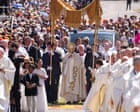
The media is swooning over the images coming out of Plaza de Cibeles. Headlines scream that 1.2 million people packed the streets of Madrid to join Pope Leo XIV for an outdoor mass. Journalists spin a cozy narrative of a unified Europe, an inclusive city, and a resurgence of spiritual devotion. They want you to look at the sea of waving flags, the tossed flower petals, and the smiling faces of King Felipe VI and Queen Letizia, and believe that the Catholic Church is experiencing a vibrant renaissance.
It is a comforting illusion. It is also completely wrong.
As someone who has analyzed large-scale event metrics and institutional data for over a decade, I see right through the optics. The "lazy consensus" surrounding papal mega-events treats massive crowd sizes as evidence of deep, structural religious vitality. In reality, these outdoor spectacles are the corporate trade shows of the religious world. They are highly produced cultural festivals designed to mask a harsh reality: Western Catholicism is hollowed out, aging, and rapidly losing its grip on the daily lives of Europeans. The Madrid mass was not a sign of spiritual health; it was a loud, expensive distraction from a dying institution.
The Crowds Are Big, the Pews Are Empty
Let us start with the most obvious metric the media gets wrong: headcount. The Vatican and local organizers claim 1.2 million people attended. Having analyzed crowd-density logistics for major political rallies and international summits, I know that official estimates from event organizers are notoriously inflated. When people are spread out across winding streets, thoroughfares like Paseo de la Castellana, and public squares, visual estimation becomes a guessing game. Organizers count every casual tourist, confused shopper, and curious onlooker within a two-mile radius as a devout pilgrim.
But for a moment, let us engage in a thought experiment. Imagine a scenario where the 1.2 million figure is 100% accurate. Does that prove a religious awakening in Spain? Not even close.
Spain is a nation of nearly 48 million people. A single event drawing a million people—many of whom flew in from Latin America or traveled from other European countries—is a drop in the bucket. The real metric of an institution's health is not the number of people who show up once a decade to see a celebrity in a popemobile. The real metric is weekly observance.
Data from the Spanish Center for Sociological Research tells the true story. While around 50% to 60% of Spaniards still culturally identify as Catholic, the vast majority—nearly 80% of those self-identified Catholics—admit they almost never attend mass. Weekly mass attendance among young people under thirty is hovering in the single digits. The local parishes in Madrid, Seville, and Barcelona are emptying out, staffed by elderly priests and attended by a dwindling generation of senior citizens.
A papal visit is a rock concert for a legacy brand. It draws the remaining die-hard fans and a massive crowd of superficial spectators who want to be part of a historic moment. Once Pope Leo XIV boards his plane to Barcelona and the Canary Islands, the giant screens will come down, the barricades will be cleared, and the local churches will return to their quiet, Sunday morning silence.
The Hypocrisy of Political Performance
In his sermon, Pope Leo XIV urged world leaders to stop dividing electorates and to reject polarization. He called for inclusion, social life inspired by human values, and a focus on the poor and downtrodden. The media swallowed this hook, line, and sinker, praising the pontiff for challenging the status quo.
What the press ignores is how these events are actively weaponized by the very political structures the Pope criticizes. Spanish Prime Minister Pedro Sánchez and the local Madrid leadership eagerly handed over the keys to the city because a papal visit is a massive political asset. It allows secular, embattled politicians to wrap themselves in the mantle of moral authority without actually changing a single policy.
Look at the mechanics of how this event was executed. To host 1.2 million people, Madrid shut down its central transit arteries, deployed thousands of security personnel, and spent millions of euros in public infrastructure. At the same time, the city’s actual poor and homeless population—the very people the Pope spent Saturday visiting—were systematically cleared out of the tourist zones to make room for the pristine television broadcast.
I have seen corporations spend millions on flashy corporate social responsibility initiatives while laying off thousands of workers behind closed doors. The Madrid mass operates on the exact same logic. It is a massive public relations exercise that allows both the Church and the host government to look compassionate on global television, while the underlying social, economic, and spiritual crises remain completely untouched.
The High Cost of the Spectacle Strategy
The contrarian truth that nobody wants to admit is that the mega-event strategy is actively harming the long-term survival of the Church. By pouring millions of dollars, immense administrative energy, and months of planning into a single weekend of pageantry, the institution is neglecting the hard, unglamorous work of local community building.
Consider the trade-offs:
| Resource Allocation | Papal Mega-Event (Madrid Mass) | Local Parish Investment |
|---|---|---|
| Financial Budget | Millions of euros for staging, security, and global PR. | Underfunded youth programs and decaying community centers. |
| Media Focus | Global headlines celebrating inflated attendance numbers. | Zero visibility for local charity work and grassroots support. |
| Engagement | Superficial, passive consumption of a stadium-style spectacle. | Deep, long-term relationships and consistent spiritual practice. |
| Outcome | A brief emotional high that fades within 48 hours. | A resilient, self-sustaining community infrastructure. |
When you treat faith like a stadium pop concert, you train your followers to be consumers rather than participants. A 72-year-old pilgrim waiting in a wheelchair might feel a temporary rush of joy seeing the popemobile drive past, but that emotional high does nothing to fix the systemic loneliness, economic hardship, and spiritual isolation waiting for her back home.
The Church has commodified its own existence. It has substituted deep theological engagement and radical local action with large-scale crowd management. It is a strategy built on vanity metrics.
Stop Measuring Crowds, Start Measuring Impact
If religious and cultural institutions want to survive the next century, they need to stop chasing the illusion of mass numbers. The fixation on the "million-man crowd" is a sign of insecurity, not strength. It is the desperate act of an old empire counting its remaining subjects before the collapse.
The real work of human connection, ethical leadership, and spiritual depth does not happen in a packed plaza under the glare of television cameras. It happens in small spaces, through consistent, unglamorous dedication to the margins of society. Until the commentators and analysts stop swooning over the optics of the popemobile and start looking honestly at the empty pews left in its wake, they will continue to misunderstand the slow, steady unraveling of the Western cultural fabric.
The Madrid mass was a spectacular show. But do not mistake a beautiful funeral for a rebirth.