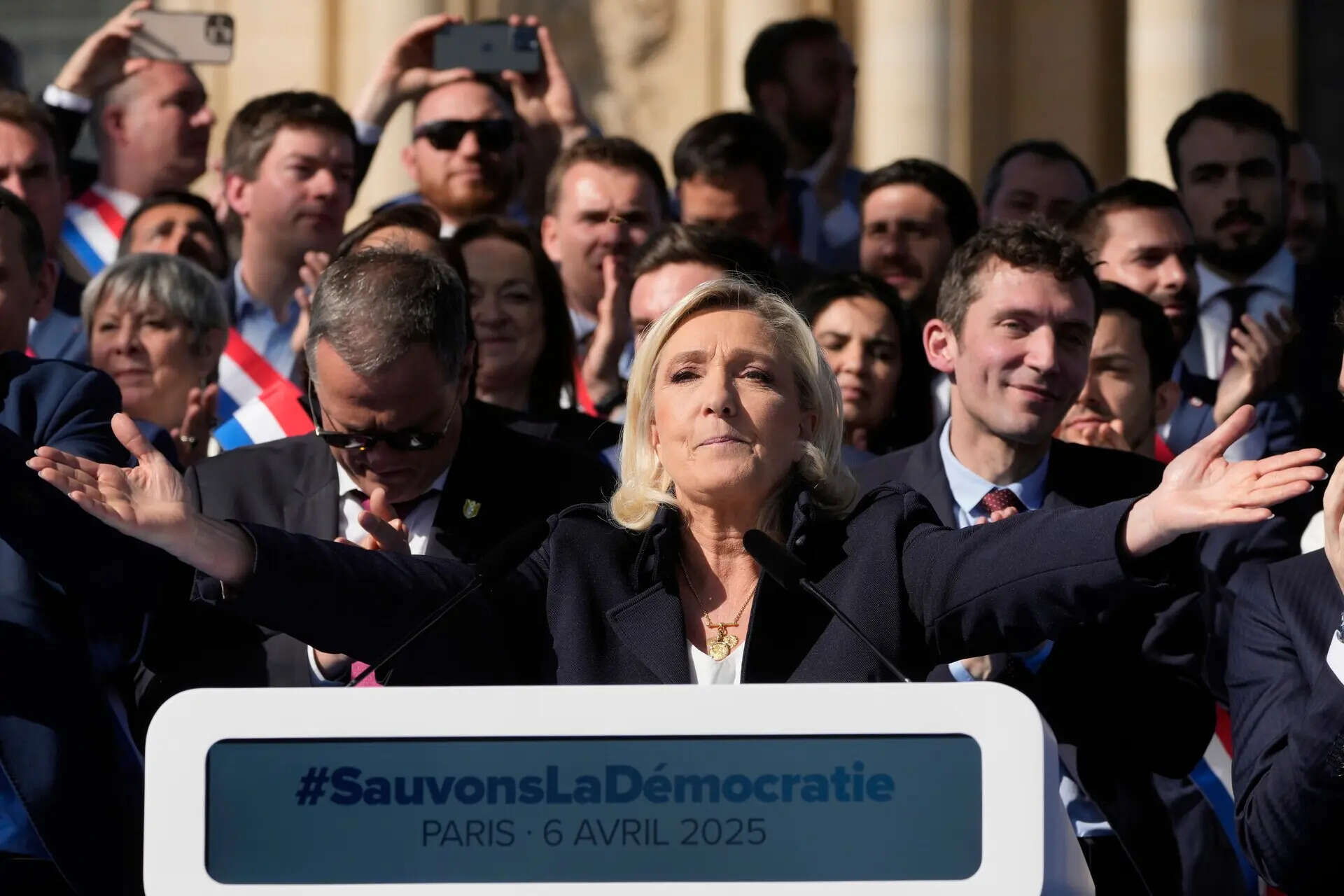
The Paris Court of Appeal's decision to modify Marine Le Pen’s embezzlement sentence alters the mechanics of the 2027 French presidential race without resolving its underlying structural volatility. By reducing her absolute ban on public office from 60 months to 45 months—with 30 months suspended and the remaining 15 months backdated to the March 2025 lower court verdict—the judiciary has technically cleared her legal disqualification. However, the enforcement of a three-year sentence, requiring one year of home detention under electronic monitoring, introduces severe logistical and operational friction. The ruling shifts the National Rally's (RN) primary challenge from a absolute legal barrier to a complex optimization problem balancing candidate mobility against party succession dynamics.
The Friction Coefficient of Electronic Monitoring
A political campaign is a high-velocity logistical operation requiring absolute spatial and temporal flexibility. The imposition of house arrest under electronic monitoring introduces a rigid institutional constraint that disrupts standard campaign mechanics.
- The Travel Authorization Bottleneck: Under standard French electronic monitoring protocols, an individual must operate within pre-approved geographical boundaries and strict time windows. Any deviation to attend unexpected rallies, media appearances, or regional town halls requires explicit judicial authorization. This dependence on magistrate approval strips a presidential campaign of its core strategic asset: agility.
- The Symbolic Cost Function: The visual asset of a presidential candidate is heavily tied to authority and statecraft. Operating a national campaign while wearing an electronic tracking tag introduces an unprecedented psychological discount for voters seeking institutional stability. Le Pen herself quantified this constraint, stating that effective campaigning is functionally impossible under conditions where movement is mediated by a judicial supervisor.
- The Mitigation Runway: Under French law, individuals sentenced to electronic monitoring can seek sentence reductions of up to six months for demonstrating good conduct and regulatory compliance. If successfully executed, Le Pen could compress her active monitoring window to six months. This creates a critical timeline constraint, as the efficiency of the campaign depends entirely on the speed of judicial administrative processing throughout late 2026.
The Strategic Trade-Off Matrix
The RN faces a dual-track leadership dilemma. The party must maximize its structural advantage in early polling while mitigating the operational liabilities of its historic figurehead. This necessitates a comparative analysis of the two viable paths forward.
| Operational Variable | Path A: The Le Pen Candidacy (Conditional) | Path B: The Bardella Succession (Unconstrained) |
|---|---|---|
| Legal Risk Profile | High; subject to judicial compliance and administrative delays. | Zero; no personal legal encumbrances. |
| Campaign Mobility | Restricted; managed via pre-scheduled judicial windows. | Unconstrained; high-velocity national deployment. |
| Institutional Brand Equity | High legacy loyalty among older, working-class demographics. | High appeal among younger voters and urban conservatives. |
| The Ineligibility Floor | Risk of sudden operational paralysis if terms are violated. | Stable execution of institutional normalization strategy. |
The transition of the party from a radical protest vehicle to an institutional contender relies on a normalization strategy. While Le Pen commands deep historical equity among the core populist base, Jordan Bardella represents a frictionless alternative designed to capture moderate, center-right swing voters who are repelled by legal controversy.
Succession Dynamics and the Bardella Alternative
The structural risk of maintaining Le Pen as the primary candidate is highlighted by the rapid optimization of Jordan Bardella’s political capital. At 30 years old, the RN party president no longer functions merely as a placeholder; he acts as a distinct electoral asset with superior polling efficiency in specific runoff simulations.
This creates a structural bottleneck for Le Pen. Her chosen successor now commands independent leverage within the party's donor networks and executive committees. Although Bardella maintains a public posture of total alignment and loyalty, the internal math of the RN suggests that a transition minimizes execution risk.
A campaign led by an unconstrained candidate avoids the daily operational drag of legal compliance. It also shifts the media narrative away from anti-corruption trials and back toward macroeconomic grievances, immigration policy, and security—the core issues where the RN holds a comparative advantage over the governing centrist coalition.
The immediate tactical move for the RN executive bureau is to execute a dual-track contingency framework. The party cannot freeze its infrastructure while waiting for judicial clarification on Le Pen's monitoring terms. The optimal play is to position Bardella as the operational lead for national tours and debates, maintaining Le Pen as the ideological anchor via prime-time media access. If the administrative petition to shorten or defer the electronic monitoring fails by the end of the fourth quarter of 2026, the formal transfer of the presidential nomination to Bardella must be executed immediately to prevent a compounding deficit in campaign momentum.