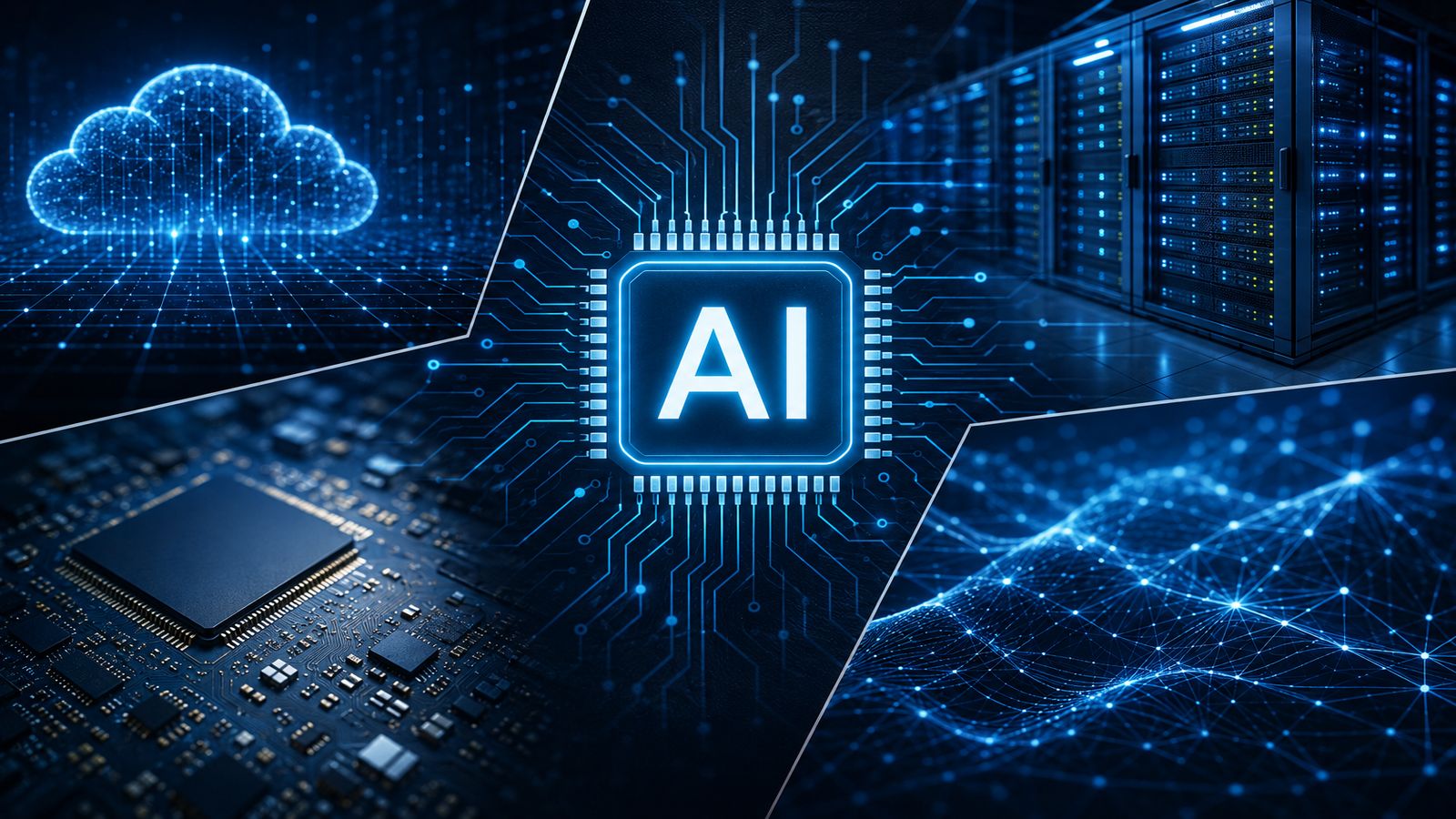
Walk into any high-end coffee shop in Shanghai’s Zhangjiang Hi-Tech Park at two in the morning, and the smell is always the same. It is a mix of stale espresso, cold convenience-store noodles, and the unmistakable, ozone-heavy scent of overclocked server racks humming somewhere down the hall.
For the past three years, this has been the frontline of a silent war.
On the surface, the global conversation around artificial intelligence has been a monotonous monologue. We have been told, repeatedly, that the race is already over. The conventional wisdom whispered that Silicon Valley had built an insurmountable moat, guarded by billions of dollars in venture capital and an ironclad monopoly on the advanced semiconductors required to train large language models. The narrative was simple: America was sprinting ahead into the future, while the rest of the world was left to merely copy the homework.
But conventional wisdom rarely survives the reality of a crowded room filled with engineers who refuse to sleep.
The dry financial wires recently carried a brief, unassuming headline about a Chinese startup called Z.ai closing its latest funding round and laying the groundwork for a public listing on Shanghai’s STAR Market. To a casual observer, it looked like standard corporate boilerplate—just another line item in the ledger of global tech commerce.
It is not. It is the seismic crack in the dam.
The Myth of the Metric
To understand what is happening inside the labs of Z.ai, you have to abandon the idea that technology progresses in a straight line.
In the West, the race toward the frontier of artificial intelligence has become an exercise in brute force. The strategy is simple: throw more computational power at the problem. Build bigger data centers. Consume more electricity. It is the digital equivalent of building a taller skyscraper by simply stacking more concrete bricks.
For a long time, this worked. It created a massive, intimidating gap between the frontrunners and everyone else.
But consider a hypothetical engineer named Zhou. Zhou does not have access to an infinite supply of the latest, restricted Western microchips. He cannot simply call up a cloud provider and order another ten thousand processors on a whim. If Zhou wants his model to compete with the best in the world, he cannot rely on brute force. He has to rely on elegance.
Optimization is born from scarcity. When you cannot build a bigger engine, you are forced to build a more efficient transmission.
What the recent breakthroughs at Z.ai demonstrate is that the "frontier gap"—the measurable distance between the most advanced Western models and their international counterparts—is no longer a canyon. It is a line in the sand, and the tide is coming in. By re-engineering how data flows through their neural networks, Z.ai’s team has managed to mimic the reasoning capabilities of models twice their size.
They did not do this by outspending their rivals. They did it by outthinking the architecture.
The Capital Flight Inward
Money is a coward. It likes certainties, predictable runways, and clear exits. For years, the brightest minds in Chinese technology looked across the Pacific for validation and funding. A listing on the New York Stock Exchange was the ultimate badge of honor, the definitive proof that a company had made it onto the global stage.
That era is dead.
The decision by Z.ai to target a Shanghai listing rather than an overseas initial public offering is a calculated statement of intent. It reflects a profound shift in the tectonic plates of global finance. The STAR Market, launched with the explicit goal of nurturing homegrown technological independence, has transformed from an experimental sandbox into a formidable engine of capital.
This is not just about avoiding geopolitical friction, though that plays a role. It is about alignment.
When a company like Z.ai chooses Shanghai, they are embedding themselves into a local ecosystem that views their success not just as a return on investment, but as a structural necessity. The capital flowing into their coffers is patient, focused, and deeply tied to the physical supply chains of East Asia.
The implications of this shift are vertigo-inducing. For decades, the global tech industry operated under a centralized hub-and-spoke model. Silicon Valley was the hub; the rest of the world was the spoke. Today, we are witnessing the birth of a genuinely bi-polar technological ecosystem. Two distinct worlds, running on different capital, trained on different data, and viewing the human experience through entirely different cultural lenses.
The Human Weight of the Code
It is easy to get lost in the vocabulary of valuation, parameters, and token throughput. We talk about these systems as if they are weather patterns—vast, impersonal forces moving across a map.
But every line of code is written by a person staring at a monitor, blinking away tears of exhaustion.
The real story of Z.ai closing the frontier gap is found in the quiet sacrifices of the people behind the keyboard. It is found in the intense, high-stakes culture where the boundary between life and work does not just blur—it vanishes entirely. There is a specific kind of pride that takes root when you are told that the odds are stacked against you, that your access to tools is restricted, and that your failure is a foregone conclusion.
It breeds a fierce, relentless ingenuity.
This is the element that cannot be captured in a financial spreadsheet or a benchmark graph. You cannot quantify the psychological drive of a generation of technologists who believe they are rewriting their nation's place in the world. When the history of this century is written, the turning points will not be marked by diplomatic treaties or corporate press releases. They will be marked by the moments when the underdog stopped looking up, looked straight ahead, and realized they were running at the exact same speed as the leader.
The servers in Shanghai continue to hum, radiating a quiet, persistent heat into the cool night air. The gap is gone. The sprint has become a marathon, and the runners are now shoulder to shoulder.