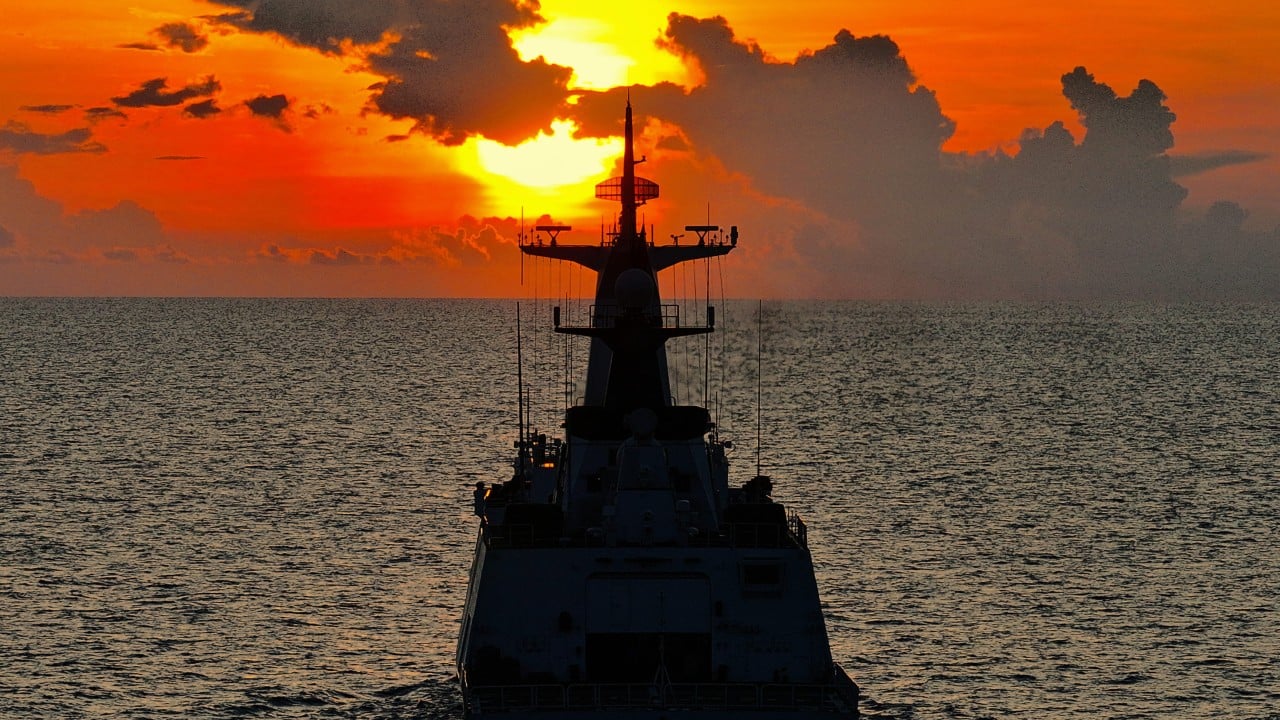
Defense analysts love a shiny new acronym. Every time four flags line up on a naval deck in the Indo-Pacific, the commentary class trips over itself to declare that Beijing’s maritime expansion has finally hit a brick wall.
They are wrong. The obsession with whether a new four-country defense hub—commonly dubbed the "Squad" (the United States, Japan, Australia, and the Philippines)—can counter China in the South China Sea misses the entire point of modern maritime coercion.
You do not stop a gray-zone campaign with traditional naval exercises. You do not deter coast guard water cannons and maritime militias with occasional multilateral photo ops. And you certainly do not rewrite the balance of power in Asia by cobbling together a loose diplomatic grouping that lacks a binding mutual defense treaty across all four members.
If you are asking whether this four-nation hub can stop Beijing, you are asking the wrong question. The real question is why Washington and its allies keep building conventional military coalitions to fight a sub-conventional war they are already losing on the water.
The Myth of the Multilateral Silver Bullet
The lazy consensus in defense journalism goes something like this: China is bullying the Philippines around Second Thomas Shoal and Scarborough Shoal. Therefore, bringing together the U.S., Japan, Australia, and the Philippines creates a unified front that forces Beijing to back down.
It sounds great in a think-tank white paper. In the actual salt spray of the West Philippine Sea, it falls apart.
I have spent over a decade watching defense ministries burn billions of dollars on interoperability exercises that look lethal on PowerPoint slides and completely irrelevant during actual crises. High-end naval wargames train sailors to sink enemy destroyers at 200 nautical miles. They do nothing to solve the tactical nightmare of a 12,000-ton China Coast Guard cutter ramming a wooden Philippine resupply boat while staying just below the threshold of an armed attack.
The Escalation Trap
Beijing’s strategists understand the rules of engagement better than Western commentators give them credit for. China operates in the gray zone—coercive statecraft that sits deliberately between normal diplomatic friction and open warfare.
When the China Coast Guard blasts a Philippine vessel with a water cannon or deploys laser pointers to temporarily blind a crew, they are exploiting a massive structural flaw in Western alliance architecture:
- The Mutual Defense Treaty Threshold: The 1951 U.S.-Philippines Mutual Defense Treaty commits Washington to respond to an "armed attack" on Philippine forces, public vessels, or aircraft in the Pacific, including the South China Sea. Water cannons, acoustic devices, and steel-hulled collisions are engineered specifically to avoid triggering that legal tripwire.
- Asymmetric Liability: Even if the U.S. decides a collision crosses the line, Japan and Australia have no formal treaty obligation to enter a shooting war over a submerged reef in the Spratly Islands. Japan’s constitution severely restricts collective self-defense unless Tokyo faces an existential survival crisis. Australia’s strategic priority remains protecting its northern maritime approaches, not fighting a high-intensity war off Luzon.
- The Logistics of Presence: A four-nation naval patrol lasts a few days. China’s maritime militia—hundreds of reinforced steel fishing trawlers funded and directed by the People's Liberation Army—stays on station 365 days a year.
Calling a loose coordination framework a "defense hub" implies permanence, unified command, and automatic deterrence. In reality, it is a scheduling committee.
What the "Squad" Actually Is (And Isn't)
To understand why the hype exceeds the hardware, you have to strip away the diplomatic branding and look at the mechanics of the grouping.
Unlike the Quad (the U.S., Japan, Australia, and India), which was explicitly framed as a diplomatic, economic, and technological partnership to avoid looking like an "Asian NATO," the U.S.-Japan-Australia-Philippines grouping is unapologetically military-focused. Defense ministers meet. Navies conduct Maritime Cooperative Activities. Coast guards share patrol schedules.
That sounds muscular until you examine the command structure. There isn't one.
No Unified Command, No Shared Deterrence
When NATO operates in the North Atlantic, ships plug into an integrated command structure with pre-approved rules of engagement, shared target data, and clear lines of escalation. When the four nations operate in the South China Sea, they are four separate navies sailing near each other under national command.
If a Chinese vessel aggressively cuts across the bow of a Philippine frigate during a joint sail, the American destroyer three miles away does not have automatic authority to intervene kinetically. Every ship answers to its own capital. Every capital has a different tolerance for escalation with its largest trading partner.
China knows this. Beijing’s leadership watches the political debates in Canberra, Tokyo, and Washington just as closely as they watch radar screens in Hainan. They know that Australia spent years digging itself out of a brutal trade freeze with Beijing and has zero appetite for a maritime clash. They know Japan is focused on the East China Sea and the Taiwan Strait, viewing the South China Sea as a secondary theater.
The Hardware Gap Nobody Wants to Mention
Let's look at the raw numbers that most coverage conveniently glosses over.
The People's Liberation Army Navy (PLAN) is already the largest navy in the world by battle force ships, operating over 370 hulls, with projections pushing past 400 before the end of the decade. Behind that sits the China Coast Guard—effectively a second navy—operating roughly 150 oceangoing patrol vessels over 1,000 tons, many built on repurposed naval frigate hulls. Behind that sits the People's Armed Forces Maritime Militia, comprising hundreds of vessels paid to loiter around contested features.
Now compare that to the Philippine Coast Guard and Navy. Despite aggressive modernization efforts and new patrol vessels donated by Tokyo and Washington, Manila is bringing a knife to an industrial shipbuilding fight. Adding a couple of Australian frigates and a Japanese helicopter destroyer for a weekend exercise changes the optics, not the permanent correlation of forces.
Dismantling the Top Myths About South China Sea Defense
If you follow mainstream coverage of the Indo-Pacific, you are constantly fed three comforting narratives about how alliances work in Asia. Every single one of them is dangerously outdated.
Myth 1: Joint patrols deter Beijing from bullying neighbors.
The Reality: Joint patrols temporarily pause Beijing’s aggression in one specific sector while accelerating it everywhere else.
Every time the four nations announce a Maritime Cooperative Activity, Beijing responds with a massive show of force of its own—deploying bomber patrols, encircling Scarborough Shoal with dozens of vessels, or declaring new baseline claims. Worse, once the foreign warships steam back to port in Yokosuka, Darwin, or Pearl Harbor, the Philippine Navy is left alone to face a Beijing that is eager to prove the Americans cannot protect them around the clock.
Myth 2: Japan and Australia are ready to fight for the South China Sea.
The Reality: Tokyo and Canberra are hedging, not committing.
Japan’s involvement is driven by cold, hard geography. Over 80 percent of Japan’s imported oil passes through the South China Sea. Tokyo wants freedom of navigation and wants to tie down Chinese resources far from the Senkaku Islands. Providing radar systems, patrol boats, and Reciprocal Access Agreements to Manila is smart, cost-effective statecraft for Japan. It is not a blank check to go to war with a nuclear-armed superpower over Second Thomas Shoal.
Australia is in a similar bind. Under the AUKUS pact, Canberra is betting its future maritime security on nuclear-powered submarines that won't arrive in force until the 2030s and 2040s. Right now, the Royal Australian Navy is operating an aging surface fleet stretched thin across the Pacific. Australia will show the flag to keep Washington happy and maintain regional relevance, but its military bandwidth is severely capped.
Myth 3: Beijing is isolated and losing the diplomatic war.
The Reality: Outside of Manila, the rest of Southeast Asia is watching the four-nation hub with deep nervousness, not applause.
The Association of Southeast Asian Nations (ASEAN) thrives on ambiguity and non-alignment. Countries like Indonesia, Malaysia, and Vietnam have their own territorial disputes with Beijing, yet none of them have rushed to join the U.S.-led defense hub. Why? Because they view the formation of a rigid four-nation military bloc as an accelerant for a Cold War in their own backyard—one that forces them to choose between their primary security guarantor and their primary economic engine.
Where the Four-Nation Hub Actually Works (And Where It Fails)
Critics of alliances often fall into the trap of saying multilateralism is useless. That is just as lazy as claiming it solves everything. To be honest about the strategic math, you have to separate what this grouping can achieve from what it never will.
What it actually achieves:
- Intelligence, Surveillance, and Reconnaissance (ISR) Fusion: Sharing real-time satellite imagery, maritime patrol aircraft feeds, and electronic intelligence gives Manila eyes over the horizon it could never afford on its own.
- Logistics and Basing Access: Expanding the Enhanced Defense Cooperation Agreement (EDCA) sites in the Philippines, combined with Reciprocal Access Agreements with Japan and Australia, complicates Beijing’s targeting calculus. Dispersed forces are harder to wipe out in a first strike.
- Industrial and Coast Guard Modernization: Japanese Official Security Assistance and U.S. Foreign Military Financing are steadily upgrading Philippine domain awareness and patrol endurance.
The undeniable downside:
Every step toward deeper military integration validates Beijing’s narrative that Washington is encircling China. It gives hardliners in the PLA the exact justification they need to militarize reclaimed islands further, deploy anti-ship ballistic missiles closer to the Philippine archipelago, and squeeze Manila economically. By turning a bilateral territorial dispute into a great-power proxy showdown, Manila gains powerful friends—and paints a massive target on its own back.
How to Actually Counter Beijing in the South China Sea
If four-nation naval parades aren't the answer, what is? Stop fighting on Beijing’s terms. Stop trying to match steel hulls with steel hulls in a theater where China enjoys overwhelming geographic proximity and industrial capacity.
Real deterrence in the gray zone requires asymmetric friction, radical transparency, and economic leverage.
1. Weaponize Radical Transparency
Beijing’s gray-zone playbook relies on plausible deniability and information control. When the Philippine Coast Guard began embedding international journalists on resupply missions and broadcasting high-definition footage of Chinese water-cannon attacks within minutes of impact, it inflicted more reputational damage on Beijing than a carrier strike group ever could.
The four nations should stop treating maritime intelligence as classified state secrets. Declassify satellite tracks, radio intercepts, and AIS spoofing data in real time. Flood the global information space with undeniable proof of maritime militia coercion before Beijing’s state media can spin the narrative.
2. Shift from Exquisite Navies to Asymmetric Denial
As defense strategists like Toshi Yoshihara and Andrew Krepinevich have argued for years, surviving inside China’s anti-access/area-denial (A2/AD) bubble requires ditching massive, vulnerable surface ships in favor of cheap, distributed lethality.
Instead of spending billions on high-profile multinational naval exercises, the four countries should flood the Philippine archipelago with mobile coastal anti-ship missile batteries, smart sea mines, unmanned surface vessels (USVs), and loitering munitions. Make the cost of invading or blockading any Philippine feature prohibitively expensive using systems that cost a fraction of a Chinese destroyer.
3. Build an Unbreakable Coast Guard Coalition
Warships signal war; white hulls signal law enforcement. Sending U.S. Navy destroyers into a coast guard standoff escalates the crisis in Beijing's favor.
The U.S., Japan, and Australia should deploy their own coast guard cutters—not naval warships—to conduct permanent, rotational law-enforcement patrols alongside the Philippine Coast Guard. Force China to choose between backing down against international law enforcement or attacking coast guard vessels from three major economies simultaneously.
4. Target the Maritime Militia’s Wallet
The People’s Armed Forces Maritime Militia is not a patriotic volunteer force; it is a state-subsidized commercial fleet. Those vessels still rely on global maritime insurance, international port access, and commercial supply chains.
Instead of empty diplomatic protests, Washington, Tokyo, and Canberra should slap targeted financial sanctions, port bans, and secondary insurance restrictions on every state-owned fishing enterprise and hull registry caught ramming foreign vessels in disputed waters. Hit the commercial operators where it hurts: their balance sheets.
Stop Confusing Activity with Strategy
The South China Sea will not be won by press releases, joint communiqués, or choreographed naval formations steaming past cameras in calm weather.
Beijing is playing a long, grinding game of territorial absorption, inching forward one reef, one water cannon blast, and one artificial island at a time. The four-nation defense hub is a useful diplomatic signal, nothing more. Until Washington and its allies abandon the illusion of conventional naval deterrence and start imposing real, daily, asymmetric costs on China's gray-zone fleet, Beijing will keep building its empire while the "Squad" holds another meeting.


