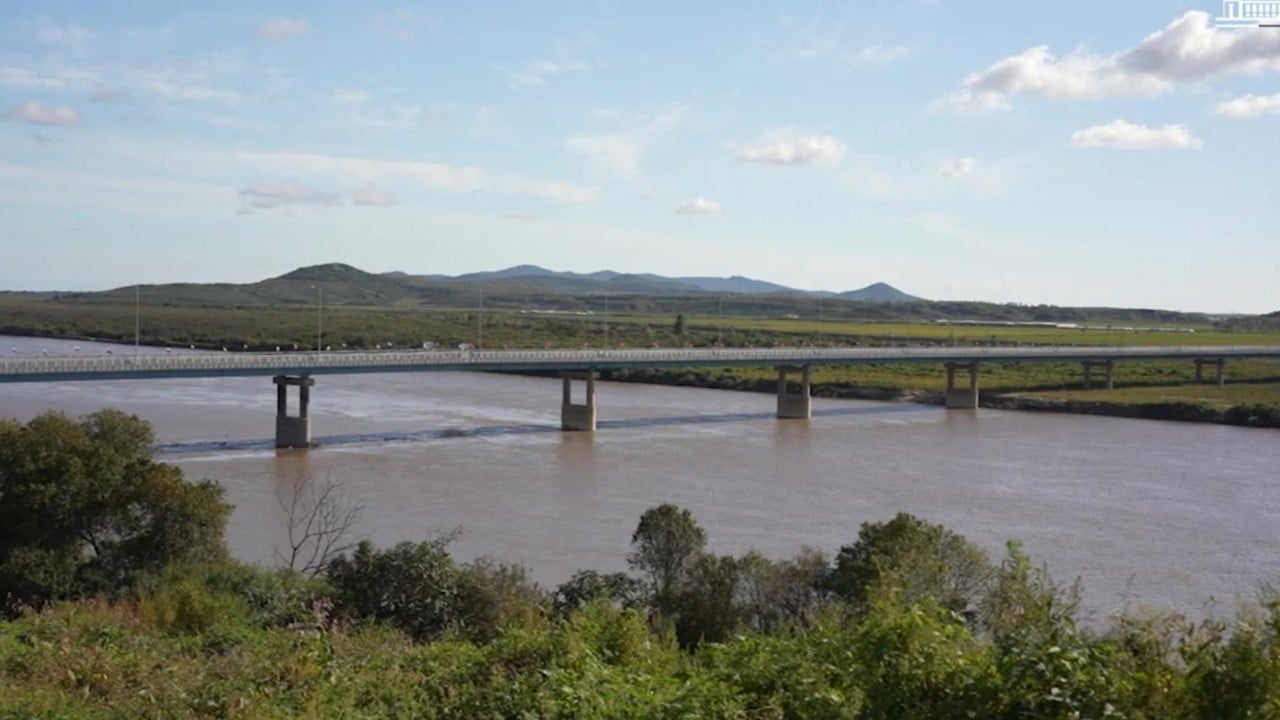
The headlines treat the grand opening of the Yakov Novichenko Bridge across the Tumen River as a monumental geopolitical shift. Mainstream outlets drone on about tourism, cultural exchanges, and a new era of bilateral commerce. They call it a symbol of friendship.
They are completely missing the point. Meanwhile, you can find similar developments here: Structural Mechanics of Statecraft: Quantifying the Xi Diplomatic Blitz.
Focusing on civilian trade or economic cooperation is a masterclass in missing the forest for the trees. Bilateral trade between Moscow and Pyongyang has historically hovered near statistical insignificance compared to global standards—barely registering tens of millions of dollars while infrastructure costs soar into the billions of rubles. Imagining a fleet of commercial semi-trucks loaded with consumer goods rolling leisurely across this span is a fantasy that ignores the fundamental mechanics of both economies.
The lazy consensus is that this bridge represents a traditional trade route upgrade. The reality is far more specific, surgical, and entirely divorced from civilian commerce. To understand the full picture, we recommend the detailed analysis by NPR.
To understand why this infrastructure project actually matters, look at the physical limitations of what came before. Since 1959, the sole physical connection has been the Korea-Russia Friendship Bridge, a rail link plagued by a glaring logistical bottleneck: the track gauge mismatch. Russia uses a broad 1,520 mm gauge, while the Korean peninsula relies on standard 1,435 mm tracks. Every single train carriage crossing that border requires manual bogie-swapping or cargo-transshipment. That process is slow, labor-intensive, and painfully transparent to anyone tracking logistics via satellite telemetry.
Rail networks leave signatures. They require marshaling yards, heavy cranes, specialized personnel, and predictable schedules. Every movement can be cataloged, timed, and analyzed by Western intelligence agencies and open-source investigators within hours.
Road transport changes the calculus entirely.
A two-lane, seven-meter-wide asphalt road does not require a crane yard to shift artillery shells or containerized crates. It bypasses the rigid scheduling of state railway timetables. More importantly, rubber tires offer tactical dispersion. Imagine a scenario where military logistics need to move heavy equipment, electronic warfare components, or personnel undetected by fixed-orbit overhead surveillance. A train offers one point of failure and total visibility. A convoy of unmarked heavy trucks moving under the cover of night offers deniability, flexibility, and operational obscurity.
The timing confirms this structural shift. Construction on this crossing accelerated aggressively following high-level military pacts and the deployment of thousands of North Korean troops to the western front lines. Yet, officials spent the opening ceremony talking up ski resorts, regional development, and employment figures.
Stop buying the tourism narrative. Nations do not spend billions of rubles on a remote, sparsely populated river crossing to facilitate weekend getaways for ordinary citizens who require state permission just to cross province lines.
The Yakov Novichenko Bridge is not a commercial pipeline. It is a high-speed logistical bypass designed to circumvent the glaring bottlenecks of nineteenth-century rail infrastructure and the unblinking eye of satellite reconnaissance. It replaces tracks with tarmac to keep heavy military supply lines fluid, hidden, and fast.
The next time you read about friendship bridges and cultural festivals, look past the ribbon-cutting ceremonies. Follow the rubber, not the rhetoric.
North Korea And Russia Open Their First Road Bridge
This short video captures the official media framing surrounding the opening ceremony of the newly inaugurated Tumen River crossing.
http://googleusercontent.com/youtube_content/1