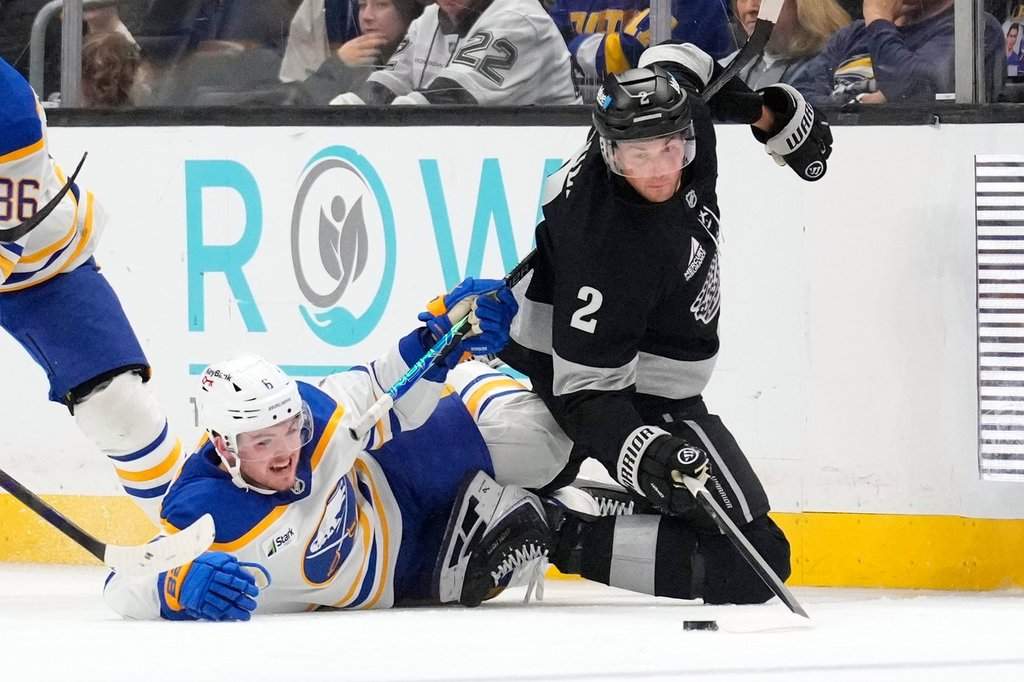
Brian Dumoulin caught Jordan Spence with a dangerous hit, and the National Hockey League handed the Los Angeles Kings defenseman a financial wrist-slap rather than a suspension. When the NHL Department of Player Safety announces a fine instead of taking a player off the ice, the league is doing more than settling a single on-ice infraction between the Kings and the Ottawa Senators. It is reinforcing a decades-old disciplinary system designed to protect multi-million-dollar payrolls, appease the players' union, and keep star rosters intact while publicly claiming to prioritize athlete health.
That is the reality of modern hockey discipline. A fine in the NHL is rarely about deterrence.
For fans watching at home, the transaction looks absurd. A veteran defenseman making millions of dollars a year crosses the line against an opponent, the league's disciplinary office reviews the tape, and the resulting punishment amounts to a fraction of a single game check. Nobody changes their on-ice behavior over a few thousand dollars. Yet the NHL Department of Player Safety continues to hand out these minimal penalties with clockwork regularity, creating an enforcement gap that leaves players vulnerable and fans baffled.
The Economics of the Collective Bargaining Agreement
To understand why the Dumoulin hit on Spence resulted in a fine rather than a seat in the press box, you have to look past the rulebook and examine the labor contract. The NHL does not operate like a unilateral dictatorship where the commissioner can arbitrarily strip a player of half his annual salary. Every dollar taken from a player is strictly governed by the Collective Bargaining Agreement (CBA) negotiated between the league owners and the National Hockey League Players' Association (NHLPA).
Under the terms of the CBA, the maximum allowable fine for a first-time offender without a suspension is capped at 50 percent of one day's pay, up to a hard ceiling of $5,000.
Think about that number for a moment. Five thousand dollars. In an era where the league's salary cap sits well above $80 million and veteran defensemen routinely earn between $3 million and $6 million per season, $5,000 is functionally a rounding error. It is less than what some players spend on dinner for the rookies during a road trip.
Why would the league agree to such a toothless penalty structure? Because the NHLPA fought hard to keep it that way.
Labor unions exist to protect the wages and working conditions of their members. From the perspective of the NHLPA, every time a player is suspended, money leaves the players' collective pocket—specifically, forfeited salary goes into the Players' Emergency Assistance Fund. Furthermore, a suspension creates a permanent disciplinary record. Under CBA rules, a player classified as a repeat offender—defined as someone who has been suspended within the previous 18 months—loses salary based on the number of games in the season (82) rather than the number of days in the season (roughly 190). That distinction more than doubles the financial sting of any future suspension.
By keeping fines capped at $5,000 and reserving suspensions only for the most egregious, undeniable violations, the union shields its members from massive financial losses. The league, in turn, gets labor peace and avoids constant arbitration battles over borderline plays. When the Department of Player Safety fines a player like Dumoulin for a hit on Spence, it is operating inside a rigid financial cage built by both management and labor.
How the Department of Player Safety Grades a Hit
When an incident happens on the ice—whether it is a late check, boarding, interference, or an illegal check to the head—the review process begins almost immediately in New York. Video technicians isolate every available broadcast angle, including high-angle tactical feeds that television viewers rarely see.
The evaluators at Player Safety are not guessing. They run every hit through a specific diagnostic checklist to determine whether the play warrants a fine, a telephone hearing, or an in-person hearing.
- The Primary Point of Contact: Did the hitter drive through the opponent's core, or did the shoulder, elbow, or stick target the head or neck?
- Timing and Possession: Was the hit delivered within the acceptable window after the player released the puck, or was the target completely defenseless and unaware?
- Force and Vulnerability: Did the hitter launch upward into the check, leave their feet, or drive an opponent dangerously into the boards from a vulnerable distance?
- Injury on the Play: While the league officially claims that the severity of an injury does not dictate whether a play is illegal, the CBA explicitly allows the department to consider injury when determining the length of a supplemental discipline penalty.
- Disciplinary History: Has the offending player been fined or suspended within the last 18 months?
In the case of a borderline hit—like Dumoulin's collision with Spence—the play often falls into a gray zone. Perhaps the target turned slightly just before impact. Perhaps the hitter kept his skates on the ice and tucked his elbow, mitigating the visual violence of the collision just enough to avoid the threshold for a suspension. When a play sits right on the fault line between a hard hockey play and a reckless infraction, the Department of Player Safety almost always defaults to a fine.
It serves as an official warning shot. The league puts a mark on the player's permanent record without altering the competitive balance of the upcoming schedule.
The Illusion of Deterrence
Ask any former NHL player who has sat across the table in a disciplinary hearing, and they will tell you the exact same thing. Fines do not stop bad hits.
Hockey is played at breakneck speeds on razor-thin blades over a frozen surface surrounded by rigid glass and dasher boards. Players make dozens of split-second spatial calculations every shift. When a defenseman steps up at the blue line or pinches down the wall to close off a breakout pass, he is not calculating the cost-benefit analysis of a $5,000 fine. He is reacting to muscle memory, coaching demands, and the relentless pressure to keep his spot in the lineup.
The only thing that genuinely alters player behavior is the threat of losing ice time—and losing real money.
When a player is suspended for three or five games, two things happen immediately. First, his team has to play without him, which hurts his standing with the coaching staff and management. Second, he forfeits tens or hundreds of thousands of dollars in salary. Even more importantly, his teammates and coaches take notice. Coaches preach discipline, until a game gets tight in the third period and they demand physical edge. If the worst-case scenario for crossing the line is a $5,000 fine, coaches will quietly encourage their players to keep playing right on that edge.
By relying on fines for borderline dangerous plays, the NHL creates a perverse incentive structure. Players learn that they can push the boundaries of safety, intimidate opponents, and disrupt an opposing team's rhythm, knowing that unless someone leaves the ice on a stretcher, the financial penalty will be negligible.
The Institutional Conflict of Interest
There is a deeper, structural flaw baked into the NHL's disciplinary model that rarely gets discussed during broadcast intermissions. The Department of Player Safety is not an independent regulatory body. It is an arm of the league itself.
Consider the dual mandate the NHL faces every single night. On one hand, the league has a legal and moral obligation to protect its athletes from concussions, spinal injuries, and career-ending trauma. On the other hand, the league is an entertainment business selling speed, collision, and physicality.
Star players drive television ratings, merchandise sales, and ticket demand. When a top-pairing defenseman or a marquee forward gets suspended, the product on the ice suffers. Broadcasters complain. Ticket holders feel cheated. General managers—the very people who sit on the Board of Governors or report directly to the owners—pick up the phone and lobby league executives behind closed doors.
Because the Department of Player Safety answers directly to the Commissioner's office, it is constantly balancing player welfare against business optics. Suspending a player for a hit that did not result in a major injury invites immediate pushback from the offending team's front office and the players' union. Issuing a fine allows the league to issue a press release, appear proactive in the morning headlines, and move on to the next slate of games without disrupting a single lineup.
The Psychological Toll on the Target
When analysts dissect a hit like Dumoulin's on Spence, the conversation almost always centers on the hitter. Was his elbow up? Did he finish his check cleanly? Was the fine fair?
We rarely examine what that disciplinary decision communicates to the player who took the hit—and to the rest of the locker room.
Jordan Spence is a skilled, mobile defenseman whose value depends on his ability to retrieve pucks under pressure, absorb contact, and make clean outlet passes. Every night in the NHL, smaller or puck-moving defensemen absorb massive physical punishment as forecheckers bear down on them in the corners. They rely on the rulebook—and the enforcement of that rulebook—to ensure that forecheckers cannot simply run them through the glass with impunity.
When a questionable hit results in nothing more than a nominal fine, it sends an unmistakable message to the opposing bench. The referees and the league office have just established the tolerance level for physical abuse.
If the league refuses to police the gray areas with meaningful suspensions, players inevitably take enforcement into their own hands. That is how hockey has operated for a century. When the official justice system fails to deter dangerous play, the informal code takes over. Next time the Kings and Senators meet, nobody in either locker room will be thinking about the $5,000 fine on the league's transaction wire. They will be remembering the hit, looking for numbers, and waiting for an opportunity to settle the score on the ice—often leading to retaliatory hits, staged fights, and an escalation of the exact violence the league claims it wants to eliminate.
Why Consistency Remains Impossible
Fans love to complain about the "Wheel of Justice"—the popular internet meme suggesting that the Department of Player Safety spins a roulette wheel to decide punishments. While the department actually follows a strict internal precedent database, the perception of inconsistency is completely justified.
The problem lies in how hockey is officiated in real time versus how it is reviewed in slow motion.
On the ice, a referee has a fraction of a second to judge angle, speed, and intent from sixty feet away while dodging flying pucks and skates. If the referee calls a five-minute major penalty and a game misconduct on the ice, the Department of Player Safety views the play through one lens. If the referee misses the hit entirely or calls a minor two-minute penalty, the department views it through another.
Furthermore, slow-motion replay distorts reality. A collision that looks entirely incidental at 25 miles per hour can look malicious when slowed down to 24 frames per second. Conversely, a devastating hit can look technically clean on replay even when the hitter clearly intended to inflict maximum punishment on an unsuspecting opponent.
Because the league refuses to adopt a strict liability standard—where the hitter is held responsible for dangerous contact regardless of whether the target turned at the last second—every ruling becomes a subjective debate over intent and mitigation. That subjectivity guarantees inconsistency. One night, a player gets two games for a high hit. The next night, a remarkably similar hit—like Dumoulin's on Spence—draws a fine because the department decided the hitter made an effort to minimize contact.
What Real Reform Would Actually Look Like
If the NHL genuinely wanted to eliminate dangerous hits from the game, the blueprint is not complicated. It would simply require the league and the players' union to prioritize long-term brain health over short-term paycheck protection.
First, the fine structure in the Collective Bargaining Agreement would need to be completely overhauled. A $5,000 cap is an insult to the concept of deterrence. Fines should be scaled dynamically as a meaningful percentage of a player's actual salary—starting at a full game check for a first-time borderline infraction. If a veteran defenseman loses $35,000 instead of $5,000 for a reckless hit, the locker room conversation changes overnight.
Second, the league needs to separate the Department of Player Safety from the Commissioner's office. An independent disciplinary panel—composed of former players, former referees, and medical experts—would remove the institutional conflict of interest that currently shields teams and star players from inconvenient suspensions.
Third, the standard for hits involving vulnerable players must shift toward strict accountability. Forecheckers and defenders should bear the burden of ensuring a check is clean before committing to the hit. If a player is in a vulnerable position along the boards or cutting across the middle with his head down, the hitter must pull up or steer clear, rather than claiming the victim put himself in a bad spot.
Until those structural changes happen, press releases announcing fines for hits like Brian Dumoulin's collision with Jordan Spence will remain pure theater. The league will collect a tiny check, deposit it into a charity fund, and pat itself on the back for maintaining order—while the players on the ice continue to pay the real price.