The rain had stopped, but the asphalt still held that slick, mirror-like sheen that tricks the human eye and confuses lasers. Outside the stadium, forty thousand people poured into the streets, a human tidal wave of jerseys, flags, and post-match adrenaline. Horns blared in a jagged, arrhythmic symphony. Exhaust fumes hung heavy in the damp night air. It was the kind of gridlock that reduces seasoned drivers to white-knuckled muttering.
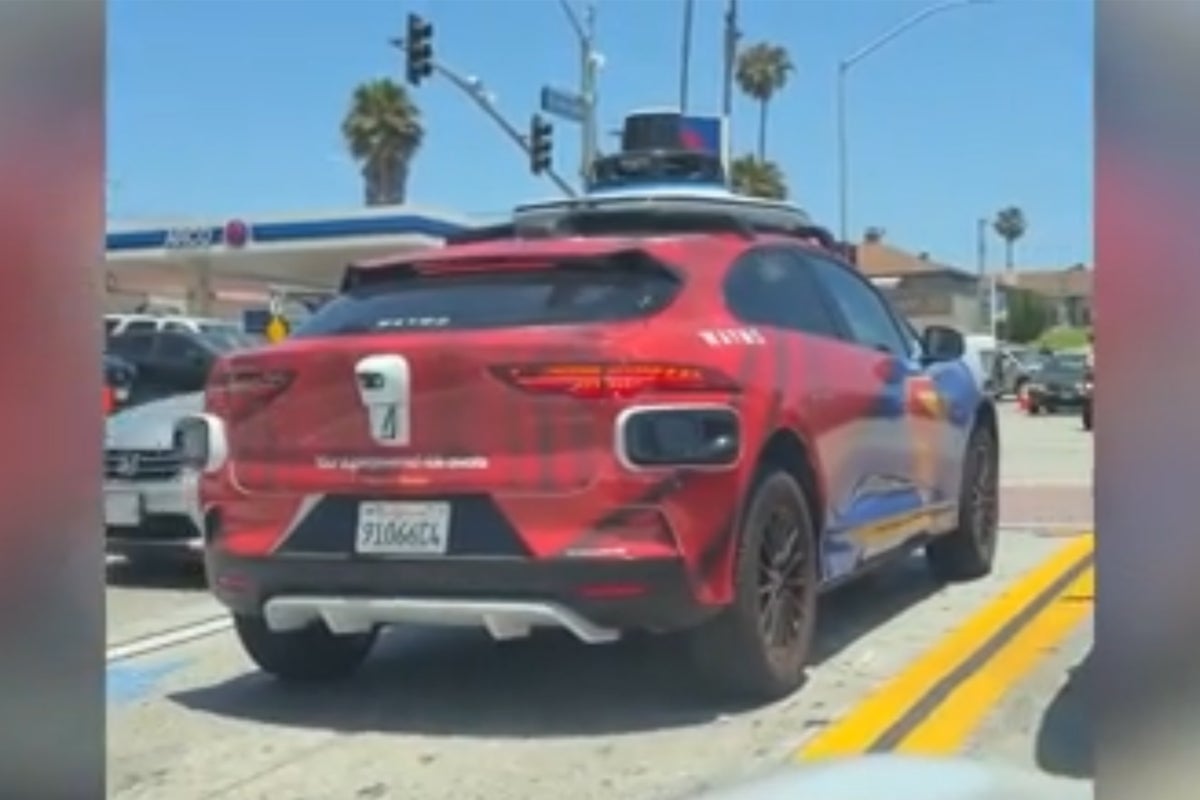
In the middle of this chaos sat a white Jaguar I-Pace. On its roof, a black cylinder spun in silence, painting the world in millions of invisible data points.
To the software guiding the vehicle, the world was a math problem. It calculated distances to the millimeter. It tracked the velocity of a wandering pedestrian three lanes over. It looked at the sea of brake lights and saw a logical puzzle waiting for an optimal path.
Then, the puzzle broke.
Consider what happens when a machine designed for perfect order meets the absolute, unbridled anarchy of human celebration. The car, operated by Waymo, found itself trapped in a bottleneck of World Cup traffic. Ahead lay a wall of stationary steel. To the right, temporary construction barriers blocked the shoulder. To the left, the double yellow lines separated the gridlock from an empty, oncoming lane.
For a human driver, the decision-making process in this moment is a messy mix of social cues and calculated rule-breaking. You look at the driver next to you. You make eye contact. You read the body language of a police officer waving a flashlight. You edge forward, nudging your way through a gap that technically shouldn't exist, committing a minor infraction to resolve a major block.
The machine had no eyes to lock with a stranger. It had no gut feeling.
Instead, the sensors registered an unacceptable delay. The path forward was blocked indefinitely. The lane to the left was clear of immediate obstacles. According to witnesses who watched the scene unfold, the robotaxi made a choice that felt chillingly human in its impatience, yet entirely mechanical in its disregard for the unwritten rules of the road. It pulled out. It crossed the double yellow lines.
It began driving directly into the oncoming traffic lane.
The Mirage of the Perfect Driver
We have been sold a specific promise for over a decade. The narrative is comforting: human drivers are flawed, easily distracted, and prone to rage. Machines are objective, tireless, and hyper-vigilant. Replace the chaotic human element with cold, predictable code, and our streets will transform into rivers of smooth, predictable efficiency.
But that promise relies on a fundamental misunderstanding of what driving actually is. Driving is not just geometry and physics. It is a continuous, silent negotiation between thousands of strangers.
Imagine you are walking down a crowded sidewalk. Someone is walking directly toward you. You don't calculate their velocity vector to avoid a collision. You look at their shoulders. You see which way their gaze turns. You lean slightly to the right, they mirror the shift, and you pass each other without a word.
When a robotaxi navigates an urban center during a massive sporting event, it tries to solve a sidewalk negotiation using pure calculus. It works beautifully 99 percent of the time. The cameras see the red light; the brakes apply. The radar spots a cyclist; the vehicle slows down.
But the remaining one percent is where reality lives.
When the white sedan crossed into the wrong lane, it wasn't a software glitch in the traditional sense. The computer didn't freeze. The cameras didn't go dark. The vehicle did exactly what its programming dictated when faced with an existential standstill: it looked for an open trajectory. The system failed because it could not comprehend the social contract that keeps oncoming traffic from turning into a head-on collision.
A witness standing on the sidewalk captured the moment on a smartphone. The video shows the vehicle moving with an eerie, confident smoothness, gliding down the wrong side of the road while oncoming headlights approach in the distance. In the clip, you can hear the crowd's reaction. It isn't anger. It is a collective, uneasy laugh.
It is the sound of people realizing the driver behind the wheel doesn't know what a car crash actually means.
The Invisible Stakes of the Boundary Line
The tech industry often talks about edge cases. An edgecase is a rare, unpredictable scenario that falls outside the boundaries of normal testing. A rogue unicycle on a highway is an edge case. A flock of turkeys surrounding a vehicle is an edge case.
Massive sports traffic, however, is not an edge case. It is a predictable feature of human civilization.
When tens of thousands of people gather in one geographic point, the physical infrastructure of a city stretches to its absolute limit. Signs are ignored. Pedestrians spill over curbs. Lanes become suggestions. In these moments, human drivers rely on an unspoken hierarchy of survival. We prioritize moving slowly, avoiding metal-on-flesh contact, and following the collective flow of the crowd, even if that flow violates local traffic ordinances.
The robotaxi lacked this hierarchy. Surrounded by flashing emergency lights, honking horns, and a sea of erratic movement, the vehicle's inputs became overwhelmed by noise.
To understand what went wrong, look at how these systems evaluate risk. The vehicle assigns a cost to every possible action. Stopping in the middle of an active lane has a cost. Turning has a cost. Staying stationary for too long increases the frustration metric of the imaginary passenger. In a normal environment, crossing a double yellow line carries an astronomical cost weight, effectively forbidden by the software.
But under extreme congestion, as the wait time spiked and the surrounding paths remained frozen, the math shifted. The cost of remaining trapped became higher than the cost of entering the oncoming lane.
The car chose the lesser of two evils according to its ledger.
The problem is that the ledger was written in an office park hundreds of miles away, completely disconnected from the immediate terror of a driver coming over the crest of a hill to find a driverless Jaguar occupying their lane.
When the Backup Plan Fails
What happens when the machine gets stuck? The industry answer is remote assistance. Somewhere in a quiet, brightly lit command center, a human operator sits in front of a bank of monitors. When a vehicle encounters a situation it cannot resolve, it flags a human handler for help.
The handler looks through the car’s cameras, assesses the situation, and draws a new path on a screen for the vehicle to follow. It is a hybrid system meant to bridge the gap between artificial intelligence and human intuition.
But during a major event like the World Cup, the cellular networks that carry those video feeds are choked by thousands of fans uploading videos, sending texts, and streaming highlights. The digital tether thins. The data packets delay.
Consider what happens next: the car is stuck in a dangerous position, the remote operator is trying to view a stuttering, pixelated feed, and the surrounding crowd is growing increasingly volatile. The safety net doesn't snap; it just stretches until it becomes useless.
This isn't an isolated technical bug that a simple software patch can fix over the weekend. It is a structural limitation of trying to automate an environment that is inherently non-automated. We have built vehicles that can read the lines on the road perfectly, but we have not built vehicles that understand why those lines exist in the first place.
The incident ended without injuries. A human operator eventually intervened, or the traffic shifted enough for the vehicle to correct its posture. The car melted back into the night, leaving behind a crowd of onlookers with a story to tell.
But the video remains, looping on social feeds, a brief window into a future we are rushing toward without fully understanding the costs.
We are replacing human error with systemic predictability, but we are also replacing human empathy with an unyielding adherence to optimization. The next time you find yourself at a congested intersection, look at the driver in the car opposite you. You might nod. They might wave you through. That brief, fleeting moment of human connection is the only thing keeping the streets from descending into chaos.
The machine cannot nod. It can only calculate. And sometimes, the math tells it to drive straight into the dark.