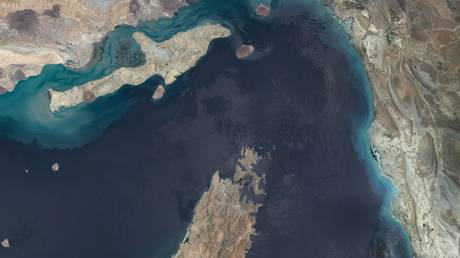
Imagine standing on the steel bridge of a very large crude carrier. The air smells of salt, heavy fuel oil, and the dry heat of the desert. Below you, two million barrels of crude oil sit in the belly of the ship, a cargo worth roughly $160 million. Ahead lies a strip of black water just twenty-one miles wide at its narrowest point: the Strait of Hormuz.
You are looking through night-vision goggles, watching for the low-profile silhouette of an Iranian fast-attack craft or the white wake of a suicide drone.
Then, a message flashes on your terminal. It is not a warning from the U.S. Navy. It is a bill.
The amount? Thirty-two million dollars. For a single transit.
This was the reality facing the global maritime industry for a chaotic twenty-four-hour window. On Monday, U.S. President Donald Trump declared the United States the official "guardian" of the Strait of Hormuz and announced a flat 20 percent "reimbursement fee" on all cargo passing through the waterway to cover the costs of American military protection. By Tuesday afternoon, the fee was dead, replaced by a vague promise of "massive" Middle Eastern investments into the American economy.
It was a head-spinning about-face that exposed the fragile, invisible threads holding the global economy together.
The Price of Passage
To understand why a 20 percent shipping toll sent shockwaves through boardroom offices from Tokyo to London, you have to look at the math.
When the United States and Israel entered a shooting war with Iran on February 28, the economics of global shipping changed overnight. The Strait of Hormuz, which usually carries a fifth of the world’s petroleum, became a shooting gallery of cruise missiles, drone strikes, and naval blockades.
Consider a hypothetical shipping executive. Let us call her Sarah. Sarah does not think in terms of geopolitics; she thinks in terms of margins.
Before the war, a tanker could sail through the strait for free. When Iran began attacking ships, insurance premiums skyrocketed, but the physical water remained a public highway. Suddenly, the American president suggested that the highway was now a toll road.
At current Brent crude prices hovering around $80 a barrel, a 20 percent fee meant that roughly $16 of every barrel on board belonged to Washington. For a massive liquefied natural gas carrier, the toll would hit $17 million. For a supertanker, it breached $30 million.
These are not numbers a business can absorb. They are numbers that break supply chains.
Industry groups reacted with a mixture of panic and disbelief. Shipping giants pointed out the obvious: charging vessels to transit an international strait is flatly illegal under maritime law. Ironically, just weeks earlier, U.S. Secretary of State Marco Rubio had publicly declared that "no country is allowed to charge tolls or fees on an international waterway" after Iran attempted to do the very same thing.
Suddenly, the "guardian" of the strait was using the exact same playbook as the adversary.
The Phones Start Ringing
But the legal arguments were not what changed the president’s mind. It was the phones.
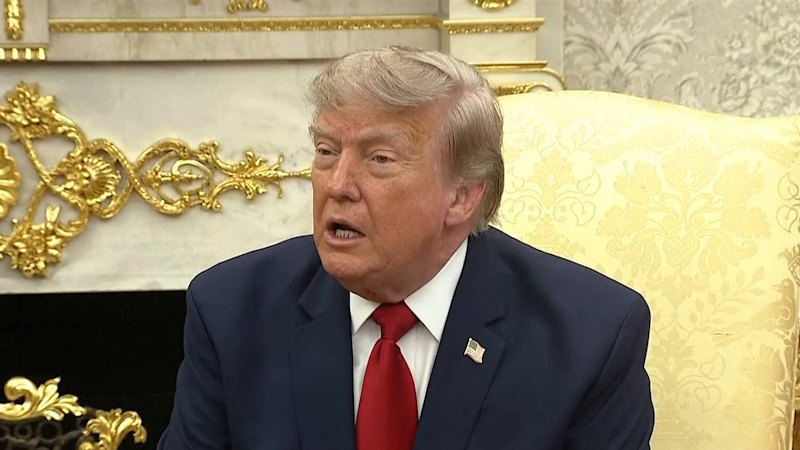
In the Oval Office on Tuesday, Trump admitted that his plan had hit a wall of diplomatic resistance. "I was called by different people, different countries, kings and emirs," he told reporters.
These leaders—from Saudi Arabia, the United Arab Emirates, Qatar, Bahrain, and Kuwait—faced a nightmare scenario. A U.S.-imposed toll would not only penalize their state-owned oil companies but would also validate the idea that international waters could be carved up and monetized.
So, they offered a classic geopolitical trade-off.
Don’t charge the ships, they essentially said. We will buy American instead.
The 20 percent toll was scrapped in exchange for "Trade and Investment Deals" to be made by Gulf states directly into the United States. It was a transactional resolution typical of the administration: a messy, public threat resolved by a private, multi-billion-dollar handshake.
Yet, while the toll vanished as quickly as a social media post, the underlying crisis did not.
The Blockade Goes Live
At 4:00 PM Eastern Time on Tuesday, the U.S. military officially reinstated its naval blockade on Iranian ports. Over twenty warships and hundreds of aircraft began patrolling the waters, effectively choking off Iran's maritime trade.
The tension in the region is thick enough to taste. Hours before the blockade took effect, Iranian-aligned forces fired retaliatory missiles at U.S. bases in Bahrain and Kuwait. Explosions rocked Iranian coastal cities, including Bushehr, home to a nuclear power plant.
For the merchant mariners actually sailing these waters, the high-level diplomatic pivot from shipping tolls to investment deals offers little comfort. The danger remains physical, immediate, and terrifying.
During the height of the toll debate, three massive tankers slowly made their way into the Persian Gulf. Not a single large vessel with its GPS transponder turned on dared to sail out.
They are waiting. They are watching the horizon. They know that even if the toll booths have been dismantled, the price of passage through the world's most dangerous choke point is still measured in blood and fire.