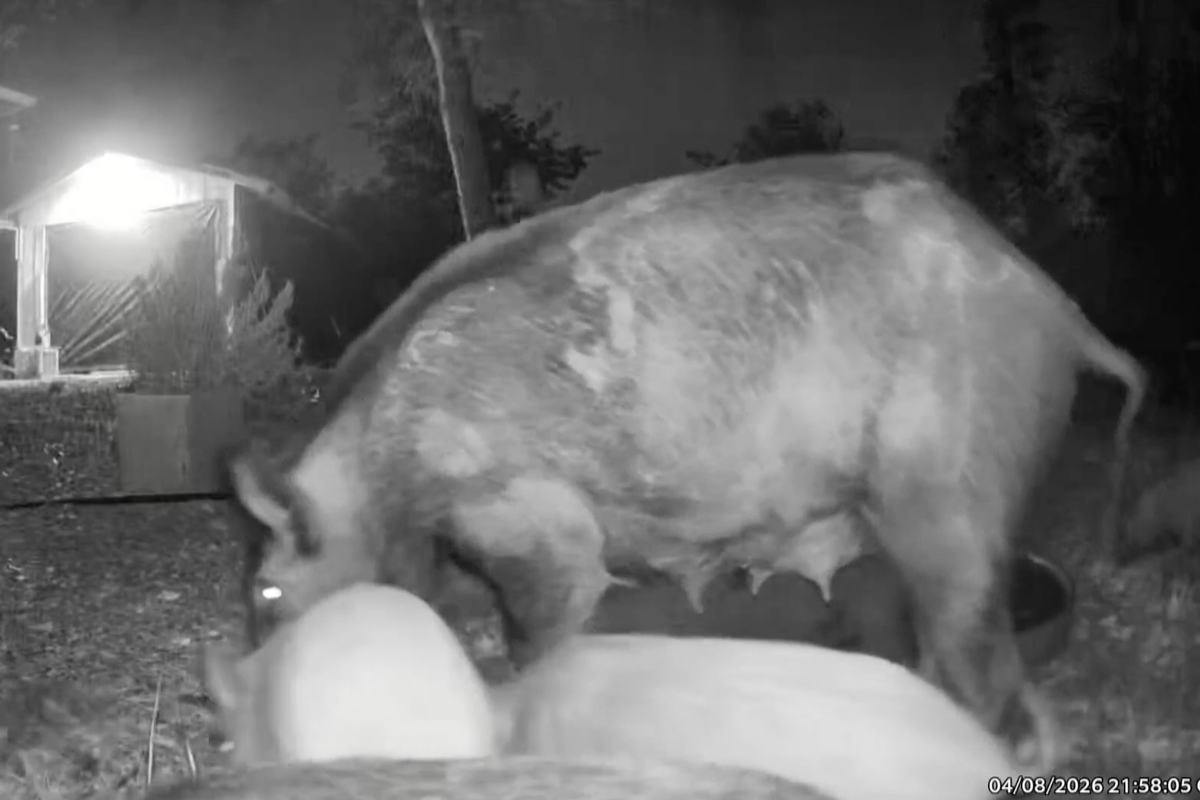
The moonlight over suburban Texas used to signify quiet. It was the silver glow on manicured St. Augustine grass, the steady hum of a neighbor’s AC unit, and the occasional rustle of a squirrel in a live oak. But lately, the silence has been replaced by a sound that doesn't belong in a cul-de-sac: the wet, heavy thud of three-hundred-pound bodies hitting soft earth and the rhythmic, frantic tearing of soil.
Imagine a homeowner—let's call him David—waking up at 3:00 AM in a suburb just outside of San Antonio. He thinks he hears a car crash or perhaps a burglar prying at the fence. He looks out his bedroom window, expecting to see a neighbor’s headlights. Instead, he sees a shadow that looks like a boulder with legs. Then another. Then six more. They are moving with a terrifying, mechanical efficiency, their snouts acting like rototillers as they flip sections of his lawn like they are peeling back a rug.
By sunrise, David’s yard, the one he spent three weekends sodding and leveling, looks like a mortar range. This is the new front line of a biological invasion.
The Concrete Frontier
For decades, the feral hog was a ghost of the rural brush. They were a problem for farmers in the Hill Country or ranchers in East Texas—mythical, tusked beasts that lived in the "over there." But the "over there" has disappeared. As Texas cities stretch their concrete fingers further into the wild, and as the hog population swells toward an estimated seven million statewide, the two worlds have collided.
These animals are not the pink, curly-tailed pigs of storybooks. They are bristly, muscular, and surprisingly intelligent survivors. They are the descendants of escaped domestic swine and European wild boars, a genetic cocktail designed for one thing: persistence.
The transition from forest to suburbia wasn't an accident. It was a tactical shift. Suburbs offer everything a feral hog desires. We have created a buffet. We plant lush, irrigated grass that stays soft and easy to root through even in a drought. We plant ornamental shrubs with juicy tubers. We leave out dog food and birdseed. To a hog, a Texas neighborhood isn't a residential zone; it's a five-star resort with no predators and an endless supply of appetizers.
The Invisible Stakes of a Midnight Raid
When a resident calls their city council member to complain about a hog, they usually focus on the aesthetics. They talk about the ruined grass or the knocked-over trash cans. But the stakes are deeper, vibrating just beneath the surface of the sidewalk.
A group of hogs, known as a sounder, can consist of two dozen individuals. When they enter a neighborhood, they don't just eat; they destroy infrastructure. They root around the bases of trees, exposing roots to disease. They wallow in drainage ditches, causing silt to clog the very systems meant to prevent neighborhood flooding.
Then there is the unseen biological threat. Feral hogs carry dozens of parasites and diseases, including pseudorabies and swine brucellosis. When they defecate in a suburban park where children play or near a backyard pool, they aren't just being a nuisance. They are introducing a wild, untamed element into a space we have spent centuries trying to make safe.
The emotional toll is perhaps the most difficult to quantify. There is a specific kind of violation in looking out at your property and seeing it reclaimed by something so primal. It shatters the illusion of the suburban bubble. It reminds us that despite our fences and our streetlights, we are still living in a landscape that can be taken back.
The Geometry of a Breeding Machine
To understand why the "hog problem" is suddenly a "neighborhood problem," you have to look at the math. It is brutal.
A single sow can have two litters a year, with six to twelve piglets per litter. They reach breeding age within months. Experts estimate that in order to simply keep the population from growing—not to shrink it, but just to keep it level—we would have to eliminate roughly 66% of the hogs in the state every single year.
We aren't even close to that number.
In the past, the solution was hunting. But you cannot fire a high-powered rifle in a gated community in Plano or Pearland. You cannot drop poison in a park where Labradors roam. The very tools we used to manage the population in the wild are useless in the suburbs. This leaves residents in a state of trapped frustration. They are told the hogs are a "statewide crisis," but when they ask for help with the sounder tearing up their flowerbeds, they find themselves caught in a web of jurisdictional hand-wringing.
The Cost of a Cracked Sidewalk
Consider the financial reality for a family living on the edge of this expansion. Replacing a lawn can cost thousands. Repairing a fence that a hog has simply walked through—because a hog doesn't go around a fence, it goes through it—is a recurring expense. Insurance companies often view hog damage as "acts of nature" or "pest infestations," terms that usually mean the homeowner is footing the bill alone.
City leaders are beginning to feel the heat. In suburban pockets across the state, "hog town halls" are becoming more common than budget meetings. The suggestions range from the practical to the desperate:
- Trapping programs that cost the city tens of thousands of dollars.
- Installing expensive, specialized fencing that goes two feet into the ground.
- Hiring professional "hog mitigators" who work in the shadows with suppressed firearms and thermal optics.
But even these are band-aids on a geyser. Trapping one sounder simply clears the territory for the next one. They are learners. If a hog sees its peer get caught in a metal cage, it will never step inside one. They are evolving alongside our attempts to stop them.
A Lesson in Humility
The arrival of the feral hog in our suburbs is a lesson in the fragility of our borders. We like to think of our neighborhoods as finished products—static, controlled, and safe. We believe that by paving over the dirt, we have conquered it.
The hogs prove us wrong every night.
They don't care about property lines. They don't care about the prestige of a zip code. They represent a wildness that refuses to be suburbanized. We are witnessing a collision of two different types of expansion: our desire for more space, and a species' incredible ability to fill it.
David, the homeowner, eventually bought a motion-activated sprinkler. It worked for two nights. On the third night, he watched on his doorbell camera as a large boar simply leaned into the spray, using the water to soften the mud for easier rooting. The hog didn't run. It didn't flinch. It just kept digging.
There is a point where a nuisance becomes a transformation. We are past the point of "fixing" the hog problem; we are now in the era of negotiating with it. The suburban dream of the perfect, velvet-green lawn is being perforated by the reality of a species that was here long before the developers arrived and will likely be here long after the last mortgage is paid.
The sun comes up over a quiet street in Austin. A woman walks her dog, carefully navigating around a patch of earth that looks like it was hit by a backhoe. She doesn't call the police anymore. She doesn't call the city. She just looks at the raw, dark dirt and realizes that the woods have finally come home.