Twelve days.
In the span of a single human gestation, twelve days is a flicker. In the life of a city, it is a heartbeat. But for the people living between the crosshairs of the Persian Gulf and the Mediterranean, twelve days has become a lifetime. Time has stopped moving forward in a straight line; it now moves in the rhythm of sirens and the heavy, metallic thud of air defense systems clawing at the dark.
The world wakes up to headlines about strategic depth and geopolitical leverage. We talk about the Middle East as if it were a chessboard, ivory and ebony pieces sliding across a lacquered map. We use words like "unprecedented" and "escalation" until they lose their teeth. But the reality isn't a board game. It is the sound of a tea glass rattling on a bedside table in Tehran. It is the smell of ozone and burnt concrete in the suburbs of Tel Aviv.
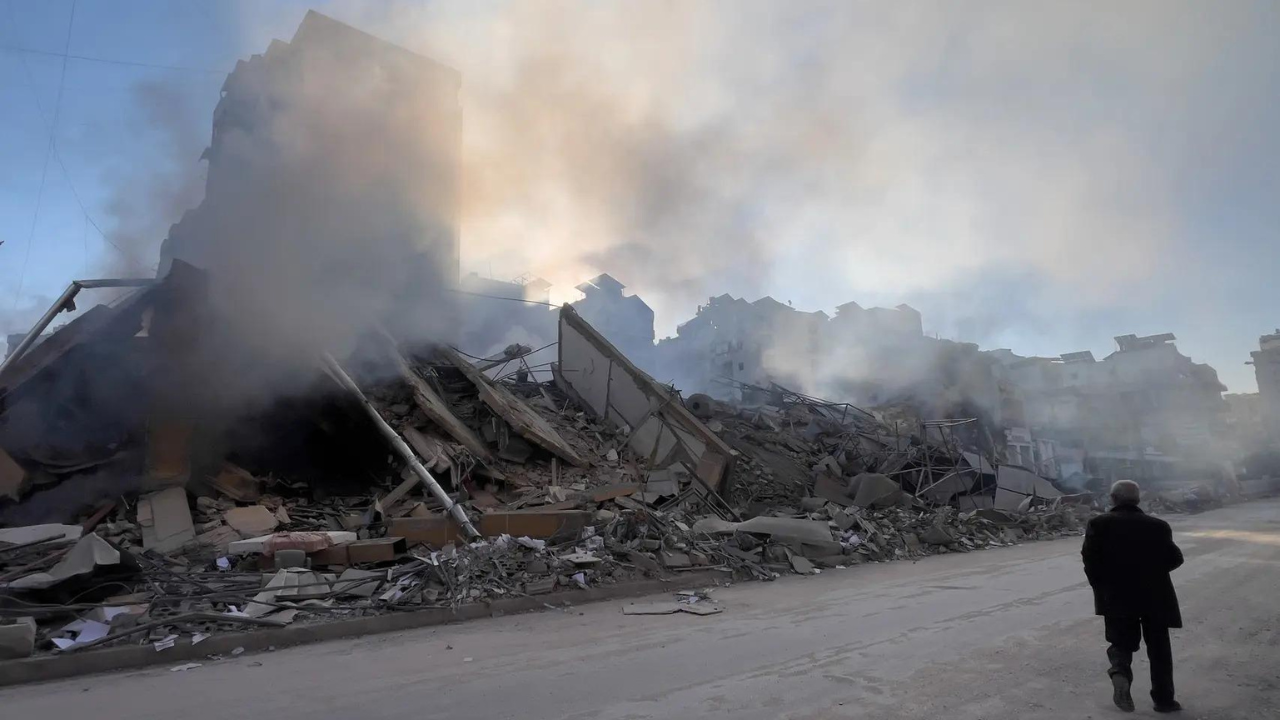
Tonight, the sky turned to iron.
The Weight of a Twelve-Day Shadow
When the news reports that the United States and Israel have coordinated the most significant strikes against Iranian soil to date, the brain tries to process the scale. We think of maps. We think of blinking red dots representing military installations, drone factories, and command centers.
Consider, instead, a woman named Farah. She is a fictional composite, but her reality is mirrored in millions of homes tonight. Farah lives in an apartment in eastern Tehran. For twelve days, she has kept a "go-bag" by the door—birth certificates, a handful of gold jewelry, a change of clothes for her son. When the first vibrations hit, they don't sound like explosions. They sound like the earth itself is clearing its throat.
The strikes weren't just a response; they were a statement written in fire. By targeting the heart of the Iranian military apparatus, the coalition sent a message that the old rules of "shadow war" are buried under the rubble. The red lines have been erased and redrawn in a darker shade of crimson.
The Architecture of Defiance
In the high halls of power, the rhetoric remains unshakable. Despite the smoke rising from the outskirts of the capital, the Iranian leadership has made its position clear: there will be no ceasefire.
This isn't just stubbornness. It is a calculated theology of resistance. To the Iranian command, a ceasefire under the pressure of these "heaviest strikes" would be more than a military defeat; it would be an existential collapse. They are betting that they can endure more pain than the West is willing to inflict.
But what is the cost of endurance?
It is the slow grinding down of a nation's soul. When a government rules out peace, the burden of that decision doesn't fall on the generals in their bunkers. It falls on the shopkeepers who see the rial plummet further into the abyss. It falls on the students who wonder if their universities will be open tomorrow.
The strikes have targeted the very infrastructure that Tehran uses to project power across the region. Logistics hubs, missile silos, and the sophisticated sensors that act as the country’s eyes. By blinding the giant, the coalition hopes to force a blink. Instead, the giant has closed its fists tighter.
The Invisible Stakes
Why now? Why this sudden, violent shift in the tempo of the conflict?
The answer lies in the terrifying math of modern warfare. For years, the conflict was managed through proxies—groups in Lebanon, Yemen, and Iraq acting as the buffer. But that buffer has evaporated. We are now witnessing a direct, face-to-face confrontation between two of the most capable militaries on the planet, with the world's superpower providing the heavy lifting.
The United States’ involvement isn't just about supporting an ally. It is about the global arteries of trade. If the Strait of Hormuz—the narrow throat through which a fifth of the world’s oil flows—is squeezed shut, the shockwaves won't stay in the Middle East. They will land in every gas station in Ohio, every factory in Germany, and every port in China.
This is the hidden gravity of the twelve-day war. We aren't just watching a regional spat. We are watching a struggle for the thermostat of the global economy.
The Anatomy of a Strike
To understand the "heaviest strikes," one must understand the technology of modern ruin. These are not the carpet bombings of the 20th century. These are surgical, terrifyingly precise operations.
Imagine a missile launched from hundreds of miles away, guided by a constellation of satellites, screaming through the atmosphere at several times the speed of sound. It doesn't just hit a building; it hits a specific room. It finds the ventilation shaft of an underground facility. It breathes fire into the lungs of the earth.
The psychological impact of this precision is often overlooked. When the "unbreakable" bunkers are breached, the sense of security among the elite vanishes. Suddenly, there is nowhere to hide. This is the "shock and awe" of a new era—one where the wall between a civilian’s home and a military target is thinner than a sheet of paper.
The Language of the Unheard
While the diplomats argue in New York and the drones hum over Isfahan, a different language is being spoken on the ground. It is the language of the bread line. It is the hushed tones of families wondering if they should leave the city or stay and risk the collapse.
There is a profound exhaustion that sets in after twelve days of high-alert living. The adrenaline that fueled the first forty-eight hours has curdled into a dull, heavy dread. You stop jumping at every loud noise. You start to look at the sky not as a source of light, but as a source of potential gravity.
We often hear experts talk about "deterrence." They say that these strikes are designed to deter Iran from further aggression. But deterrence is a fickle thing. It requires the person you are striking to feel fear. What happens when fear is replaced by a sense of having nothing left to lose?
The Breaking Point
History tells us that wars of this nature eventually reach a tipping point. Either the pressure becomes so immense that the internal structures of a regime begin to crack, or the conflict spills over its borders, drawing in neighbors who have spent years trying to stay out of the fray.
The rejection of a ceasefire by Tehran is a gamble of cosmic proportions. They are betting on the "long game," believing that the international community’s stomach for a prolonged, high-intensity war is weak. They are betting that the images of destruction will eventually turn the tide of global opinion against the coalition.
But Israel and the U.S. have signaled that they are no longer playing by the old clock. They are playing by a new one—one where the objective isn't just to delay a threat, but to dismantle the capacity to threaten altogether.
The Ghost of the Future
What happens on day thirteen? Or day thirty?
If the strikes continue at this intensity, the very fabric of the region’s stability will be tested beyond its limits. We are no longer talking about "containing" a conflict. We are talking about the potential for a total reconfiguration of power in the East.
The human element, however, remains the most volatile variable. You can calculate the trajectory of a missile. You can estimate the blast radius of a bunker-buster. You cannot calculate the trajectory of a father’s grief or the blast radius of a generation’s anger.
When the smoke finally clears—and it will, eventually—the buildings can be rebuilt. The sensors can be replaced. But the trust, the sense of a shared future, and the belief that the world is a predictable, safe place will remain in pieces.
Farah, in her apartment in Tehran, watches the horizon. The orange glow of a distant strike illuminates her son’s sleeping face. She doesn't care about "strategic depth." She doesn't care about the "ceasefire ruling." She only cares about the sun coming up and the silence that follows the storm.
The sky is still iron. The ground is still shaking. And the world continues to watch, holding its breath, waiting to see if the next twelve days will bring the end of a war, or the beginning of a much larger fire.
The silence between the explosions is the loudest sound of all.
Would you like me to analyze the historical parallels of this conflict or explore the potential economic impacts on global energy markets?